
 English
 usheenthermal

Solving the AI Chip Packaging Thermal Management Solutions Crisis
Date:2026-09-30
AI chip packaging Thermal Management Solutions aren’t a conductivity beauty contest. As heat crowds into tighter packages, tiny interface flaws can send junction temperatures climbing—and turn a promising material into a production headache.
Grease, gap fillers, graphene, and cold plates must match warpage, bond lines, reliability, and factory consistency.
Sheen Technology’s technical guidance emphasizes matching thermal materials to application conditions, making qualification—not headline conductivity—the path forward.
Poetic Key Points for AI chip packaging Thermal Management Solutions
➔ Material Matchmaking: Select TIMs (grease, gap filler, graphene sheet) that align with warpage, bond-line thickness, and reliability demands.
➔ Flux Density Mastery: Address hotspots via microchannels, copper heat pipes, or liquid cold plates for extreme heat flux.
➔ Interface Integrity: Minimize voids with precision dispensing, surface roughening, and phase-change fillers to stabilize thermal resistance.
➔ Modular Reliability: Qualify cold-plate assemblies through vacuum soldering, sintering underfill, and thermal shock testing for data-center durability.
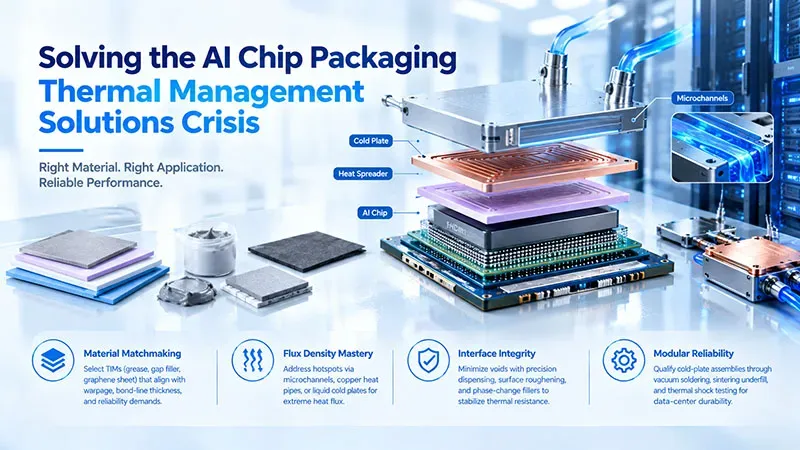
This image was generated with the assistance of AI; it is not a real photograph and is for reference only.
Classification Of Thermal Interface Materials
Picking an interface material can make or break heat flow in compact hardware. For AI chip packaging Thermal Management Solutions, Sheen Technology considers surface fit, electrical needs, package stress, and cooling space, helping designers keep AI chip packaging practical without overcomplicating things.
Thermally conductive silicone grease characteristics
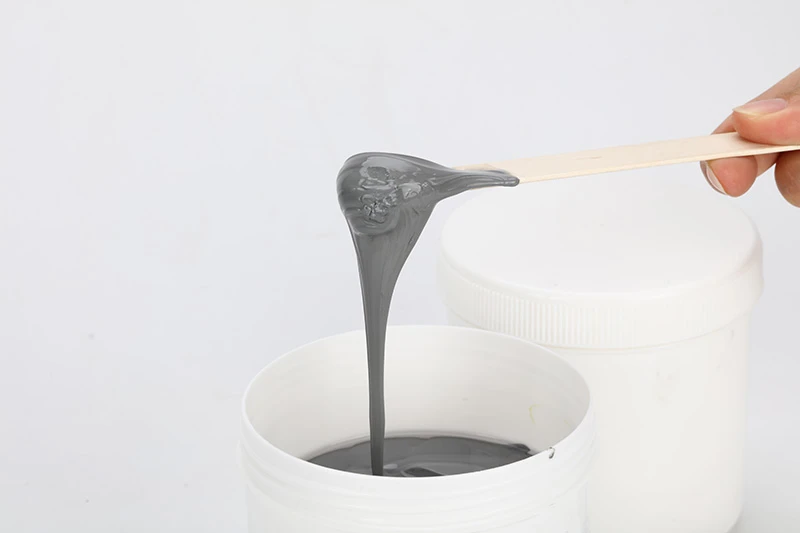
Thermally conductive silicone grease works well where close contact matters:
- A silicone matrix gives useful viscosity for spreading.
- Higher filler loading raises thermal conductivity.
- Thin bond line thickness lowers thermal resistance.
- Good clamping helps limit the pump-out effect during heat cycling.
That makes grease a practical Thermal Management choice.
Phase change material: improving junction temperature limit
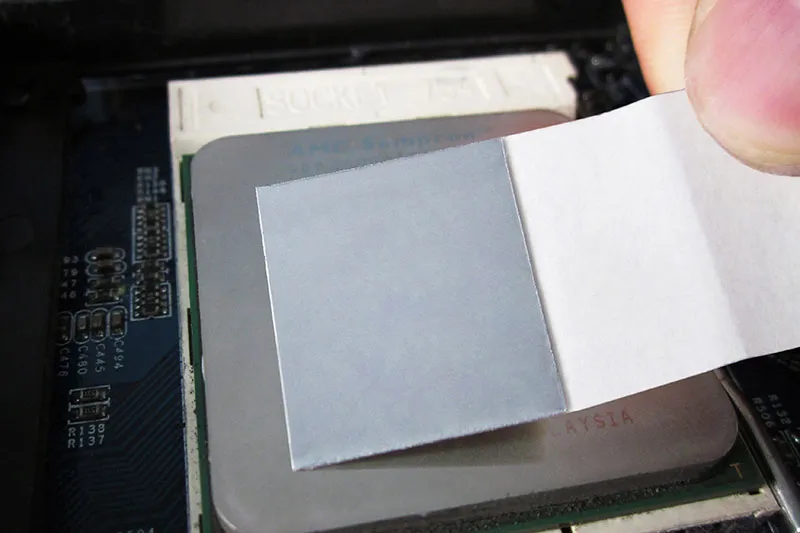
Phase change material starts firm, then softens around its phase change temperature.
- Near the melting point, improved wetting behavior fills tiny surface gaps.
- Lower thermal impedance helps control junction temperature.
- Stable cycling and suitable latent heat support long-term reliability.
For AI chip packaging Thermal Management Solutions, that self-conforming behavior is pretty handy.
Graphene thermal sheet for ultra-thin packaging
Sheen Technology’s graphene thermal pads use a vertical alignment process, in which the conductive filler is oriented normal to the pad surface rather than settled along it. That orientation is what produces high through-plane thermal conductivity, and it is the property that matters for a pad:
- a gap-filling material is loaded through its thickness, not along its plane. An ultra-thin profile suits tight packaging.
- A thin profile suits tight packaging because the pad reaches its rated performance at a designed compression rather than requiring a machined gap, so the joint height is set by the pad rather than by the tolerance stack above it.
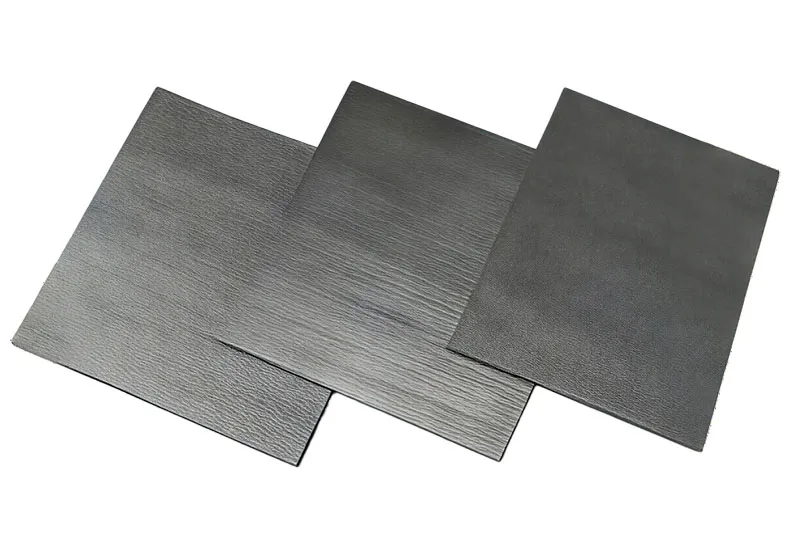
Material choice matters.
- Natural graphite can offer cost benefits.
- Synthetic graphite supports controlled performance, flexibility, and possible electromagnetic shielding functions.
Metal thermal pad versus ceramic base plate
- Conductive choices:A copper pad supports strong heat dissipation.
- Insulating choices:aluminum nitride combines heat transfer with dielectric strength.
- Package demands:coefficient of thermal expansion, thermal stress, and mechanical support guide selection.
Sheen Technology can match these traits to AI chip packaging needs.
Thermally conductive gap filler on silicon interposer
A gap filler handles height variation where rigid contact gets tricky. Careful dispensing controls coverage, while:
- compliance supports stress relief;
- a stable thermal interface moves heat across the silicon interposer without adding excessive package strain.
3 Cooling Challenges In High-Power AI Chips
Modern accelerators pack enormous computing power into tight packages, so cooling has become a make-or-break engineering issue. Effective AI chip packaging Thermal Management Solutions must move heat quickly while keeping interfaces stable and packages flat. Sheen Technology addresses these linked AI chip packaging challenges through practical thermal management design choices.
Managing extreme heat flux density
AI workloads can concentrate power density into a small hotspot, making ordinary air cooling run out of steam.
At the package level:
- Choose low-resistance thermal interface material to improve heat dissipation.
- Add a vapor chamber when lateral heat spreading is needed.
At the cooling level:
- A microchannel cold plate shortens the heat path.
- Direct liquid cooling can handle concentrated loads that challenge conventional AI chip cooling.
For AI chip packaging Thermal Management Solutions, the key is matching cooler capacity to local heat flux, not just average package power.
Mitigating thermal resistance value spikes
A cooling path can look good on paper and still stumble after assembly or aging. Voids, pump-out, delamination, and weak contact raise contact resistance, increasing the temperature gradient between silicon and the cooler.
- Better interface material preserves thermal conductivity under repeated heating.
- Stable pressure limits thermal boundary resistance.
- A suitable heat transfer coefficient helps maintain cooling efficiency when chip power swings quickly.
That keeps thermal management performance from taking a sudden hit.
Controlling warpage deformation in organic substrate
Heat also changes package shape, and that movement matters.
Control material behavior:
- Balance coefficient of thermal expansion across the stack.
- Reduce built-in residual stress.
Control physical distortion:
- Limit substrate warpage and overall package deformation.
- Maintain interface flatness for steady cooler contact.
Protect long-term operation:
- Lower mechanical stress around solder joints and TIM layers.
- Validate thermomechanical reliability through thermal cycling.
Good AI chip packaging design ties flatness, contact quality, and cooling together rather than treating them as separate problems.
Raising Thermal Conductivity in the Package Path
AI chip packaging Thermal Management Solutions must move heat fast while keeping package temperatures even and interfaces reliable. Sheen Technology combines high-conductivity materials with compact cooling hardware, so AI chip thermal management can handle rising power density without eating up precious package space. In practice, better heat dissipation also helps protect performance when workloads really crank up.
Copper heat pipe combined with graphene thermal sheet
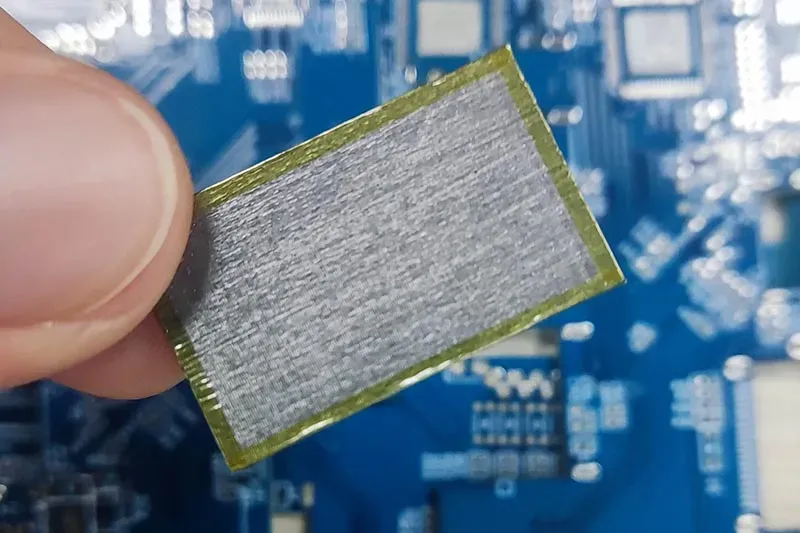
Heat pickup
- A copper heat pipe uses phase change to carry concentrated heat away from an AI die with low effective thermal resistance.
Heat transfer
- Graphene thermal conductive sheets realize vertical conduction of heat energy due to their high through-plane thermal conductivity.
- Paired with suitable thermal interface material, this AI chip packaging thermal management solution design improves cooling efficiency and cuts stubborn hotspots.
Microchannel heat sink on glass core substrate
Cooling path
- A microchannel heat sink places liquid cooling close to the package, where strong fluid dynamics can raise the heat transfer coefficient.
Integration limits
- The glass core substrate needs careful packaging integration around seals and channels.
Sheen Technology balances flow pressure against thermal stress, keeping AI packaging cooling practical rather than simply pushing pump power higher.
Liquid cooling cold plate paired with conductive epoxy resin
The cooling side
- Liquid cooling through a cold plate tackles high heat flux directly.
- Conductive epoxy resin provides both heat transfer and adhesion strength.
The bonded side
Voids can raise thermal resistance, while repeated heating can weaken bonds, so reliable thermal management depends on controlled curing. This AI chip packaging Thermal Management Solutions approach is pretty handy where mechanical attachment space is tight.
Vapor chamber integration using red copper heat spreader
- A vapor chamber absorbs hotspot energy through latent heat, enabling efficient two-phase cooling.
- Red copper then supports rapid thermal diffusion across the heat spreader.
- Lower interface resistance strengthens hot spot management.
- Flatter temperature gradients reduce local stress around AI chips.
Sheen Technology tunes contact surfaces so AI chip packaging Thermal Management Solutions can distribute intense package heat without adding bulky cooling hardware.
TIM Vs. Gap Filler: Which Wins?
For AI chip packaging Thermal Management Solutions, the better thermal interface material depends on the space between surfaces, package pressure limits, and heat load. Silicone grease shines across very thin joints, while gap filler handles bigger spaces and uneven hardware. In practical AI chip packaging, fit matters just as much as headline conductivity.
Thermally conductive silicone grease
Grease works best when AI chip packaging Thermal Management Solutions need an extremely thin thermal path. It flows into microscopic surface defects, cutting contact resistance without putting much force on delicate chips.
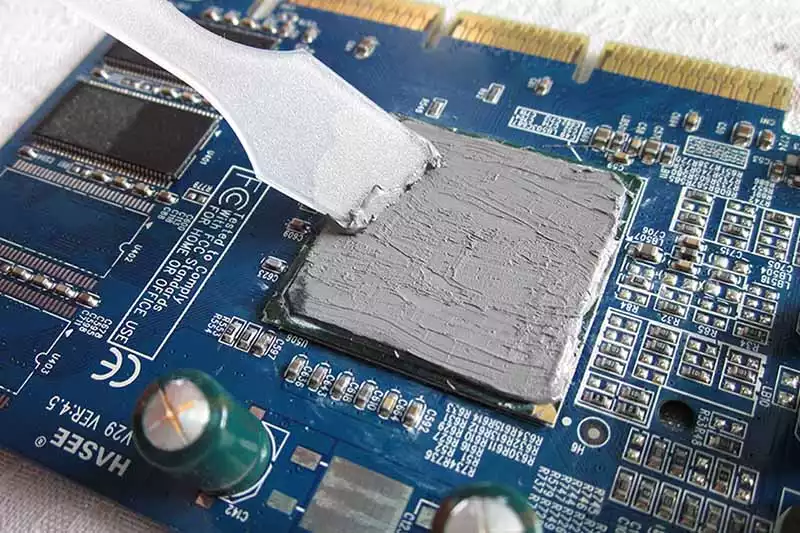
Thin, closely matched interfaces
- High thermal conductivity supports fast heat transfer from package to cold plate.
- Low interface resistance can keep overall thermal impedance down when the bond line stays thin.
Material behavior
- Suitable viscosity helps grease spread and wet both mating surfaces.
- Higher filler loading can improve heat conduction, though it may make application harder.
Long-term design checks
- Repeated thermal cycling can cause the pump-out effect, pushing material away from hot areas.
- Silicone oil separation should also be checked during qualification.
For tight-clearance thermal management, grease is often the neat fit.
Thermally conductive gap filler
Gap filler becomes practical when AI chip packaging Thermal Management Solutions must bridge uneven parts or spaces that grease cannot reliably cover. It gives thermal engineers more room to work with real manufacturing tolerances.
Fit the physical gap
- Gap filling handles thicker interfaces and variable vertical clearance.
- Low hardness and good compliance reduce pressure on sensitive packages.
Match production needs
- Controlled dispensing supports repeatable automated assembly.
- Suitable cure time keeps manufacturing moving without sacrificing final material stability.
Check operating demands
- Adequate dielectric strength helps maintain electrical isolation around powered components.
- Cured material can also tolerate vibration and shifting parts better than a free-flowing grease.
In short, gap filler favors tolerance and mechanical control; silicone grease favors ultrathin thermal paths.
Overheating AI Chips? Ultrafine TIM To Rescue.
As AI accelerators pack more heat into tight spaces, microns matter. Effective AI chip packaging Thermal Management Solutions depend on thin, stable interfaces, reliable contact, and measurable material behavior. Sheen Technology focuses on these practical links between AI chip packaging and Thermal Management Solutions.
Dispensing technique for sub-10µm adhesive layers
An adhesive layer below sub-10um thickness leaves little room for process drift.
Deposition control
- A calibrated micro-dispenser and precision nozzle meter tiny volumes.
- Stable viscosity control keeps fluid dynamics predictable during spreading.
Bond formation
- Pressure and dispense speed should limit trapped air.
- Thickness mapping catches local variation before it becomes a hot spot.
For AI chip packaging Thermal Management Solutions, tight bond-line control helps thermal results stay consistent from package to package.
Surface roughening treatment to lower thermal interface resistance
A mild surface roughening treatment can improve interface bonding without making the surface overly coarse. More useful contact area gives the TIM better wetting, helping reduce thermal interface resistance and support heat dissipation.
- Tune the etching process to create a controlled microstructure, not deep peaks.
- Check roughness against final bond thickness; going too far can trap voids. That’s where a seemingly good idea can backfire.
This balance matters in AI chip packaging Thermal Management Solutions, especially for thin TIM designs.
Evaluating thermal conductivity coefficient in hermetic sealing glue
Good coefficient evaluation starts with cured samples that match production conditions. Measure thermal conductivity across realistic thicknesses, then check how filler settling or aging changes heat transfer.
For hermetic sealing, underfill glue also has to protect against moisture without sacrificing thermal performance. Sheen Technology can pair such testing with material characterization, giving Thermal Management Solutions data that better reflects an actual AI chip package.
Data Center: Modular Cold-Plate Integration
Modular cooling has little room for guesswork. AI chip packaging Thermal Management Solutions must connect materials, joints, and testing into one practical design path, so AI chip cooling hardware can move heat efficiently while surviving everyday data-center operating cycles.
Vacuum soldering process for liquid cooling cold plate
A vacuum furnace supports clean fluxless soldering, cutting contamination and helping liquid channels stay leak-tight.
Joint preparation
- Control the copper-aluminum joint gap and surface finish.
- Limit oxide before heating.
Solder cycle
- Tune temperature and vacuum to restrict excessive intermetallic compound growth.
- Track void fraction, since trapped gaps raise thermal interface resistance.
Verification
- Confirm hermetic sealing before flow testing.
For AI chip packaging Thermal Management Solutions, good solder control pays off: fewer thermal bottlenecks and fewer leak headaches.
Compression molding method for composite radiator fin
A thermoplastic composite can form thin, repeatable fins when the mold temperature and pressure are tightly controlled. A hydraulic press provides high-pressure consolidation, while carbon fiber orientation influences thermal anisotropy.
That fiber direction matters. Engineers balance the resin matrix, fin shape, and heat-flow path so AI chip packaging Thermal Management Solutions gain useful conductivity without making mass production a pain.
Sintering technology in underfill adhesive applications
Sintered underfill can reinforce both heat transfer and package support.
Material design
- silver nanoparticles raise thermal conductivity.
- A polymer matrix helps manage strain.
Process control
- pressureless sintering simplifies assembly.
- Lower porosity generally improves heat paths.
Reliability
- Check shear strength.
- Match coefficient of thermal expansion carefully to reduce fatigue.
That balance keeps AI chip packaging Thermal Management Solutions mechanically stable through repeated heating.
Thermal shock resistance testing of modular assemblies
- Run temperature cycling across defined hot and cold limits.
- Place each thermocouple sensor near critical interfaces.
- Inspect delamination, cracking, and warpage after cycling.
- Compare failures with finite element analysis, including residual stress predictions and accelerated aging trends.
| Path element | Material | Governing property | Method |
| Die to spreader | Silicone grease or phase-change material | Joint impedance at the intended bond line and pressure | ASTM D5470 |
| Die to spreader | Graphene thermal pad | Through-plane k; compression; isolation of the conductive pad | ASTM D5470; ASTM D149 / IEC 60243 |
| Lateral spreading | Graphite sheet | In-plane and through-plane k stated separately | ASTM D5470 where a joint figure is claimed |
| Uneven gap | Gap filler | Usable compression range; dielectric strength at the working gap | ASTM D575 / D395; ASTM D2240; ASTM D149 |
| Isolation layer | AlN substrate or film lamination | Dielectric withstand at working voltage, traded against series resistance | ASTM D149 / IEC 60243 |
| Sealing | Silicone rubber gasket, ceramic-filled polymer seal | Compression set; durometer; flame rating | ASTM D395; ASTM D2240; UL 94 V-0 |
| Fluid path | Seals and wetted elastomers | Swell and hardness retention in the working fluid | ASTM D471 |
| Hermetic volume | Underfill adhesive | Outgassing; moisture sensitivity if reflowed | ASTM E595; IPC/JEDEC J-STD-020 |
| Whole assembly | All of the above | Impedance retained and joints intact after cycling | JESD22-A104 / IEC 60068-2-14; ASTM D5470 |
This gives modular thermal-management hardware a practical reality check before data-center deployment.
【Request a Custom Quote】Sheen Technology supplies the interface materials, graphene thermal pads, phase-change materials, gap fillers, silicone thermal pad and the silicone foam components, and can provide their specification limits against the service envelope you provide. Contact the engineering team with the package stack, the bond-line range, the cycling profile and the cooling architecture, and request a sample lot for qualification.
Sheen Thermal
Dongguan Sheen Electronic Technology Co., Ltd · Founded in 2008
Manufacturer of thermal interface materials and silicone foam for automotive electronics, energy storage, power electronics, communications and consumer electronics.
Certified
- ISO 9001:2015
- ISO 14001:2015
- IATF 16949:2016
What we supply
- Thermal conductivity Up to 90 W/m·K
- Thickness 0.3–10.0 mm
- Custom & samples Die-cut to drawing, 3–7 days