
 English
 usheenthermal

Are graphene pads better than thermal paste?
Date:2026-10-14
Heat is rising, and electronics can’t afford a meltdown! But are graphene pads better than thermal paste? Graphene offers consistent thickness and lasting stability, while thermal paste excels at filling tiny gaps for efficient cooling.
For manufacturers, the real showdown comes down to thermal performance, reliability, production costs, and bulk material quality.
Quick Answers: Graphene Pads
➔ Superior Thermal Stability: Multilayer graphene ensures consistent thickness, long-term durability, and reusable interfaces.
➔ Installation Best Practices: Clean surfaces, vacuum-seal pads, use precision stamping, and follow storage temperature guidelines.
➔ Performance Boost: Proper pad thickness and lateral coverage can cut CPU temperatures by up to 15%.
➔ Quality Control: Verify defect density with Raman spectroscopy and check electrical resistivity for uniform material consistency.
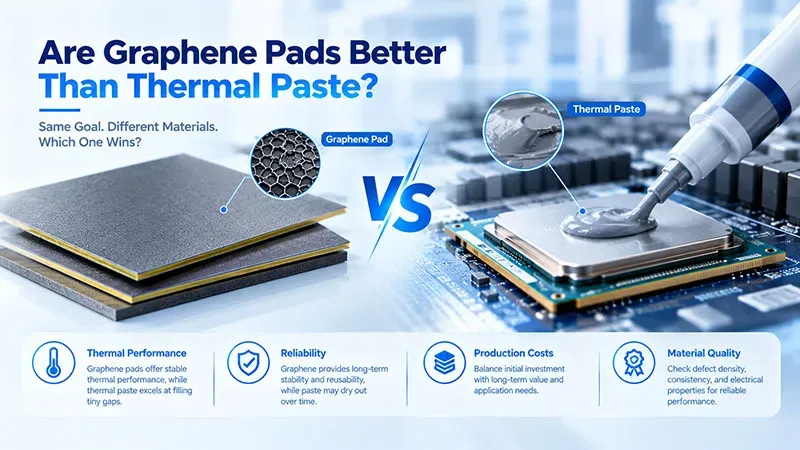
Graphene Pads Vs Thermal Paste Performance Tiers
Choosing between graphene pads and thermal paste comes down to cooling performance, maintenance, and long-term reliability. Both transfer heat from processors to coolers, but their materials, installation methods, and performance characteristics differ quite a bit.
Graphene Pads
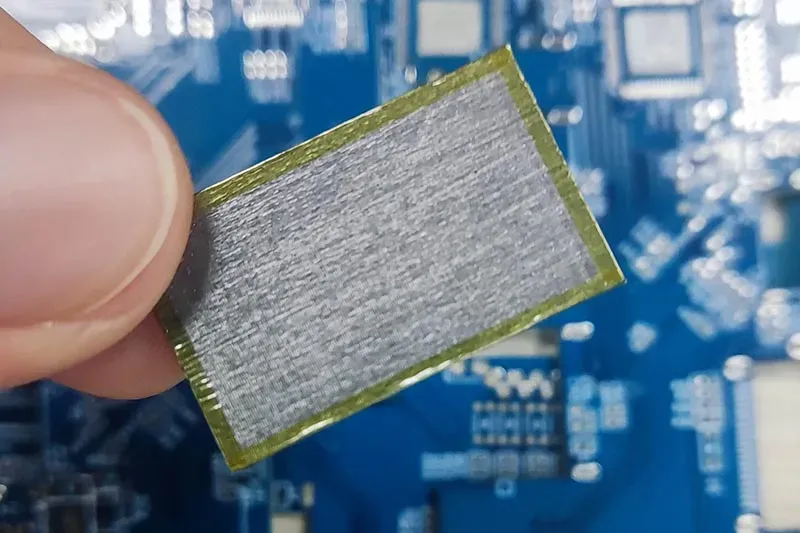
Graphene pads provide a clean, reusable cooling solution for CPUs and other electronic components. Their layered carbon structure supports efficient heat transfer, although actual cooling performance depends heavily on contact pressure and surface quality.
Cooling Performance
- Thermal conductivity: While graphene inherently possesses exceptional in-plane thermal conductivity, lateral heat spreading alone is insufficient for thermal interface materials (TIMs). Sheen Technology’s vertically aligned graphene thermal pads offer outstanding through-plane thermal conductivity; notably, the GSF130-030 model achieves a thermal conductivity of up to 130 W/m·K and a thermal resistance as low as 0.06 K·cm²/W.
- Electrical conductivity: Most graphene pads conduct electricity, making careful placement essential to prevent short circuits.
| GSF130-030 Graphene Pad Technical Specifications | ||||
|---|---|---|---|---|
| Performance | Properties | Unit | GSF130-030 | Test Method |
| Thermal Properties | Thermal Conductivity | W/m·K | 130 | ASTM E1461 |
| Thermal Resistance (@50psi) | ℃*cm²/W | ≤0.06 | ASTM D5470 | |
| Application Temperature | ℃ | -40~150 | / | |
| Physical Properties | Rebound Rate | % | ≥90 | / |
| Tensile Strength | Mpa | ≥0.05 | ASTM D412 | |
| Color | - | Black | Visual | |
| Thickness | mm | 0.2~2.0 | ASTM D374 | |
| Density | g/cm³ | 0.3~0.7 | ASTM D792 | |
| Oil Bleeding Rate | % | ≤3 | / | |
| Flame Retardancy | Flame rating | - | V-0 | UL 94 |
Practical Advantages
- Reusability: Unlike traditional paste, graphene pads can often be removed and reinstalled without replacement.
- Installation ease: Their solid structure eliminates messy spreading and simplifies cooler installation.
Long-Term Reliability
- Durability: Quality graphene pads maintain consistent thickness under suitable operating conditions.
- Dry-out resistance: Since graphene thermal pads contain no liquid carrier, conventional paste drying isn't an issue.
For users prioritizing low-maintenance cooling, Sheen Technology offers thermal management solutions worth exploring.
Thermal Paste
Thermal paste remains a popular thermal interface material because it fills microscopic gaps between processors and heatsinks.
Its biggest strength? Excellent surface contact.
Key performance factors include:
- Thermal resistance: Properly applied paste reduces heat-transfer barriers between contacting surfaces.
- Viscosity: Thicker compounds resist spreading, while thinner formulas may offer easier application.
- Application coverage: Even coverage prevents trapped air without creating an unnecessarily thick layer.
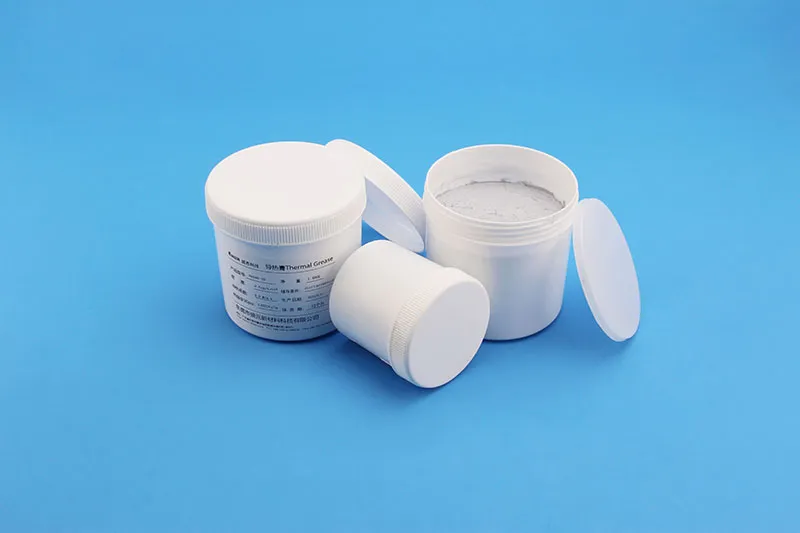
Many formulations use a silicone compound combined with thermally conductive fillers.
However, repeated heating and cooling can trigger the pump-out effect, gradually pushing paste away from critical contact areas.
Ultimately, graphene pads favor convenience and reuse, while premium thermal paste often delivers better peak cooling performance.
- A paste is for a joint that is thin, flat and closely matched, where the bond line is set by mounting force and the material only has to displace entrapped air; its advantage is the lowest achievable impedance at a thin bond line, and its risk is pump-out and oil separation over a long service life.
- A graphene thermal pad is for a joint with vertical tolerance that a paste cannot be relied on to hold, where a specified compression sets the bond line and keeps it; its advantage is a bond line that is defined by the part rather than by the assembly process, and its risk is the isolation requirement that comes with a conductive material, plus compression set if it is compressed past its range.
The practical rule is the one the joint gives you. If the two surfaces are flat and can be held at a thin bond line, specify a paste and control the dispense volume. If the clearance varies, or the flatness cannot be held, or the joint has to be reopened and remade, specify a pad and put its compression range and isolation condition on the drawing. A design that applies either material outside the joint it suits is not a material failure — it is a joint that was never specified.
How Graphene Pads Cut CPU Temps By 15%
CPU overheating can slow performance and shorten hardware life. Graphene pads offer a practical way to improve cooling by moving heat away from hot spots and improving contact between surfaces. Under suitable conditions, temperature reductions approaching 15% may be possible, although actual results depend on pad design, installation pressure, and cooling hardware.
Thermal Conductivity and Heat Dissipation Mechanics
Graphene conducts heat efficiently because its crystal structure allows phonons, or atomic vibrations, to carry thermal energy.
Two factors determine cooling performance:
Heat distribution
- Vertically oriented graphene thermal pads conduct heat along the Z-axis (i.e., the thickness direction) of the interface, as the filler is oriented perpendicular to the pad's surface.
Thermal interface performance
- Low thermal resistance helps heat reach the heatsink.
- Through-plane conductivity and mounting pressure strongly affect CPU cooling.
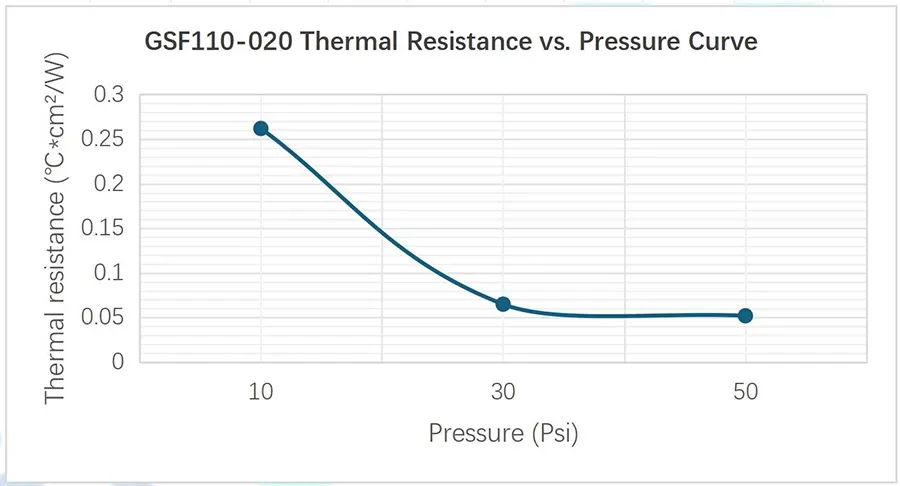
Figure Note: In thermal resistance testing of the GSF110-020 graphene pad, increasing the pressure from 10 psi to 30 psi reduced thermal resistance by approximately 75.2%, while a further increase from 30 psi to 50 psi resulted in an additional reduction of about 20%. For engineers: a pressure of 30 psi already achieves low thermal resistance in this test; increasing it to 50 psi offers further thermal performance improvements but entails higher structural loads and greater material compression. The actual operating point should be determined by considering the device's pressure limits, support structure, contact area, and assembly tolerances.
Influence of Pad Thickness and Lateral Dimensions
Getting the size right matters just as much as choosing the material.
- Pad thickness: Thinner pads generally reduce thermal resistance, provided sufficient compression maintains contact.
- Contact area: Full coverage prevents exposed regions and uneven heat flow.
- Aspect ratio: Pad geometry influences heat spreading and lateral diffusion.
A poorly fitted thermal pad creates gaps at the interface, limiting cooling performance even when the material conducts heat well.
Surface Functionalization: Reducing Contact Resistance
Even polished metal surfaces contain tiny imperfections.
Improving surface contact
- Surface roughness creates microscopic gaps that trap insulating air.
- Better adhesion helps graphene pads conform around each roughness peak.
Controlling surface chemistry
- Oxygen-containing groups encourage nanoscale bonding.
- Improved contact can lower interfacial resistance.
However, excessive oxidation damages graphene's structure and reduces heat conductivity. Balanced treatment offers the best chance of improving CPU cooling without sacrificing thermal performance.
5 Steps To Install Graphene Pads Correctly
Installing graphene pads correctly helps maintain stable CPU temperatures and reliable heat transfer. From cleaning surfaces to checking thermal contact, small details make a big difference. Sheen Technology emphasizes careful handling, proper alignment, and consistent mounting pressure for dependable thermal performance.
1. Surface Cleaning and Contamination Control
Clean CPU and heatsink surfaces before installing graphene pads.
Remove contamination:
- Use high-purity isopropyl alcohol and a lint-free wipe to remove old thermal paste.
- Check for microscopic debris, oil residue, and moisture.
Inspect surface condition:
- Allow cleaning solvents to evaporate completely.
- Watch for surface oxidation or scratches that could affect contact.
A spotless surface helps minimize thermal resistance.
2. Vacuum Sealing and Storage Temperature Considerations
Unused graphene pads need protection from dust and humidity.
Packaging protection:
- Keep pads inside an antistatic storage container with a suitable moisture barrier.
- Check packaging seal integrity before installation.
Environmental control:
- Limit exposure to ambient humidity.
- Follow manufacturer temperature recommendations to prevent thermal degradation.
A vacuum chamber is generally unnecessary for everyday CPU installations.
3. Precision Stamping for Optimal Geometric Tolerance
Properly sized graphene pads provide consistent thermal interface coverage.
Dimensional control:
- Industrial cutting die equipment improves dimensional accuracy.
- Consistent thickness uniformity supports even mounting pressure.
Installation alignment:
- Choose manufacturer-precut pads matching CPU dimensions.
- Avoid edge burr damage, folding, and excessive shear stress.
Correct alignment prevents unwanted overhang.
4. Thermal Annealing for Enhanced Interface Bonding
Industrial heat treatment can modify graphene's molecular structure and reduce certain defects.
Controlled temperature profile settings and an inert gas atmosphere help protect the crystal lattice during processing.
However, consumer graphene pads require no additional annealing. Excessive heating may damage the material rather than improve contact resistance.
5. Verifying Contact via Raman Spectroscopy and Electrical Resistivity
Confirming proper contact is essential for reliable cooling.
Laboratory verification:
- Raman spectroscopy examines peak intensity, phonon scattering, and defect density.
- A conductivity meter or probe station evaluates electrical properties.
Practical CPU testing:
- Check mounting pressure and pad alignment.
- Monitor idle and load temperatures.
For everyday installations, temperature testing is more practical than laboratory analysis. Properly installed graphene thermal pads should provide stable cooling performance.
The answer to the question in the title is the joint rather than the material. A thermal paste is the right choice for a thin, flat, closely matched joint where mounting force sets the bond line and the material only has to displace trapped air; a vertically aligned graphene thermal pad is the right choice for a joint with vertical tolerance in it, where a specified compression sets the bond line and holds it, and where a joint that has to be reopened and remade favours a pad that can be refitted.
【Request a Custom Quote】Not sure whether a graphene thermal pad or thermal paste fits your joint, or fighting dried-out paste, pump-out, or uneven mounting pressure? Send us your component and cooler geometry, gap and tolerance range, mounting force, target bond-line thickness, electrical isolation needs, and production volume, and our engineers can recommend the interface format and graphene pad specification that keeps cooling stable over the life of the device.
Sheen Thermal
Dongguan Sheen Electronic Technology Co., Ltd · Founded in 2008
Manufacturer of thermal interface materials and silicone foam for automotive electronics, energy storage, power electronics, communications and consumer electronics.
Certified
- ISO 9001:2015
- ISO 14001:2015
- IATF 16949:2016
What we supply
- Thermal conductivity Up to 90 W/m·K
- Thickness 0.3–10.0 mm
- Custom & samples Die-cut to drawing, 3–7 days