
 English
 usheenthermal

What is the role of thermal grease in thermal conductive materials?
Date:2026-08-22
Most of the cooling system design is actually very simple. The main design principle is to reduce the temperature inside the device through active guidance or the influence of the external environment. Usually, a radiator is installed on the surface of the heat source, and the excess heat of the heat source is guided to the outside through the radiator, so as to reduce the temperature of the device.
Thermal grease (thermal paste / thermal compound) is a semi-fluid TIM that fills microscopic air gaps between heat-generating components and heat sinks, reducing interface thermal resistance. In volume electronics manufacturing, thermal grease enables low bond-line thickness and high heat transfer at the component-to-heatsink interface — a critical factor for power electronics, CPU/GPU modules, and automotive inverters.
What Is Thermal Grease
Thermal grease is a semi-fluid paste-like thermal conductive material made of silicone oil base material, adding thermal conductivity, temperature resistance, and insulating materials in a certain proportion. It has high thermal conductivity, low interface thermal resistance, and good electrical insulation. It is generally considered to be extremely The best thermal interface thermal material, due to its stable performance, there will be no corrosive substances during operation.
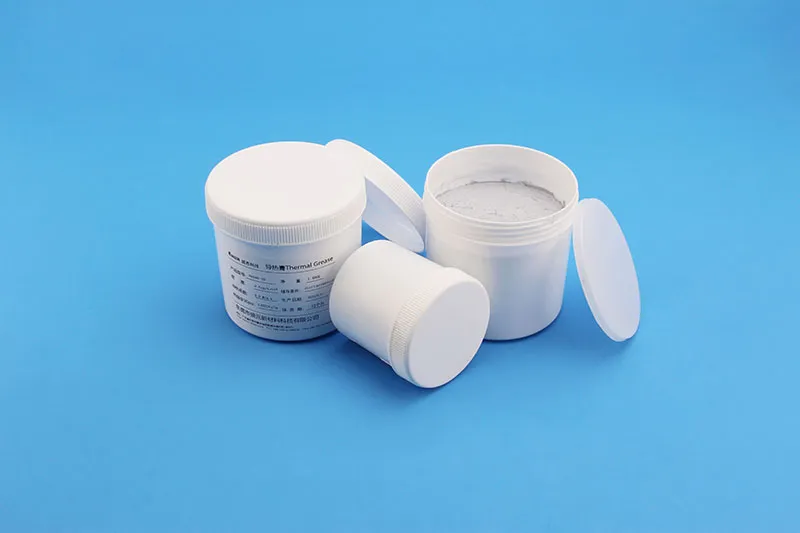
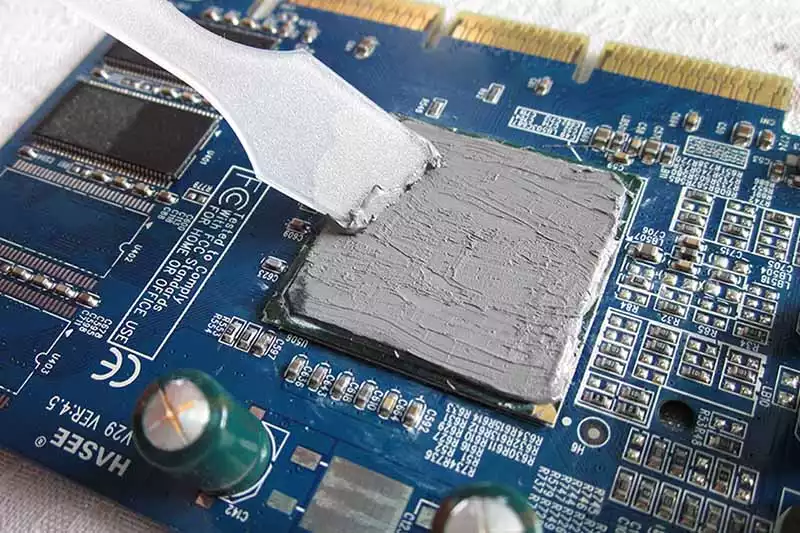
Thermal grease itself has excellent interface lubricity. It is evenly spread on the surface of power-consuming electronic components, which can eliminate the air contacting the interface. Because it is a semi-fluid paste, it can effectively fill the rough surface between the interfaces. This increases heat flow and reduces thermal resistance.
There is a gap between the surfaces, and the thermal conductive material represented by thermal grease can effectively reduce the contact thermal resistance between the interfaces and increase the rate of heat transfer between the two, thereby truly improving the heat dissipation effect of the device.
Sheen Technology thermal grease performance properties:
| Properties | Color | Thermal Impedance (@30psi) | Thermal Conductivity | Minimum Interface Thickness |
| Unit | - | ℃*in2/W | W/m·K | mm |
| SG560-10 | White | ≤0.15 | 1.0±0.1 | 0.06 |
| SG560-20 | White/Gray | ≤0.045 | 2.0±0.2 | 0.05 |
| SG560-30 | Gray | ≤0.03 | 3.0±0.3 | 0.05 |
| SG560-40 | Gray | ≤0.02 | 4.0±0.4 | 0.05 |
| SG560-50 | Gray | ≤0.016 | 5.0±0.5 | 0.05 |
| Test Method | Visual | ASTM D5470 | ASTM D5470 | - |
Note: Values are typical ranges; specific grades vary. Sheen Technology provides product-specific datasheets.
Thermal Grease vs. Other TIMs
Multi-Parameter Comparison:
| Parameter | Thermal Grease | Thermal Pad | Phase-Change | Gap Filler |
| Thermal Conductivity (W/m·K) | 1–5 | 1–15 | 3–8 | 1–12 |
| Thickness (mm) | 0.05-0.06 | 0.3-10.0 | 0.13-0.5 | 0.10-0.22 |
| Thermal Resistance (°C·in²/W) | 0.016–0.15 | 0.1–0.9 | 0.015–0.06 | 0.045–0.10 |
| Pump-Out Resistance | Poor–Moderate | Excellent | Moderate | Good |
| Assembly | Dispense + inspect | Pick-and- place | Place + heat activate | Dispense |
| Rework | Solvent clean | Peel + replace | Heat + clean | Mechanical remove |
| Cost (relative) | Low | Moderate | Moderate | Low–Mod |
| Best Application | Thin flat high-heat-flux | Gap filling + isolation | Low resistance + easy handling | Large/variable gaps |
Note: Values are typical ranges; specific grades vary. Sheen Technology provides product-specific datasheets.

Selection Decision Framework:
- STEP 1: Is electrical isolation required? → Yes: pad (or grease + separate film). No: continue.
- STEP 2: What is the gap size? → <100 μm: grease or phase-change. >500 μm: gap filler. 100–500 μm: pad.
- STEP 3: Is reworkability/serviceability critical? → Yes: pad or phase-change (cleaner). No: grease acceptable.
- STEP 4: What is the heat flux? → >50 W/cm²: liquid metal or high-conductivity grease. <20 W/cm²: any standard TIM.
- STEP 5: What is the production volume and process? → High volume + automation: pad (pick-and-place). Low volume + flexibility: grease (dispense).
Thermal Grease Application & Reliability
Failure Modes and Quantified Behavior:
| Failure Mode | Mechanism | Quantified Impact | Prevention |
| Pump-Out | Cyclic thermal expansion squeezes grease from interface | Thermal impedance rises 20–50% after 500–1,000 cycles | High-viscosity formulation; controlled BLT; validate per IEC 60068-2-14 |
| Dry-Out | Volatile component evaporation thickens grease over time | Conductivity drops 10–30% after 1,000 h at 150°C | High-temperature stable oil carrier; sealed packaging |
| Oil Bleed | Low-molecular-weight oil separates and migrates | Contamination of adjacent components; reduced viscosity | Thixotropic formulation; specify low-bleed grade |
| Void Formation | Air entrapment during dispensing or assembly | Local hot spots; 2–5× higher local resistance | Automated dispensing; controlled compression |
Application-Specific Requirements:
| Application | Key TIM Requirement | Typical Grease Grade | Qualification Focus |
| CPU/GPU modules | Low resistance, thin BLT | 3–8 W/m·K | Thermal impedance, pump-out |
| IGBT power modules | Dielectric + thermal | Insulating grade 1–5 W/m·K | Dielectric (ASTM D149), thermal cycling |
| Automotive inverters | High-temp stability + cycling | 2–6 W/m·K high-temp oil | Thermal shock (IEC 60068-2-14), aging |
| LED assemblies | Long-term stability, low oil bleed | 1–4 W/m·K | Oil bleed, optical contamination |
| Telecom equipment | Reliability, consistency | 2–5 W/m·K | Batch consistency, aging |
- Applications: CPU/GPU modules, IGBT power modules, LED assemblies, automotive inverters, telecom equipment.
- Pump‑Out: cyclic thermal expansion squeezes grease from the interface — validate per IEC 60068‑2‑14.
- Dry‑Out: volatile component evaporation thickens grease over time — check aging at operating temperature.
- Dispensing: automated systems achieve ±5% volume tolerance; manual application varies ±20–50%.
→ Request Thermal Grease Application & Dispensing Guide
FAQ
Q: What is thermal grease made of?
A: Thermal grease is a silicone or hydrocarbon oil carrier loaded with thermally conductive fillers (alumina, zinc oxide, boron nitride). Insulating grades provide electrical isolation; metal-filled grades are electrically conductive. Typical thermal conductivity is 1–12 W/m·K.
Q: How does thermal grease reduce interface resistance?
A: It displaces air (0.026 W/m·K) from microscopic surface-roughness valleys, filling gaps and increasing real contact area. This reduces interface resistance by 10–100× compared to dry contact, enabling thin bond lines (20–100 μm).
Q: What causes thermal grease pump-out?
A: Cyclic differential thermal expansion between component and heatsink squeezes grease from the interface during thermal cycling. High-viscosity formulations resist pump-out better. Validate per IEC 60068-2-14 for >500 cycle applications.
Q: When should I choose thermal grease over a thermal pad?
A: Choose grease when surfaces mate closely (<50 μm BLT) and minimum thermal resistance is the priority. Choose a pad when gap filling, electrical isolation, or repeatable automated placement is required.
Thermal grease plays a foundational role in thermal management by minimizing interface resistance at the component-to-heatsink junction. Its thin bond line and conformability make it the preferred TIM for high-heat-flux, tight-tolerance applications. Sheen Technology provides thermal grease products with ASTM-referenced data, dispensing guidance, and application engineering for power electronics and industrial cooling.
→ Contact Sheen Technology for Thermal Grease Selection Support
Sheen Thermal
Dongguan Sheen Electronic Technology Co., Ltd · Founded in 2008
Manufacturer of thermal interface materials and silicone foam for automotive electronics, energy storage, power electronics, communications and consumer electronics.
Certified
- ISO 9001:2015
- ISO 14001:2015
- IATF 16949:2016
What we supply
- Thermal conductivity Up to 90 W/m·K
- Thickness 0.3–10.0 mm
- Custom & samples Die-cut to drawing, 3–7 days