
 English
 usheenthermal

Boost Production Speed with Automated Dispensing Thermal Gel
Date:2026-09-20
On crowded electronics lines, automated dispensing thermal gel can separate smooth takt time from a sticky bottleneck. Viscosity, flow consistency, and packaging set the pace.
Precise deposits can curb waste and rework while preserving thermal performance. No magic wand—just tighter process control.
Elon Musk said: “Prototypes are easy, production is hard.”
Key Insights: Symphony of Automated Dispensing Thermal Gel
→ Cycle Time Reduction: Automate deposit volume and placement speed to accelerate PCB thermal gel application with consistent repeatability.
→ Viscosity Mastery: Maintain stable gel viscosity, density, and temperature for predictable flow on high-speed lines.
→ Precision Curing: Metered gel thickness minimizes cure time while ensuring optimal thermal conductivity.
→ Waste & Lead-Time Control: Metered dispensing slashes material waste, enhances batch traceability, and meets tight production schedules.
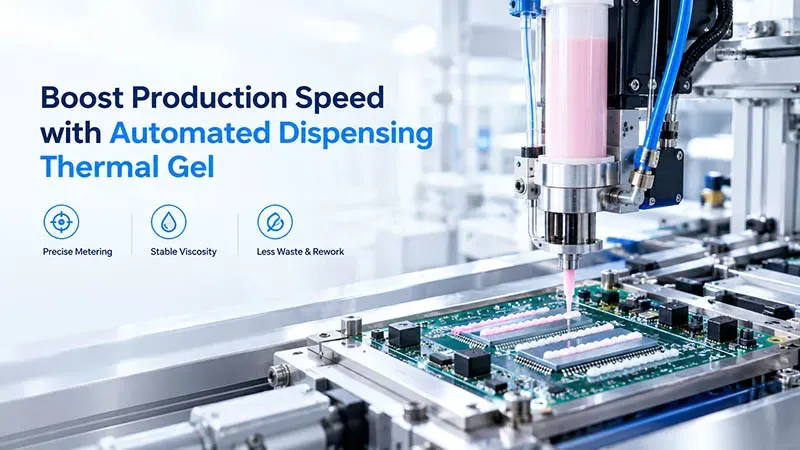
Why Automate Thermal Gel Dispensing
For busy electronics lines, automated dispensing thermal gel keeps application moving without giving operators another fiddly job. Accurate gel delivery can shorten production delays, stabilize thermal results, and keep expensive material from going down the drain.
Automation only pays off if dispensable gel is the right material in the first place. The comparison below is the decision that precedes any equipment purchase.
| Material | Gap tolerance | Best fit | Production trade-offs |
| Thermal pad (pre-cured) | Tight, uniform | Flat stacks, known bond line | Cannot fill uneven gaps; force required; stick-and-place step |
| Thermal grease | Very tight | High-performance interfaces, dispensed or printed | Pump-out and bleed over thermal cycles |
| Thermal gel (dispensable) | Moderate | Automated lines with uneven component stacks | Viscosity and storage discipline; valve wear on filled formulations |
Reducing cycle time with automated dispensing
A well-tuned automated dispensing process links motion and dosing so the cycle time stays predictable as output rises.
Production movement
- A robotic arm places each thermal gel deposit without repeated manual positioning.
- Controlled travel speed supports higher production speed without turning placement into guesswork.
Line performance
- Greater throughput comes from reducing pauses between deposits.
- Better efficiency keeps each dispensing operation focused on useful machine time.
For dense PCB production, automated dispensing thermal gel can therefore remove small delays that quickly add up across thousands of units.
Consistent viscosity control for high-speed lines
Viscosity control matters because thermal gel must flow smoothly without running away from its target. On a high-speed line, temperature shifts or poor storage can change fluid flow and upset deposit size.
A practical setup keeps temperature regulation steady while monitoring material consistency. The dispensing valve can then meter predictable shots from cartridges or syringes, giving automated thermal gel dispensing a much better shot at repeatable results.
Deposit Control, Cure Time, and Waste
Dispensing accuracy puts the interface material exactly where heat must travel, and volume control avoids needlessly thick deposits.
- Correct thickness supports heat dissipation across the interface.
- Excess material wastes gel, adds thermal resistance at the outer edge of the bond line, and can extend the heat needed to reach cure temperature, but it does not by itself change the cure chemistry.
That balance matters: using more thermal gel than needed does not automatically improve cooling.
Careful metering helps resource optimization by limiting material waste at every PCB.
Production costs
- A controlled dispensing system supports cost reduction through fewer oversized deposits.
- Less rework also protects valuable thermal gel.
Planning
- Better inventory control helps teams manage shelf life.
- Predictable consumption simplifies the supply chain and supports shorter lead time targets.
The payoff is pretty practical: buy what production needs, dispense the right amount, and waste less.
Types of Dispensing Systems Explained
Choosing hardware for automated dispensing thermal gel comes down to volume, material behavior, board layout, and production speed. From benchtop tools to factory automation, each approach has a practical sweet spot.
| System | Typical volume | Best fit | Watch-outs |
| Syringe + pneumatic controller | Prototypes, low volume | Fast material swaps, development builds | Frequent refills; operator-dependent setup |
| Cartridge + meter-mix | Low to medium volume | Two-component gels needing on-ratio mixing | Pot life after mixing; static-mixer maintenance |
| Jetting (non-contact) | High speed, small deposits | Dense SMT assemblies, tight keep-outs | Filled gels are viscous and abrasive — valve wear; deposit size is microliter-class, not picoliter, for thermal gels |
| Stencil printing | Many sites per board | Flat substrates with repeated pad patterns | Viscosity and stencil thickness must match; not suited to tall components |
| Robotic / gantry placement | Medium to high volume | Complex patterns, programmable paths | Programming and fixture investment; motion tuning is the cycle-time lever |
Syringe systems
Syringes keep thermal gel work simple when prototypes or low-volume runs call for quick material swaps.
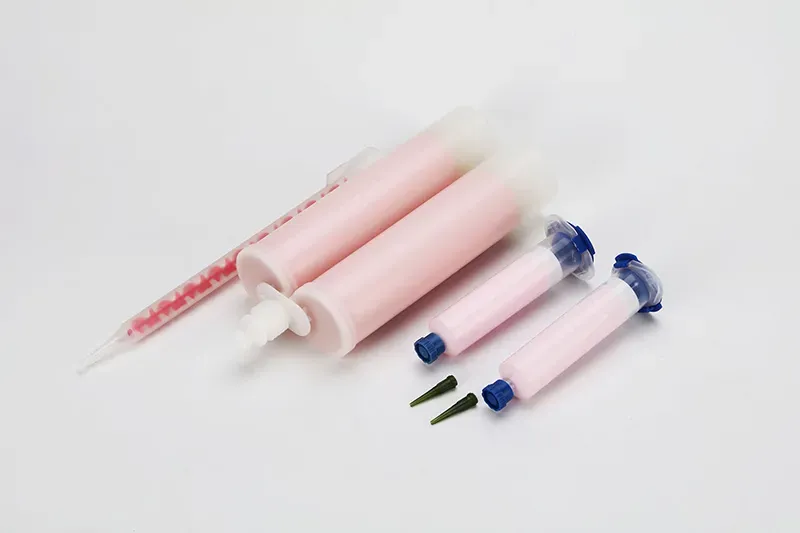
For day-to-day control:
- A pneumatic controller drives gel from the fluid reservoir through a barrel adapter.
- A precision tip or dispensing needle controls deposit size.
For production planning:
- The compact manual setup suits low-volume production, where changing materials without much fuss matters.
This is an accessible starting point for automated dispensing thermal gel, including development work at Sheen Technology.
Cartridge-based dispensers
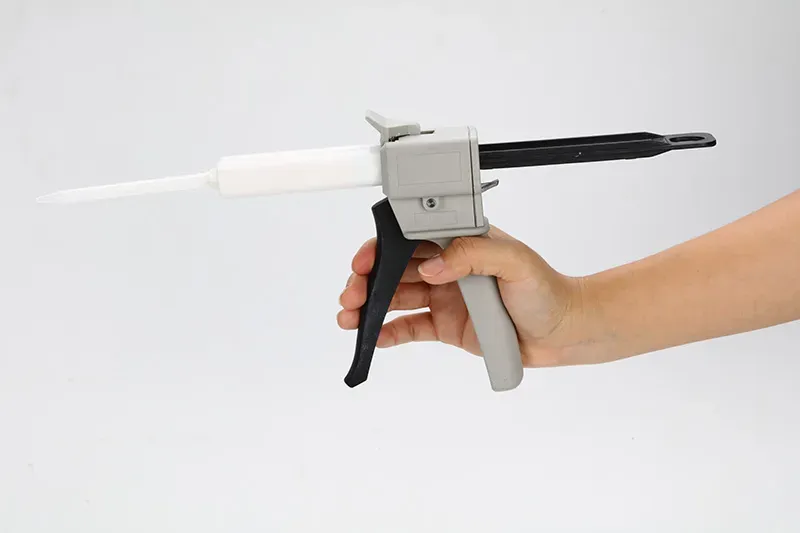
Cartridges step up capacity without making operation overly complicated. An adhesive cartridge paired with a pneumatic gun delivers steady pressure for repeatable thermal gel deposits.
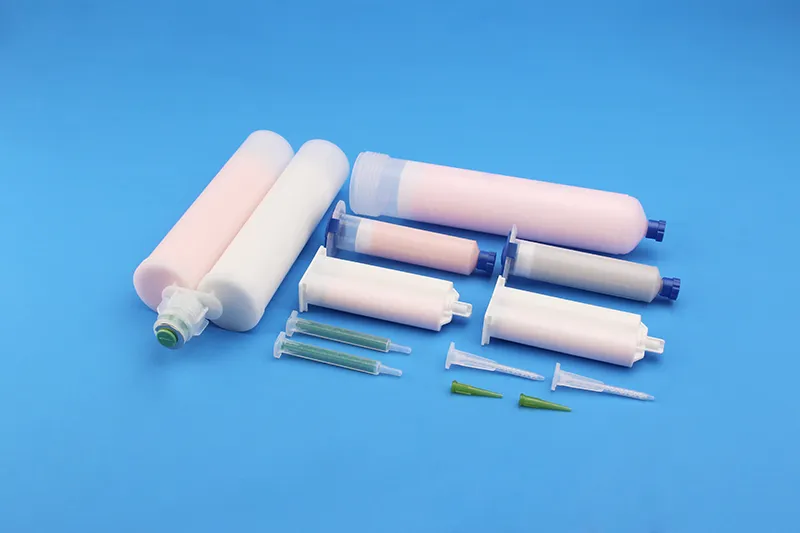
For two-component material, a meter mix system and static mixer combine materials at the required ratio. Bulk packaging also reduces refill frequency during higher-volume sealant application or PCB production.
Jetting technologies
Non-contact jetting is a good fit when tiny, fast deposits matter.
The delivery hardware:
- A piezoelectric actuator operates the dispensing valve at high-frequency output.
- Non-contact dispensing avoids touching sensitive parts.
The deposit:
- Accurate dot placement can reach picoliter volume scales where equipment supports it.
- This approach fits dense surface mount technology assemblies.
That speed makes automated dispensing thermal gel practical around tightly packed processors and packages.
Stencil printing setups
Stencil printing handles many thermal gel locations in one pass.
- Secure the flat substrate with an alignment fixture.
- Position the aperture plate or mesh screen.
- Draw a squeegee blade across it, controlling paste transfer onto the PCB assembly.
Gel viscosity and stencil thickness need to match; get that pairing right, and repeatable coverage becomes much easier.
Robotic placement units
Robotic systems bring programmable thermal gel dispensing to complex production patterns.
Motion control:
- A multi-axis arm or gantry system follows a programmable path.
- The motion controller coordinates position and speed.
Material delivery:
- The dispensing head places gel between components and heat sinks.
- An automated workflow supports high-speed production with consistent locations.
For Sheen Technology applications, this setup can connect automated dispensing thermal gel with repeatable PCB assembly processes.
3 Steps to Implement Automated Thermal Gel Dispensing
Automated dispensing thermal gel can make PCB production faster, cleaner, and far more consistent, but good results depend on more than buying a robot. Material behavior, package choice, machine settings, and final testing all matter. The three steps below show how to put automated thermal gel dispensing into everyday production without making the process a headache for operators.
Step 1: Choose the right viscosity & cartridge packaging
Start with the gel itself. Viscosity and other rheological properties determine how easily material flows, holds its shape, and responds to pressure.
Material fit
- Check thermal gel material formulation, conductivity, density, storage temperature, and shelf life.
- Match viscosity to the desired dispensing rate and bead geometry. Automated dispensing thermal gel that is too stiff may require excessive pressure.
The following parameter information is from the Sheen Technology SE series datasheet:
| Properties | Color | Thermal Conductivity | Thermal Impedance(@50psi) | Flow Rate(@30cc,90psi) |
| Unit | - | W/m·K | ℃*in²/W | g/min |
| SE20 | Pink | 2.0 | 0.08 | 80±15 |
| SE30 | Pink | 3.0 | 0.08 | 50±5 |
| SE35 | Pink | 3.5 | 0.075 | 30±5 |
| SE40 | Pink | 4.0 | 0.07 | 30±5 |
| SE50 | Pink | 5.0 | 0.065 | 35±5 |
| SE60 | Gray | 6.0 | 0.055 | 35±5 |
| SE80 | Gray | 8.0 | 0.06 | 30±5 |
| SE100 | Gray | 10.0 | 0.05 | 25±10 |
| SE120 | Gray | 12.0 | 0.05 | 15±5 |
| Test Method | Visual | ASTM D5470 | ASTM D5470 | - |
Package fit
- Select cartridge packaging sized for production volume and equipment capacity.
- Consider changeover frequency and storage needs. Sheen Technology can support material and package selection for automated thermal gel dispensing applications, helping manufacturers find a practical production fit.
Step 2: Integrate robotic dispensing on PCB assembly lines
Good robotic dispensing depends on controlling both material flow and machine movement. Machine setup:
Fluid dispensing
- Set pressure and deposit volume around component geometry.
- Choose a dispensing head suitable for the gel and required bead size.
Motion control
- Program paths, speeds, acceleration, and stop points to reduce stringing or overflow.
- Link automation with existing PCB assembly handling.
Line setup
- Confirm sensors, fixtures, and cycle timing during production line integration.
- Run automated dispensing thermal gel trials before raising line speed. Small adjustments here can save a lot of cleanup later.
Step 3: Validate thermal impedance and RoHS compliance
Production approval needs measured performance, not just a neat-looking deposit.
Performance checks
- Measure thermal impedance across the intended bond-line thickness.
- Verify thermal conductivity, dielectric strength, and operating-temperature limits through a documented testing protocol.
Compliance checks
- Confirm RoHS compliance and applicable REACH declarations as part of quality validation.
- Review supplier material records against current environmental regulation requirements.
Sheen Technology can provide supporting material documentation for qualification. With these checks complete, automated dispensing thermal gel becomes a controlled manufacturing process rather than a trial-and-error task.
Inconsistent Flow? Try Automated Gel Dispensing
Stable gel deposits start with knowing how the material behaves and reacting before small shifts become PCB defects. Automated dispensing thermal gel processes pair material checks, responsive controls, and production records so Sheen Technology can keep dispensing thermal gel consistent from lot to lot.
Diagnosing viscosity and density fluctuations
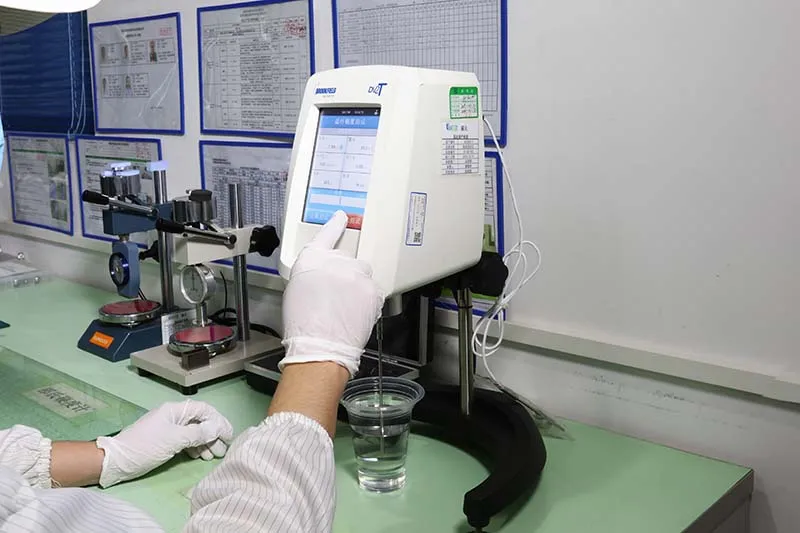
Automated dispensing thermal gel accurately gets tricky when temperature or storage changes the gel's material properties. A quick material check helps pinpoint what’s going on.
Material behavior
- Viscosity reflects resistance to movement; rising viscosity can reduce flow rate.
- Density changes may signal lot variation or storage issues.
Production conditions
- Track temperature, shelf life, and storage history.
- Compare rheology, meaning deformation and flow behavior, with actual deposit size.
| Check | Low | Target | High | Computed effect (typical viscosity-temperature sensitivity) |
| Temperature (°C) | 20 | 23 | 26 | A few kelvin is a meaningful shift for most gels |
| Viscosity change (%) | –5 | 0 | +5 | ≈5% flow-rate swing — the tightest constraint in the table |
| Density change (%) | –2 | 0 | +2 | Usually a lot or storage signature, not a temperature effect |
These example control bands should be replaced with limits validated for the actual thermal gel.
Automated parameter tuning to stabilize dispense flow
A closed feedback loop can make automated dispensing thermal gel far less sensitive to routine material drift. Instead of letting a thicker batch throw production off, controls respond on the fly.
- Sensors detect changes in dispense flow.
- The controller compares readings with the programmed target.
- Adjust pressure control when output volume shifts.
- Change dispensing speed or temperature when gel behavior varies.
- Fine-tune timing through the actuator.
- The machine checks the next deposit and repeats parameter tuning as needed.
This automated dispensing approach helps Sheen Technology maintain stable deposit dimensions without constant manual tweaking.
Ensuring batch consistency and full traceability
For automated dispensing thermal gel, stable output also depends on knowing exactly what happened during every run.
- Material records: Connect lot number, shelf life, and safety documentation to each job.
- Production records: Capture sensor data, equipment settings, and alarms through continuous data logging and process monitoring.
- Quality records: Link inspection results to the manufacturing execution system where applicable. That creates practical traceability while supporting quality control and stronger batch consistency.
With dispensing thermal gel records tied to each PCB run, Sheen Technology can investigate variation faster and support ISO-aligned production documentation.
PCB Coating: Automated Gel Dispensing Benefits
Automated dispensing thermal gel gives PCB assembly teams tighter control over material placement, thermal performance, and output. Sheen Technology applies precise dispensing controls so production stays practical when tolerances get tight.
Enhanced heat-sink bonding on power modules
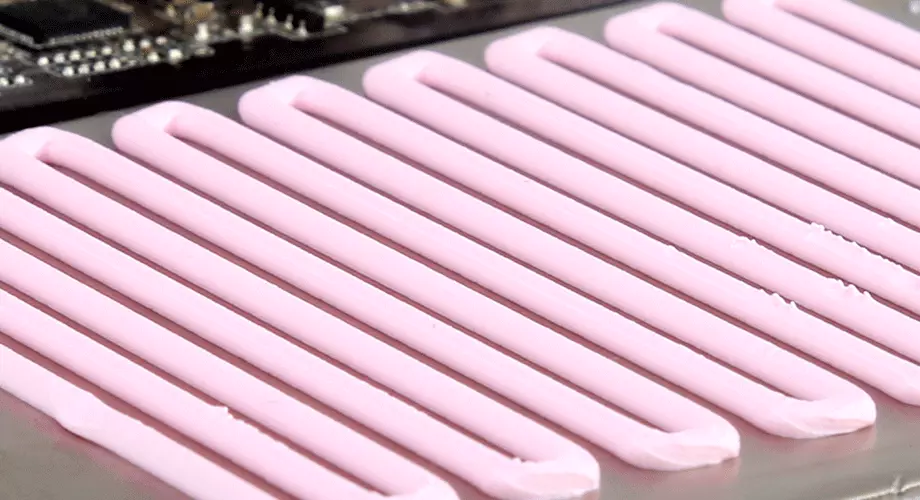
Automated dispensing thermal gel controls bond-line thickness, helping the thermal interface fill tiny air gaps between a power module and its heat sink.
Bond quality
- Accurate gel placement improves heat dissipation by keeping contact areas consistently filled.
- Stable thermal conductivity helps move heat away from high-load devices.
Production control
- Fine dispensing precision supports repeatable adhesive bonding.
- That repeatability can improve mechanical stability when assemblies face vibration or temperature cycling.
The payoff is pretty simple: less variation at a critical interface.
Uniform coverage for semiconductor packages
For each semiconductor package, a controlled dispensing pattern puts thermal gel where it is actually needed. Automated dispensing thermal gel keeps material flow steady without piling on excess material.
- Coverage: Micro-dispensing reaches small target areas with better placement control.
- Protection: Consistent surface adhesion supports void reduction and dependable encapsulation.
- Consistency: Repeatable automated dispensing helps maintain dielectric and thermal properties from unit to unit.
Sheen Technology can tune dispensing paths around package geometry, making tricky layouts far easier to handle.
Faster cure times on microprocessors
Automated dispensing thermal gel can reduce unnecessary deposit thickness around a microprocessor, which may shorten curing where the selected chemistry permits it.
- Meter the required volume for effective thermal management.
- Avoid excess gel that can extend cycle time.
Match curing conditions to the material.
- UV curing, when supported by the formulation, can raise assembly speed.
- Cure energy and temperature influence the reaction rate and crosslinking process.
Confirm cure quality rather than assuming thinner always means faster.
That keeps production moving without trading away thermal performance.
Halogen-free, UL 94V-0 compliance guaranteed
Compliance depends on selecting qualified materials; automated dispensing thermal gel itself cannot guarantee a material certification.
- Material safety: Choose documented halogen-free gel with suitable flame retardant performance.
- Regulatory approval: Verify the exact product's UL 94 V-0 status plus RoHS and REACH declarations.
- Environmental compliance: Keep supplier documents tied to lot and batch records.
- Thermal insulation: Confirm electrical and thermal properties under the intended operating conditions.
Good traceability makes each safety standard claim verifiable, rather than just taking it on faith.
【Request a Custom Quote】Tuning dispense volume, flow rate, and cure time for high-speed PCB assembly? Send us your gap tolerance, dispense system type, target bond-line thickness, line speed, and traceability requirements, and our engineers can recommend thermal gel and gap-filler materials with dispense-compatible packaging and lot-linked test data for your automated dispensing thermal gel process.
Sheen Thermal
Dongguan Sheen Electronic Technology Co., Ltd · Founded in 2008
Manufacturer of thermal interface materials and silicone foam for automotive electronics, energy storage, power electronics, communications and consumer electronics.
Certified
- ISO 9001:2015
- ISO 14001:2015
- IATF 16949:2016
What we supply
- Thermal conductivity Up to 90 W/m·K
- Thickness 0.3–10.0 mm
- Custom & samples Die-cut to drawing, 3–7 days