
 English
 usheenthermal

Common Thermal Glue Issues and How to Solve Them
Date:2026-08-14
In modern electronics manufacturing, thermal glue plays a crucial role in both thermal management and structural bonding. Unlike traditional thermal interface materials such as thermal paste or pads, thermal glue provide a permanent connection between components while simultaneously transferring heat.
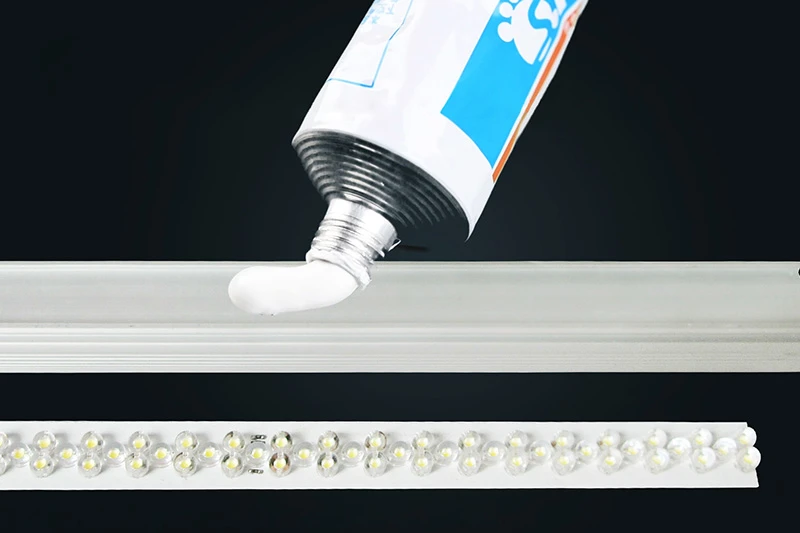
This dual function makes thermal glue especially valuable in applications such as:
- LED modules
- power electronics
- industrial control equipment
- lithium battery packs
- automotive electronics
In the high-stakes world of 2026 hardware—where we’re cramming 600W AI processors into tiny boxes and strapping lithium battery packs onto high-vibration EV chassis—thermal glue (thermal adhesive) has to be more than just "sticky." It has to be a structural engineer, a thermal highway, and a vibration damper all at once.
At Sheen Technology, we’ve seen it all: from heatsinks that "ghost" their components to adhesives that have a "mid-life crisis" and refuse to cure. Whether you're using our TIV single-component or PU two-component series, here is the enriched survival guide to fixing common thermal glue drama before it turns your hardware into an expensive, overheating paperweight.
Problem 1: Poor Thermal Performance
Common Symptoms
One of the most common issues engineers encounter with thermal glue is inefficient heat transfer.
Signs of poor thermal performance include:
- electronic components running hotter than expected
- heat sinks remaining relatively cool
- uneven temperature distribution across components
In many cases, engineers initially suspect that the adhesive itself has poor thermal conductivity. In reality, the problem is often related to how the thermal glue was applied.
Why Thermal Glue Sometimes Fails to Transfer Heat
Several factors can increase thermal resistance in an adhesive layer.
| Cause | Effect |
| Adhesive layer too thick | Heat must travel a longer path |
| Air bubbles in adhesive | Air blocks heat transfer |
| Uneven spreading | Inconsistent thermal contact |
| Dirty bonding surfaces | Reduced thermal interface efficiency |
Air pockets are particularly problematic because air is a very poor conductor of heat. Even small bubbles trapped in the adhesive layer can significantly reduce thermal performance.
How to Fix Poor Thermal Conductivity
To improve heat transfer, consider the following steps:
1)Control adhesive thickness
Thermal glue should form a thin, uniform layer between surfaces.
2)Use proper dispensing patterns
- dot pattern for small chips
- line pattern for heat sinks
- cross pattern for larger surfaces
3)Apply even pressure during assembly
Pressure spreads the adhesive and helps remove trapped air.
4)Ensure clean bonding surfaces
Remove dust, oil, and oxidation using isopropyl alcohol and lint-free wipes.
When applied correctly, thermal glue forms a continuous heat-transfer pathway between components and cooling structures.
Problem 2: Weak Bonding Strength (The "Sudden Breakup")
There is nothing quite as heart-sinking as hearing a clink from inside a 5G base station and realizing your heatsink has decided to "break up" with the PCB and move to the bottom of the enclosure.
- Surface Contamination: Finger oils, dust, and mold-release agents create a low-surface-energy layer that prevents adhesive wetting. Fix: 99% IPA scrub with lint-free wipes, followed by contact-angle verification (>40 dynes/cm).
- CTE Mismach: Differential thermal expansion between aluminum heatsinks (~23 ppm/°C) and silicon (~2.6 ppm/°C) generates cyclic shear stress. Rigid epoxies may crack; flexible PU adhesives absorb the strain. Fix: select PU series for high-CTE-mismatch or vibration applications.
- Inadequate Surface Preparation: Without proper cleaning or priming, adhesive adhesion is governed by weak van der Waals forces rather than chemical bonding. Fix: follow surface preparation procedure per adhesive datasheet; consider plasma treatment for critical applications.
Problem 3: Uneven Thermal Glue Spreading
If you pull apart a failed assembly and the glue looks like a messy map of the Himalayas, you’ve got a coverage problem. Uneven glue creates "Thermal Hot Spots" where the silicon literally starts to cook itself.
Uneven distribution can lead to inconsistent heat transfer and unreliable bonding.
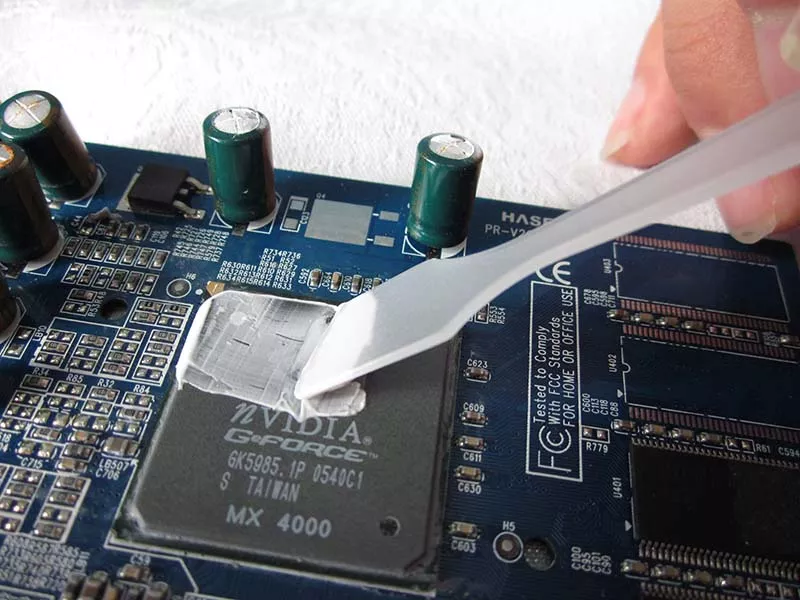
Why Uneven Spreading Causes Thermal Hotspots
When adhesive coverage is uneven, some areas may have:
- thick adhesive layers
- trapped air pockets
- insufficient contact between surfaces
These inconsistencies create thermal hot spots, where heat accumulates instead of being dissipated.
Common Dispensing Mistakes
| Mistake | Result |
| Incorrect dispensing pattern | Poor coverage |
| Misaligned components | Uneven adhesive layer |
| Insufficient mounting pressure | Thick adhesive spots |
Best Dispensing Patterns for Thermal Glue
Choosing the right pattern helps ensure uniform distribution.
| Pattern | Best Use |
| Dot pattern | Small electronic components |
| Line pattern | Heat sinks or elongated surfaces |
| Cross pattern | Large modules |
Trust the "Squish." Use a Center-Dot or X-Pattern. Let the mechanical pressure of the mounting process push the glue from the center out. It’s the only way to ensure the air is pushed out and the coverage is 100%.
Problem 4: Adhesive Overflow and Excess Glue
Applying too much thermal glue is another common issue, especially in manual assembly processes.
Why Applying Too Much Thermal Glue Is a Problem
Excess adhesive can cause several complications:
- overflow around component edges
- contamination of nearby circuitry
- thicker adhesive layers that reduce thermal efficiency
Although it may seem safer to apply extra adhesive, excessive glue can actually reduce heat transfer performance.
Common Causes of Overflow
| Cause | Effect |
| Excess dispensing volume | Adhesive leakage |
| High mounting pressure | Glue pushed out of interface |
| Poor dispensing control | Inconsistent application |
How to Control Adhesive Volume
To prevent overflow:
- calibrate dispensing equipment regularly
- use controlled syringe or automated dispensing systems
- perform small test applications before full production
Automated dispensing equipment is often preferred in high-volume manufacturing because it ensures consistent adhesive quantities and placement.
Problem 5: Curing Failures (The "Mushy Middle" Crisis)
You wait 24 hours, but the glue is still tacky, or the heatsink moves when you poke it. The glue has essentially decided to go on strike and remain in a liquid state.
Signs of Incomplete Curing
- adhesive surface remains sticky
- components shift after bonding
- adhesive deforms under mechanical stress
These symptoms indicate that the curing process has not completed properly.
Common Curing Mistakes
| Cause | Effect |
| Incorrect mixing ratio | Incomplete chemical reaction |
| Low curing temperature | Slow curing process |
| Insufficient curing time | Weak adhesive structure |
Two-component thermal glue are particularly sensitive to mixing ratios. Even small deviations can prevent proper curing.
How to Ensure Proper Adhesive Curing
To achieve reliable curing:
- Follow the manufacturer’s recommended mixing ratios.
- Maintain appropriate temperature conditions.
- Allow sufficient curing time before applying mechanical stress.
In some manufacturing environments, heat curing is used to accelerate the process and improve production efficiency.
Problem 6: Difficult Rework (The "Ex You Can't Escape")
Thermal glue is designed to be a lifetime commitment, not a weekend fling. Its structural strength is its greatest virtue and its biggest rework headache.
Safe Methods for Removing Thermal Glue
| Method | Description |
| Heat softening | Heating reduces adhesive strength |
| Mechanical separation | Carefully prying components apart |
| Chemical solvents | Used in limited cases |
Even with these techniques, there is a risk of damaging components or surfaces during removal.
When Rework Is Possible
Rework may be feasible when:
- components are large and durable
- the adhesive layer is relatively thin
- sufficient heating equipment is available
In many cases, however, replacing the bonded components may be more practical.
FAQ: Frequently Asked "Sticky" Questions
Can I use TIV single-component glue on high-power EV battery modules?
Absolutely. It’s a 2026 favorite for its flame retardancy (UL 94-V0) and "one-step" simplicity. Just give it the full 24 hours to reach its "structural seatbelt" phase.
Is thermal glue better than thermal paste?
They have different advantages in different application scenarios, so the choice between thermal paste and thermal glue depends entirely on your intended use.
Why is my 2-part PU glue still tacky after a day?
Check your mixing ratio! If it’s not exactly 1:1, the molecules are still waiting for their partners and won't finish the reaction. Also, check the expiration date—expired glue is "chemically exhausted.
Does thermal glue "pump out" over time?
Unlike paste, cured glue is a cross-linked solid. It stays exactly where you put it, making it the perfect choice for high-vibration automotive electronics.
Can thermal glue be removed?
Once cured, thermal glue is difficult to remove and typically requires heat and mechanical separation.
The six common thermal glue issues described in this guide share a common root: process control. Proper surface preparation, accurate dispensing, controlled assembly pressure, and correct curing conditions resolve the majority of thermal adhesive failures. By implementing these engineering practices, manufacturers can achieve reliable thermal bonds and consistent product performance. Sheen Technology provides application engineering support, dispensing parameter guidance, and product samples to support process qualification.
Is your production line currently suffering from "mushy bonds" or "heatsink ghosting"? [Contact Sheen’s Engineering Team] today for a complete list of common thermal glue questions and scientific solutions.
Sheen Thermal
Dongguan Sheen Electronic Technology Co., Ltd · Founded in 2008
Manufacturer of thermal interface materials and silicone foam for automotive electronics, energy storage, power electronics, communications and consumer electronics.
Certified
- ISO 9001:2015
- ISO 14001:2015
- IATF 16949:2016
What we supply
- Thermal conductivity Up to 90 W/m·K
- Thickness 0.3–10.0 mm
- Custom & samples Die-cut to drawing, 3–7 days