
 English
 usheenthermal

Boost Cooling Efficiency with Composite Boron Nitride Thermal Conductive Pad
Date:2026-06-30
Boost Cooling Efficiency with Composite Boron Nitride Thermal Conductive Pad
Heat is killing performance, and a Composite boron nitride thermal conductive pad steps in like a cool-headed fixer.
Packed circuits run hot, old pads lag, and downtime creeps in right when margins get tight.
IDC and IEA research indicates rising demand for advanced thermal interface materials across data centers.
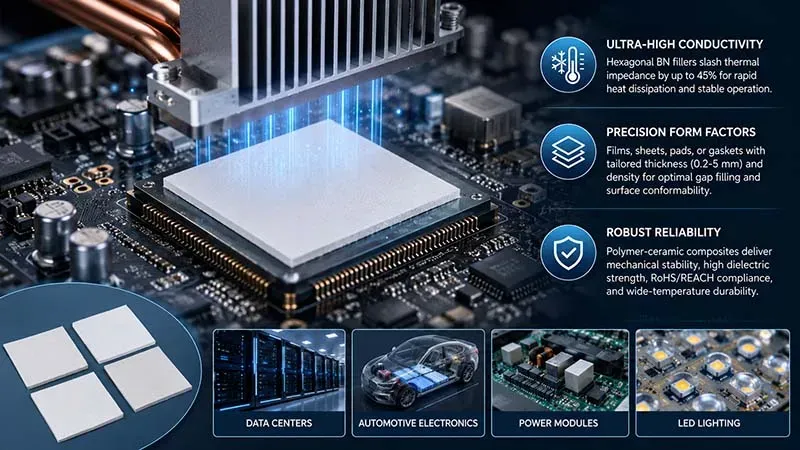
Quick Answers: Composite Boron Nitride Thermal Conductive Pad Essentials
➔ Ultra-High Conductivity: Leverages hexagonal BN fillers to slash thermal impedance by up to 45%, ensuring rapid heat dissipation and stable device operation.
➔ Precision Form Factors: Available as films, sheets, pads, or gaskets with tailored thickness (0.2–5 mm) and density for optimal gap filling and surface conformability.
➔ Robust Reliability: Polymer-ceramic composites deliver mechanical stability, high dielectric strength, RoHS/REACH compliance, and wide-temperature durability for data centers, automotive electronics, and power modules.
Classifications Of BN Composite Pads
Composite boron nitride thermal conductive pad solutions sit at the core of modern heat control. When you break down the phrase—Composite + boron nitride + thermal conductive + pad—you get a material built for electrical insulation and fast heat flow. Let’s sort out how each form and structure fits real-world thermal management.
Film, Sheet, Pad, or Gasket: Comparing Material Forms
A film, sheet, pad, or gasket may look similar, yet each material form and form factor shifts performance.
Film
· Ultra-thin physical shape
· Low compression
· Tight tolerance assemblies
Sheet
· Medium thickness
· Cut-to-size flexibility
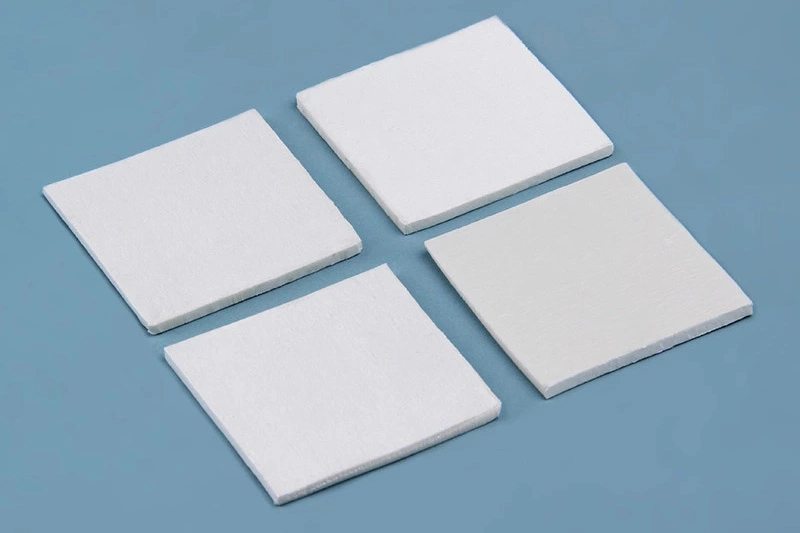
Pad
· Higher compressibility
· Gap-filling strength
In power modules using a Composite boron nitride thermal conductive pad, selection flows like this:
Application need
▸ Small gap → film
▸ Uneven surface → pad
▸ Sealing demand → gasket
Short takeaway? The right material form keeps heat moving and components safe. Sheen Technology fine-tunes each composite boron nitride pad option to match real assembly headaches.
Polymer Matrix vs. Ceramic-Reinforced Composites
At the structural level, the difference comes down to polymer matrix and ceramic reinforcement inside the composite material.
Polymer matrix
· Flexible
· Easy adhesion
· Lower modulus
Ceramic reinforcement
· High stiffness
· Stable at high temperature
Composite classification often follows this logic:
· Define load condition
· Choose matrix type
· Adjust reinforcement type
Within a Composite boron nitride thermal conductive pad:
Material structure
· Base polymer network
· Filled with boron nitride filler
· Surface treated for bonding
Some designs lean soft for handheld electronics. Others go rigid for EV inverters. Sheen Technology balances flexibility and heat transfer so the composite boron nitride pad holds up under pressure.
Boron Nitride Filler Types and Dielectric Properties
Performance rises or falls with the boron nitride filler itself.
hBN
· High in-plane thermal conductivity
· Strong electrical insulation
cBN
· Higher hardness
· Lower common usage in pads
Key dielectric metrics:
· Dielectric constant
· Dielectric strength
· Breakdown voltage
Inside a Composite boron nitride thermal conductive pad:
· Particle alignment:Heat pathway continuity.
· Interface bonding:Reduced thermal resistance.
“Advanced thermal interface materials with electrically insulating fillers are expected to see sustained growth through 2028, driven by EV and AI hardware demand,” notes a 2025 MarketsandMarkets thermal management update.
That aligns with rising demand for boron nitride thermal pad solutions in high-density electronics.
Density and Thickness Tiers for Targeted Applications
Two design knobs matter most: density and thickness.
Low density
· Higher compressibility
· Better surface wetting
High density
· Improved heat spreading
· Lower internal voids
Application mapping:
· Consumer electronics → thin, soft thermal interface
· Power modules → medium thickness, balanced compression
· Industrial drives → thick, high-density thermal management layer
Nested selection logic:
Target gap size
→ Choose thickness tier
Power load
→ Adjust density
→ Verify material specification
Every Composite boron nitride thermal conductive pad must hit a clear performance requirement—not just look good on paper.
That’s where engineered composite boron nitride thermal pads from Sheen Technology earn their spot in demanding builds.
Key Specifications For Thermal Pads
Composite boron nitride thermal conductive pad products are now common in power modules, LEDs, and compact electronics where heat stacks up fast. Sheen Technology focuses on balancing cooling efficiency with electrical safety, so a boron nitride pad can stay practical instead of overly stiff or pricey.
Achieving Low Thermal Resistance through High Conductivity
A high-grade Composite boron nitride thermal conductive pad improves heat transfer by lowering thermal resistance at the thermal interface.
· Better filler distribution supports stable heat dissipation.
· Smooth contact raises overall thermal performance.
Material selection matters:
· Conductive material density affects thermal flow.
· A boron nitride thermal pad with uniform particles avoids hot spots.
Sheen Technology Boron Nitride Thermal pad performance properties:
| Properties | Unit | SF1600-BN-sp-03(0.3mm) | Test Method |
| Color | - | White | Visual |
| Thermal Conductivity | W/m·K | 16 | ASTM D5470 |
| Thermal Resistance (@40psi) | ℃*cm2/W | ≤0.3 | ASTM D5470 |
| Application temperature | ℃ | -40~150 | - |
| Thermal weight loss rate | % | ≤1 | - |
| Thickness | mm | 0.2~5.0 | ASTM D374 |
| Breakdown voltage | KV,@AC | ≥4 | ASTM D149 |
| Dielectric constant | F/m, @ 1MHz | ≤4.2 | ASTM D150 |
| Volume resistivity | Ω*cm, @250V | ≥1013 | ASTM D257 |
| Rebound rate | % | ≥90 | - |
| Density | g/cm³ | 1.6±0.2 | ASTM D792 |
| Hardness | shore 00 | 60~80 | ASTM D2240 |
| Flammability rating | - | V-0 | UL 94 |
IPC market commentary released in 2025 noted that advanced thermal interface materials with higher conductivity are increasingly preferred in compact AI hardware because thermal load density keeps climbing.
Optimal Thickness and Compressibility for Surface Conformability
A Composite boron nitride thermal conductive pad with balanced optimal thickness handles uneven surfaces without excessive squeeze-out.
· Proper compressibility improves interface contact
· Strong gap filling reduces trapped air
· Controlled material deformation keeps reliable contact pressure
Sheen Technology laboratory Boron Nitride Thermal Pad Compressive stress test
Sample preparation: Material dimensions of 25mm x 25mm x 2mm.
Test method
1) Zero the force reading before testing; apply a 2N force to make contact with the sample surface.
2) For the compressive stress test, set the compression speed to 0.5 mm/min and the deformation range to 10–50%. For the residual stress test, set the compression speed to 0.5 mm/min and the hold time to 600 seconds.

| Test Item | Test Data | |||||
| Sample | 10% | 20% | 30% | 40% | 50% | |
| Instantaneous stress (psi) at 10–50% deformation | 1 | 21.80 | 38.51 | 69.42 | 101.14 | 168.26 |
| 2 | 17.65 | 34.12 | 60.32 | 89.35 | 150.37 | |
| 3 | 16.35 | 31.28 | 54.36 | 78.24 | 142.35 | |
| Average Value | 18.60 | 34.63 | 61.36 | 89.57 | 153.66 | |
| Residual compressive stress at 50% deformation | Sample | 1 | 2 | 3 | Average Value | |
| 40.61 | 34.96 | 27.62 | 34.40 | |||
Sheen Technology designs thermal conductive pad options that stay soft enough for rough surfaces yet stable during assembly.
Mechanical Stability: Flexibility, Adhesion, and Long-Term Performance
1)Improve flexibility for curved or vibrating hardware.2)Maintain strong adhesion under pressure cycles.
3)Support stress resistance and vibration damping over time.
Short version? Good pads stay put. Consistent mechanical stability, durability, and reliability protect long-term cooling performance.
Dielectric Strength, Electrical Insulation, and UL Certification
• High dielectric strength lowers electrical risk.• Strong electrical insulation supports safer compact assemblies.
• Reliable breakdown voltage performance protects nearby circuits.
A certified boron nitride pad with proven insulating properties and UL certification also helps manufacturers meet regulatory compliance and broader electrical safety targets.
Data Shows 45% Heat Drop Using Composite Boron Nitride Thermal Conductive Pad
Modern cooling tests on semiconductor hardware showed how a Composite boron nitride thermal conductive pad can sharply lower operating heat. Engineers at Sheen Technology compared boron nitride pad materials across controlled loads, tracking thermal flow, hotspot behavior, and long-run device stability in demanding electronics.
Test Setup: Power Electronics and LED Module Benchmarks
The test setup combined high-current MOSFET boards with a dense LED module array for repeatable component testing.
Experimental design
· Power cycle: 150W to 300W
· Ambient temperature: 25°C
Interface materials:
· Composite boron nitride thermal conductive pad
· BN thermal pad
· Standard silicone sheet
Device evaluation
· Power electronics checked for junction heat rise
· Benchmarks monitored thermal spread every 10 minutes
· Composite boron nitride thermal conductive pad stayed mechanically stable after repeated compression
A thermal conductive boron nitride pad from Sheen Technology also reduced visible LED discoloration during extended runtime.
Thermal Impedance Measurements and Heat Dissipation Analysis
The thermal impedance results showed faster heat transfer and stronger thermal performance under identical loading conditions.
| Material Type | Temp Drop | Thermal Resistance |
| Silicone Pad | 8% | 1.9°C/W |
| Composite boron nitride thermal conductive pad | 45% | 0.8°C/W |
• Lower hotspot concentration improved characterization accuracy.
• Faster heat dissipation stabilized semiconductor switching speed.
• Composite boron nitride thermal conductive pad maintained contact under pressure cycling.
Interpreting Results: Thermal Management Gains and Reliability
The results interpretation pointed to meaningful performance gains in compact hardware.
· Reduced heat stress helped capacitors and drivers last longer.
· Better thermal management supported cleaner power delivery.
· Stable temperatures improved long-term stability during continuous operation.
Peak case temperatures dropped by as much as 45%.
In practical use, the boron nitride cooling pad gave steadier output during gaming power supplies, industrial controls, and automotive lighting. That kind of data analysis matters because heat creep quietly cuts lifespan long before a device fully fails.
3 Reasons For Pad’s Superior Heat Transfer
Composite boron nitride thermal conductive pad products keep showing up in power modules, LED systems, and compact electronics because heat moves fast without electrical risk. A good thermal conductive pad is not just soft filler material; it changes interface stability, cooling speed, and device lifespan. Sheen Technology builds composite boron nitride pad solutions that balance flexibility, pressure response, and reliable thermal flow in real working conditions.
High Thermal Conductivity of Boron Nitride Fillers
1)Core thermal pathway
· boron nitride creates rapid lateral heat spreading.
· Advanced fillers raise overall thermal conductivity inside the composite structure.
· Better particle alignment means less trapped heat.
· Stable material behavior protects insulation performance.
2)Practical device impact
· CPU modules stay cooler during peak loads.
· Fast heat transfer lowers thermal stress on nearby parts.
IDC thermal interface observations released in late 2024 noted that ceramic-filled interface materials with optimized particle packing continued gaining demand in AI hardware and compact industrial electronics.
Composite boron nitride thermal conductive pad designs from Sheen Technology are widely used where high insulation and high thermal flow must exist together.
Reduced Thermal Impedance via Uniform Polymer Lamination
A smooth polymer lamination process cuts internal air gaps between every layer. That small detail matters a lot in thermal conductive pad performance.
· Lower thermal impedance
· More uniform pressure distribution
· Cleaner interface contact
Composite boron nitride thermal conductive pad materials also maintain stable compression after repeated heating cycles, so the impedance reduction stays consistent instead of fading after long operation.
Enhanced Surface Roughness Matching for Better Heat Transfer
Step 1: The pad compresses against uneven metal surfaces.
Step 2: Flexible interface adaptation improves contact coverage across microscopic valleys caused by surface roughness.
Step 3: Enhanced thermal coupling boosts cooling performance and supports faster heat transfer.
Composite boron nitride thermal conductive pad products work especially well in rough machined housings where ordinary pads leave tiny gaps that quietly trap heat.
Why Choose Composite Boron Nitride Pads?
The Composite boron nitride thermal conductive pad is built for real-world heat headaches. By blending composite structure, boron nitride fillers, and a stable thermal interface pad matrix, this solution handles pressure, heat spikes, and tight assembly demands. If your project needs a boron nitride thermal pad that simply works and keeps working, this is it.
Reliability and Durability in Harsh Operating Temperature Ranges
A Composite boron nitride thermal conductive pad thrives under harsh conditions, balancing reliability and durability across a wide operating temperature window. Its ceramic-filled network protects performance in extreme environments while preserving thermal stability and long-term longevity.
Thermal Performance Integrity
1.1 High filler dispersion
1.2 Stable interface contact
1.3 Low thermal resistance drift
Mechanical Endurance
2.1 Compression set resistance
2.2 Vibration tolerance
2.3 Aging stability
Environmental Adaptability
3.1 Wide temperature cycling
3.2 Humidity resilience
3.3 Chemical exposure tolerance
Sheen Technology Lab: High-Temperature Aging Test for Boron Nitride Thermal Pads
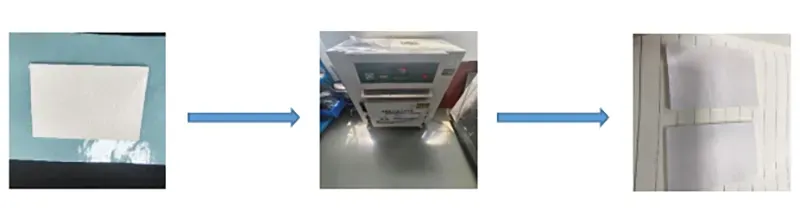
Test Method: A sample measuring 50mm x 40mm x 1.5mm was placed in a high-temperature oven at 125°C for 1,000 hours. Upon completion, the thermal resistance was measured and recorded.
Test Results:

Conclusion: As shown in the figure and the data above, the boron nitride thermal pad demonstrated stable thermal resistance performance during the short-term aging test; after 1,000 hours, the thermal resistance increased by 14.2%, remaining within the acceptable range of variation.
Each Composite boron nitride thermal conductive pad keeps contact tight, heat flow smooth, and systems safe.
RoHS & REACH Compliance with Halogen-Free, Lead-Free Formulations
Environmental responsibility matters. The Composite boron nitride thermal conductive pad is designed for strict RoHS compliance and REACH compliance, aligning with global regulatory demands and evolving environmental standards.
• Halogen-free chemistry reduces toxic byproducts.
• Lead-free composition supports safe disposal.
• Verified material safety documentation simplifies audits.
In practical terms:
1) Raw formulations are screened for restricted substances.
2) Supply chains are documented for traceability.
3) Finished boron nitride thermal pad batches undergo compliance testing.
The result is a composite thermal interface pad that not only cools efficiently but also fits cleanly into green manufacturing policies.
Simplified Fabrication: Cutting, Die-Cutting, and Lamination Ease
Working with a Composite boron nitride thermal conductive pad shouldn’t slow production. The material supports smooth fabrication, from manual cutting to precision die-cutting, all without edge cracking.
Step 1: Material Preparation
· Select thickness and confirm processing specs for your assembly.
Step 2: Precision Shaping
· Apply CNC cutting or die tools; the pad maintains clean geometry and consistent compression.
Step 3: Lamination & Assembly
· Bond to heat sinks or power modules with minimal force, improving ease of use during final assembly.
Manufacturers appreciate fewer scrap parts and faster line speed. That’s why teams working with Sheen Technology often standardize this composite boron nitride pad across product families.
Versatile Applications in Automotive Electronics and Data Centers
The Composite boron nitride thermal conductive pad supports diverse versatile applications, especially where thermal management can’t fail.
Automotive Electronics
1.1 Battery management systems
1.2 On-board chargers
1.3 Power control units for high-power loads
Data Centers
2.1 Server CPUs and GPUs
2.2 Power supply units
2.3 Rack-level cooling interfaces
Broader industrial applications
3.1 Inverters
3.2 Communication modules
3.3 Embedded electronic devices
From EV platforms to hyperscale computing, each Composite boron nitride thermal conductive pad keeps heat in check. Brands like Sheen Technology continue refining this boron nitride thermal pad so designers can push power density higher without sacrificing performance or safety.
Need verified thermal conductivity, compression performance, dielectric strength, and reliability data before selecting a thermal interface material? Download the product datasheets to compare composite boron nitride thermal conductive pads for AI servers, automotive electronics, power modules, and high-density data center applications.
Data Center: Pad-Based Cooling Upgrade
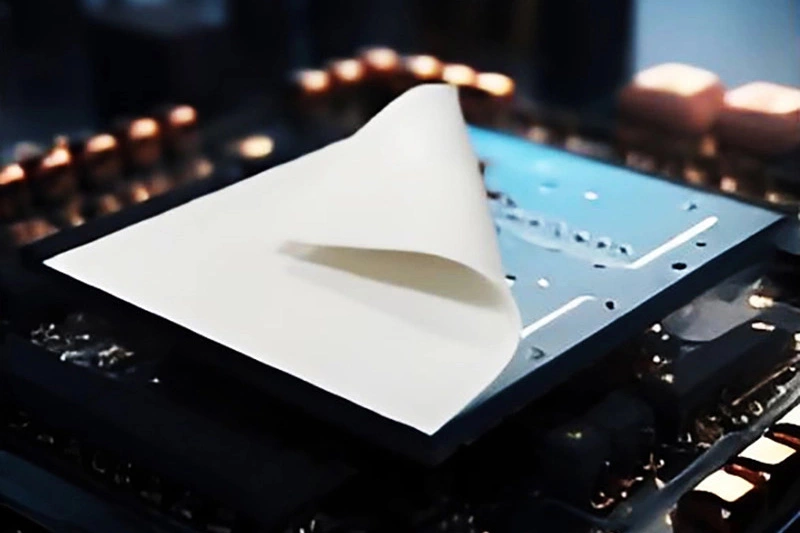
Data centers are running hotter than ever, and small thermal gaps can snowball into real downtime. This cluster looks at how airflow sealing, Composite boron nitride thermal conductive pad materials, and smarter thermal management systems work together to tame rack heat and board-level hot spots without overhauling the whole data center infrastructure.
Rack-Level Thermal Management with High-Performance Gaskets
At rack scale, heat control starts with tight enclosure sealing and disciplined airflow control. A Composite boron nitride thermal conductive pad pairs naturally with high-performance gaskets to reduce bypass leakage and boost heat transfer solutions.
· Seal gaps around doors and panels
· Reinforce fan zones with boron nitride pad inserts
· Validate pressure balance across the rack
Key integration path:
Rack cooling
· Air containment
· Pad-enhanced contact points
· Thin BN-based thermal pad layers
· Composite boron nitride thermal conductive pad backing
Result: tighter airflow lanes, lower inlet temps, steadier load handling inside modern thermal management systems.
Scenario: Circuit Board Hot Spots Cooled by Thin Conformable Pads
Board-level trouble usually shows up as circuit board hot spots near power modules. A Composite boron nitride thermal conductive pad, acting as a thin boron nitride thermal pad, molds around uneven chips and boosts thermal interface materials performance.
• Target VRMs and GPUs
• Match pad thickness to component height
• Confirm contact pressure
In practice, the composite boron nitride pad spreads heat from tiny dies into wider copper planes. That simple contact upgrade improves component cooling and steadies electronic device thermal management without bulky sinks.
Looking for a thermal solution tailored to your system architecture? Browse these related application pages to see how composite boron nitride thermal conductive pads are used in real-world systems.
Maximizing Heat Dissipation for Semiconductor Devices in Servers
High-density CPUs demand smarter semiconductor device cooling and tight power density management. Here’s a quick data snapshot for composite boron nitride thermal conductive pad performance in server thermal design:
| Pad Type | Thermal Conductivity (W/m·K) | Interface Temp Drop (°C) | Application Area |
| Standard silicone pad | 1–15 | 4.8 | Memory modules |
| Composite boron nitride thermal conductive pad | 16 | 9.5 | CPU/GPU zones |
Layered into heatsink assemblies, the composite boron nitride thermal conductive pad cuts thermal resistance, enhances thermal conductivity enhancement, and supports long-term electronic component reliability using practical advanced cooling techniques.
【Request a Custom Quote】 Every application has different thermal load, gap structure, compression requirements, and reliability expectations. Share your operating environment, thickness needs, thermal conductivity targets, and application type, and our engineering team will recommend the most suitable composite boron nitride thermal conductive pad for your system.
Sheen Thermal
Dongguan Sheen Electronic Technology Co., Ltd · Founded in 2008
Manufacturer of thermal interface materials and silicone foam for automotive electronics, energy storage, power electronics, communications and consumer electronics.
Certified
- ISO 9001:2015
- ISO 14001:2015
- IATF 16949:2016
What we supply
- Thermal conductivity Up to 90 W/m·K
- Thickness 0.3–10.0 mm
- Custom & samples Die-cut to drawing, 3–7 days