
 English
 usheenthermal

Thermal Interface Materials for 51.2T and 102.4T Ethernet Switches
Date:2026-09-08
Ethernet Switches Thermal Interface Materials face a hot-seat challenge: moving concentrated heat from high-power ASICs and CPUs into cooling hardware without turning assembly into a headache. For 51.2T and 102.4T platforms, power density raises the stakes.
Grease, phase-change materials, gap pads, gels, and Graphene sheets each play differently. This guide connects thermal performance with volume qualification, traceability, manufacturability, and supply continuity.
Melodic Key Takeaways for Ethernet Switches Thermal Interface Materials
- High-performance TIMs like phase-change materials, gap pads, gels, grease, and graphite sheets minimize junction-to-sink thermal resistance, ensuring 51.2T and 102.4T ASICs stay within safe operating temperatures.
- Selection criteria must balance thermal conductivity, dielectric breakdown voltage, hardness, and density against assembly demands, volume qualification, and traceability controls.
- Precision die cutting and automated dispensing improve bond-line consistency across densely populated switch assemblies.
- Compliance with RoHS, WEEE, and UL flammability standards plus rigorous thermal shock and stress screening underpin reliable long-term operation.
Request the Switch TIM Selection Guide →
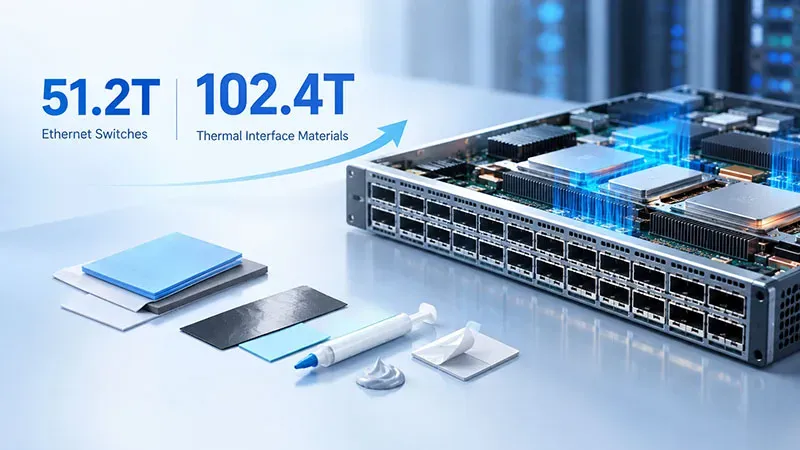
3 Key Factors In Ethernet Switches Thermal Interface Materials
Ethernet Switches Thermal Interface Materials sit between hot chips and cooling hardware, where small material choices can make a big difference. Good switch thermal materials move heat quickly, limit interface losses, and provide safe insulation so high-speed Ethernet hardware can keep working under heavy loads.
Maximizing Thermal Conductivity in Heat Sink Assemblies
For 51.2T and 102.4T hardware, high thermal conductivity helps move concentrated ASIC heat into the heat sink before chip temperature climbs. Ethernet switches' thermal interface materials therefore need more than a good conductivity number on paper.
Material selection
Choose a thermal interface material suited to the mounting gap.
- Thin phase change material works well on controlled, flat interfaces.
- A thermal pad can handle larger tolerances while supporting practical ASIC cooling.
Assembly checks
- Match thickness and compression to the hardware.
- Poor contact can restrict heat dissipation, even with a highly conductive switch thermal interface material.
Minimizing Thermal Impedance between ASIC and Heat Sink
Low thermal impedance means heat meets less resistance from the chip package to the cooler. Grease, gel, and gap-filling thermal interface materials fill tiny valleys caused by surface roughness.

| Properties | Color | Thermal Resistance(@50psi) | Thermal Conductivity | Minimum Interface Thickness |
| Unit | - | ℃*in²/W | W/m·K | mm |
| SG560-10 | White | ≤0.15 | 1.0±0.1 | 0.06 |
| SG560-20 | White/Gray | ≤0.045 | 2.0±0.2 | 0.05 |
| SG560-30 | Gray | ≤0.03 | 3.0±0.3 | 0.05 |
| SG560-40 | Gray | ≤0.02 | 4.0±0.4 | 0.05 |
| SG560-50 | Gray | ≤0.016 | 5.0±0.5 | 0.05 |
| Test Method | Visual | ASTM D5470 | ASTM D5470 | - |
As gap thickness grows, total impedance rises faster than linearly, because the bulk term grows with thickness while the contact term stops improving at lower pressure. The practical reading of these rows is therefore not "thicker is better" but "each gap range needs its own material, and the larger gap will always pay an impedance penalty".
In practice, higher interface pressure lowers contact resistance, but excessive force may stress the package — particularly a large organic substrate or a multi-die package with a stiff lid. A compliant gap filler accommodates tolerance; measured thermal performance under production-representative pressure should guide the design.
Ensuring Dielectric Breakdown Voltage for Reliable Operation
Electrical safety matters as much as thermal control, so dielectric properties deserve careful attention.
Insulation target
- Specify adequate dielectric strength and breakdown voltage.
- This preserves electrical isolation around nearby PCB conductors.
Qualification
- Check the required voltage withstand under expected thickness and compression.
- Compare testing with the applicable safety standard and operating voltage.
Long-term use
- Confirm electrical insulation after thermal aging and assembly stress.
This supports Ethernet Switches Thermal Interface Materials reliability without sacrificing useful heat transfer.
Why Do Ethernet Switches Need High-Performance TIM?
Ethernet Switches Thermal Interface Materials have a tough job as switching capacity and power keep climbing. Tiny gaps between chips and cooling hardware can trap heat, so better interfaces matter a lot. From thermal management around processors to softer PCB solutions, Sheen Technology helps designers move heat efficiently while keeping demanding Ethernet switches stable and ready for nonstop traffic.
Preventing ASIC and CPU Overheating under 102.4T Loads
At 102.4T, an ASIC and CPU can pack serious heat into a small area. Ethernet switches' thermal interface materials help control chip temperature by filling microscopic air gaps that otherwise slow heat dissipation.
Cooling priorities start at the chip:
Higher power density raises local temperature quickly.
- A high-performance thermal interface material lowers resistance between silicon packages and cooling hardware.
- Better heat transfer can reduce the chance of throttling during heavy traffic.
Stable cooling also supports long-term electronics life. In short, less trapped heat means less thermal strain.
Boosting Heat Sink Assembly Efficiency with Graphite Thermal Sheet
A graphite thermal sheet tackles hot spots differently. Its high in-plane thermal conductivity spreads concentrated heat sideways across a heat sink, helping more surface area join the cooling job.
Ethernet Switches Thermal Interface Materials can pair this spreading action with conformable interfaces:
- Lower contact resistance improves heat movement between mating surfaces.
- Useful mechanical compliance accommodates small assembly tolerances.
- More even temperatures support consistent thermal performance and practical assembly efficiency.
For dense switch hardware, that combo can be a pretty handy fix.
Sustaining PCB Assembly Signal Integrity through Low-Impedance Gel
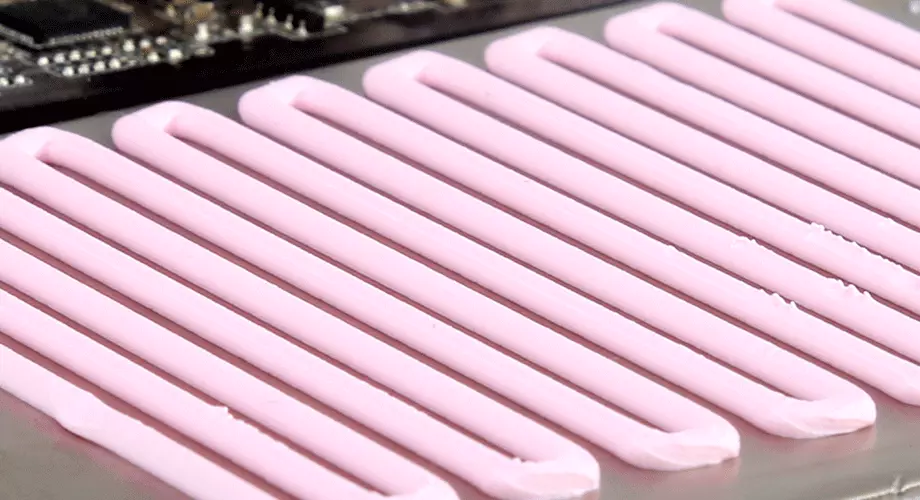
Ethernet Switches Thermal Interface Materials must also work around components that do not share the same height. Soft low-impedance gel can conform to these uneven areas without placing excessive force on the PCB assembly.
Mechanical control matters:
- Reduced thermal stress limits unwanted board bending.
- Less deformation helps protect high-speed signal integrity.
- Soft gel can serve where a conventional thermal pad is harder to fit.
Electrical design still matters:
- Material selection should account for electromagnetic interference requirements.
- Good thermal contact supports cooling and long-term reliability.
Used carefully, these thermal interface materials give dense Ethernet hardware a practical path to cooler, steadier operation.
Reliability Layers In High-Rate Ethernet Switches Thermal Interface Materials
Ethernet Switches Thermal Interface Materials need tight process control because small material or assembly changes can raise chip temperatures fast. For 51.2T and 102.4T switches, Sheen Technology pairs thermal material controls with practical reliability checks.
Material Properties and Batch Traceability Controls
Incoming material control starts with evidence.
- Certificates of analysis confirm thermal conductivity, density, and key electrical properties.
- SDS records support safe handling of grease, pads, and phase change material.
Production records keep each batch easy to trace.
- Lot tracking and barcode identification connect raw material to finished Ethernet switch parts.
- Recorded viscosity helps spot dispensing changes before they become a headache.
Storage control matters too.
- Defined shelf life limits reduce risks from aging or poor storage.
These controls make Ethernet Switches Thermal Interface Materials more repeatable from batch to batch.
Precision Die Cutting & Automated Dispensing Best Practices
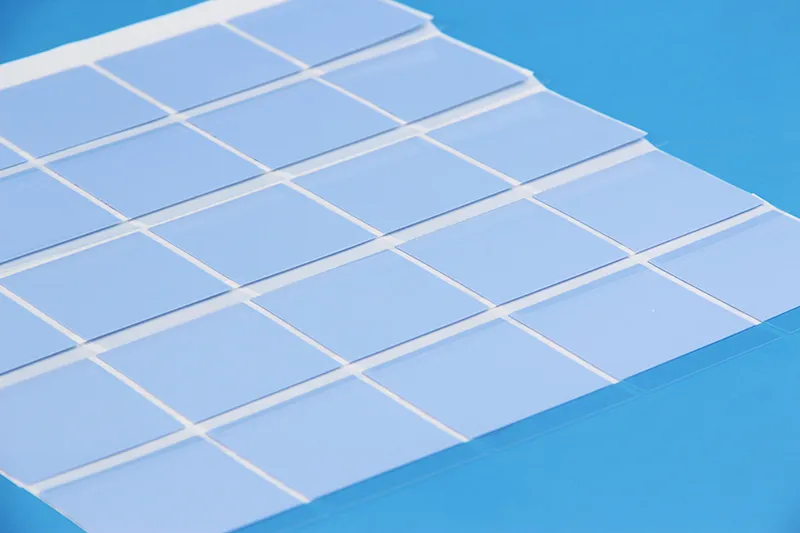
Graphite sheets and gap pads need tight tolerance and accurate alignment around crowded ASICs, optics, and power parts. Laser cutting can handle detailed shapes where suitable.

For grease and gel, automation controls the dispensing pattern and fluid control. Keeping interface thickness consistent helps prevent excess squeeze-out while supporting predictable switch thermal performance. Sheen Technology can match converting and dispensing methods to high-rate hardware geometry, which keeps assembly practical on the factory floor.
Compliance with RoHS, WEEE & UL Flammability Ratings
Material qualification should cover regulatory needs.
- RoHS controls specified hazardous substances.
- Halogen-free options may support customer material policies.
Equipment programs also need end-of-life planning.
- WEEE supports recyclability and responsible electronic-waste handling.
- Supplier documentation strengthens environmental compliance.
Fire performance requires evidence.
- UL94 V-0 may be specified where applicable.
- Relevant certification should match the required safety standard, not just a marketing claim.
Compliance records add another reliability layer to Ethernet switches' thermal interface materials.
Thermal Shock Testing and Environmental Stress Screening
- Run temperature cycling and high-temperature aging to accelerate material changes.
- Add controlled humidity and mechanical stress where deployment conditions justify them.
- Measure thermal impedance before and after exposure to track performance drift.
- Use failure analysis to inspect pumping, cracking, hardening, or delamination.
| Concern | Standard / Method | What It Establishes |
| Interface thermal impedance | ASTM D5470 | Resistance at stated pressure, thickness and temperature — the only comparable TIM metric |
| Dielectric strength | ASTM D149 / IEC 60243 | Voltage withstand at the compressed bond line |
| Volume resistivity | ASTM D257 | Distinguishes insulating BN from conductive graphite / graphene |
| Hardness / compliance | ASTM D2240 (Shore 00) | Compressed thickness at the available clamp force |
| Compression set | ASTM D395 / ISO 815 | Whether clamping force survives service life |
| Outgassing (TML / CVCM) | ASTM E595 | Screens volatiles that contaminate optics and contacts |
| Thermal cycling endurance | IEC 60068-2-14 | Reveals pump-out, dry-out, cracking and delamination |
| Network equipment environment | Telcordia GR-63-CORE | Temperature, humidity and altitude criteria for network hardware |
| Network equipment EMC / safety | Telcordia GR-1089-CORE | Electromagnetic compatibility and electrical safety baseline |
| Junction temperature method | JEDEC JESD51 series | Standardised thermal measurement for packaged devices |
| Ethernet interface | IEEE 802.3 | Defines the physical layer the switch platform implements |
| Flammability | UL 94 (V-0) | Burning behaviour; usually required for in-chassis materials |
| Restricted substances | RoHS / REACH | Substance declarations required by most markets |
| Quality system | ISO 9001 | Process control, lot traceability and consistency |
This screening gives Sheen Technology useful evidence about TIM reliability before Ethernet switches' thermal interface materials reach long-life switch deployments.
Download the Switch TIM Qualification Checklist →
Phase-Change Vs. Gap Filler: A Comparison
Ethernet Switches Thermal Interface Materials solve different contact problems inside high-speed hardware. Phase-change compounds suit tight interfaces, while gap fillers handle uneven spacing, helping Ethernet switches move heat where it needs to go.
Phase Change Material
Phase-change material starts firm for clean handling, then softens around its melting point as an ASIC heats up. That change helps the material wet tiny surface flaws, cutting thermal resistance without requiring a thick interface.
ASIC contact behavior
During heating:
- Lower viscosity lets the material spread into microscopic voids.
- Moderate interface pressure improves contact between a flat package and heat sink.
During cooling:
- Solidification returns the compound toward its firm state.
- Proper material selection maintains steady heat transfer through repeated temperature cycles.
This makes phase-change products a neat fit for Ethernet switches' thermal interface materials when mechanical gaps are small. Sheen Technology can also support silicone-free thermal pad choices for designs where silicone contamination is a concern. For Ethernet switches with close package-to-sink contact, the thin bond line keeps things simple.
Thermal Conductive Gap Pad
A gap pad tackles a different headache: real hardware rarely lines up perfectly. A silicone pad can span variable spaces between memory, ASICs, power parts, PCB components, and a common heat sink.
- Match the pad thickness to the physical gap and tolerance range.
- Check compression so contact improves without putting excessive force on solder joints or the PCB.
- Balance hardness and elasticity for easy assembly and recovery after load changes.

For electrical safety, suitable dielectric strength helps isolate conductive surfaces. At the same time, higher thermal conductivity supports useful heat flow across thicker gaps.
In Ethernet switches, thermal interface materials and flexibility are a big deal when component heights vary. Sheen Technology gap fillers give Ethernet switches a practical thermal interface option when a phase-change layer simply cannot bridge the distance.
Interface material selection on a 51.2T or 102.4T switch is decided by three things: the gap the assembly actually presents, the direction the heat has to travel, and whether the joint must insulate. Get those right and the material list narrows quickly — a phase-change film or grease for the thinnest bond line on a flat ASIC interface, a vertically aligned graphene or carbon fiber pad where coplanarity error exists, a boron nitride pad wherever live features sit beneath the joint, a gap pad or gel where heights vary under a common heatsink, and a graphite film only ever as a lateral spreader paired with a genuine through-plane layer.
Contact Sheen Technology for Switch TIM Qualification Support →
Internal Linking
How to Choose the Right Thermal Interface Material for Data Center Switches
Why AI Network Switch Thermal Management Is Key to Scaling Clusters
How to Select a Thermal Pad for High-Power Switch ASICs
Vertically Aligned Graphene Thermal Pad vs. Silicone
How to Test Graphene TIMs Under ASTM D5470
Sheen Thermal
Dongguan Sheen Electronic Technology Co., Ltd · Founded in 2008
Manufacturer of thermal interface materials and silicone foam for automotive electronics, energy storage, power electronics, communications and consumer electronics.
Certified
- ISO 9001:2015
- ISO 14001:2015
- IATF 16949:2016
What we supply
- Thermal conductivity Up to 90 W/m·K
- Thickness 0.3–10.0 mm
- Custom & samples Die-cut to drawing, 3–7 days