
 English
 usheenthermal

Why Graphite is Key to Heat Dissipation for New Energy Vehicle Batteries
Date:2026-07-13
Why Graphite is Key to Heat Dissipation for New Energy Vehicle Batteries
Graphite Heat dissipation for new energy vehicle batteries isn’t a lab fantasy—it’s the fix for packs running hot, fast, and expensive. When heat piles up, performance dips, warranties swell, and safety margins shrink.
Graphite spreads heat sideways like butter on toast, calming hotspots without adding weight or hassle. It slips into existing builds, steadies fast charging, and keeps cells in line—so procurement gets reliability without ballooning costs.
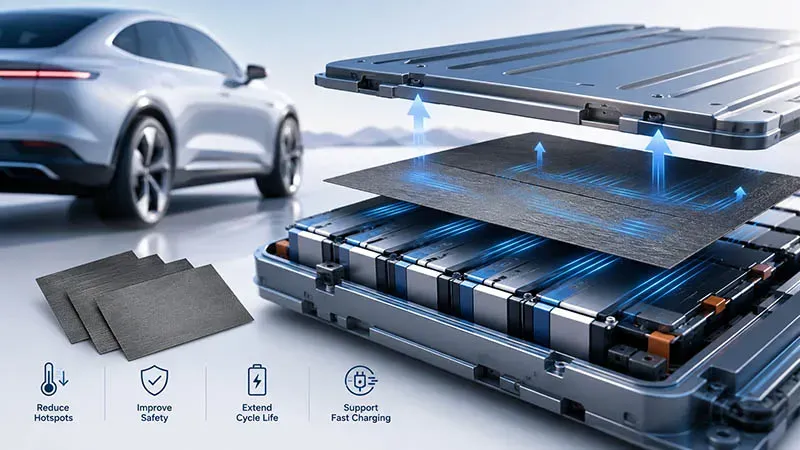
Reading Notes: Graphite Heat dissipation for new energy vehicle batteries
➔ Conductivity Edge: Graphite’s high in-plane thermal conductivity evens out hotspots, cutting peak temperatures by up to 35%.
➔ Layered Pathways: Its crystalline layers channel heat laterally, while graphene alignment technology directs heat transfer along the thickness direction, creating a highly efficient heat dissipation channel.
➔ Composite Integration: From powders to sheets, graphite interfaces link cells to cooling systems without added weight.
➔ Performance Gains: Lower thermal gradients boost safety, extend cycle life, and support rapid charging with stable pack temperatures.
How Graphite Improves Battery Cooling By 35%
Graphite Heat dissipation for new energy vehicle batteries has become a practical topic as EV packs grow more powerful. By combining graphite, heat dissipation design, battery cooling, and new energy vehicle battery engineering, manufacturers can control heat more effectively and maintain steadier operating temperatures.
Understanding Graphite’s Thermal Conductivity Advantage
The strength of Graphite Heat dissipation for new energy vehicle batteries begins with thermal conductivity and efficient heat transfer.
Core material behavior
· High phonon transport inside the crystalline structure helps heat move rapidly.
· Strong material properties support demanding operating cycles.
Battery benefits
· Reduced hotspots.
· Better thermal management.
· More stable high performance output.
For Graphite Heat dissipation for new energy vehicle batteries, heat spreads across a wider area instead of remaining concentrated in a small region. That simple change can noticeably improve temperature uniformity.
Layered Graphite Structures for Efficient Heat Paths
The effectiveness of Graphite Heat dissipation for new energy vehicle batteries is closely tied to its layered structure.
· Graphene layers create directional movement of heat.
· Efficient heat paths reduce localized heating.
· A well-designed thermal interface improves contact between components.
Nested design priorities:
· Material architecture:Anisotropic conductivity guides heat laterally.
· Surface performance:Faster thermal spreading across cell surfaces.
· Engineering outcome:Smarter material design for EV battery modules.
Graphene Thermal Pads: Vertically Oriented Thermal Conductivity
Key features of Sheen Technology graphene thermal pads:
· Vertically oriented thermal conductivity.
· High compressibility and high resilience.
· Low thermal resistance.
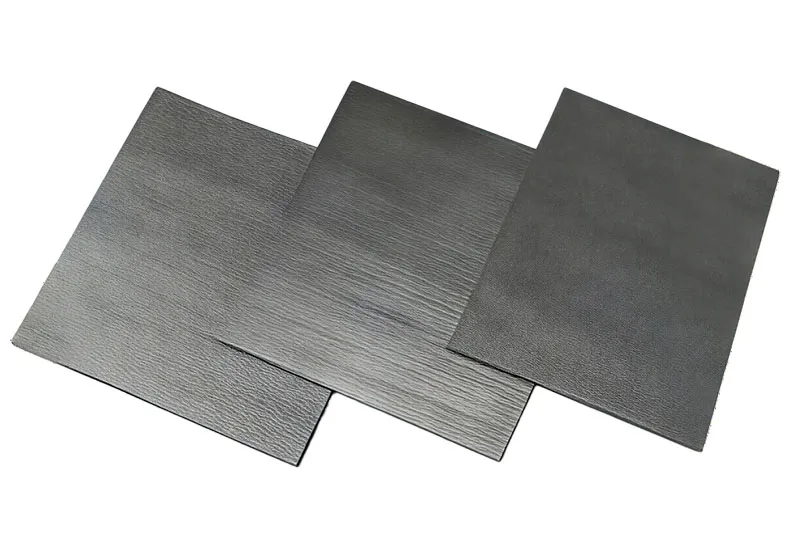
Sheen Technology supports advanced thermal solutions where material integration and the manufacturing process are optimized for efficient battery cooling performance.
| Properties | Unit | GSF75-03 Graphene Thermal Pad | GSF90-03 Graphene Thermal Pad | Test Method |
| Color | - | Black | Black | Visual |
| Thermal Conductivity (vertical orientation) |
W/m·K | 75 | 90 | ASTM E1461 |
| Thermal Resistance (@40psi) | ℃*cm2/W | ≤0.12 | ≤0.10 | ASTM D5470 |
| Thickness | mm | 0.3~2.0 | 0.3~2.0 | ASTM D374 |
| Density | g/cm³ | 0.3~0.7 | 0.3~0.7 | ASTM D792 |
| Rebound Rate | % | ≥90 | ≥90 | - |
| Tensile Strength | Mpa | ≥0.03 | ≥0.05 | ASTM D412 |
| Oil Bleeding Rate | % | ≤3 | ≤3 | / |
| Application Temperature | ℃ | -40~150 | -40~150 | / |
| Flame rating | - | V-0 | V-0 | UL 94 |
Real-World Impact on Battery Pack Temperature
In real driving conditions, Graphite Heat dissipation for new energy vehicle batteries contributes to safer operation and longer service life.
Vehicle level
· Lower battery pack peak temperatures.
· Better temperature regulation.
Safety level
· Reduced risk associated with thermal runaway.
Performance level
· Improved thermal performance in new energy vehicles.
· Extended battery life.
· Higher system efficiency.
✓ Cooler packs.
✓ More consistent charging behavior.
✓ Better long-term durability.
Sheen Technology continues to promote Graphite Heat dissipation for new energy vehicle batteries through practical thermal solutions that help EV systems operate with greater stability and efficiency.
Need exact thermal conductivity, thermal resistance, compression characteristics, and battery-pack thermal management data before selecting a cooling solution? Download the product datasheets to compare graphite and graphene thermal materials designed for new energy vehicle battery systems.
3 Key Reasons To Choose Graphite Heat Dissipation
Graphite Heat dissipation for new energy vehicle batteries is gaining attention because battery packs must handle higher power and tighter packaging demands. By combining fast thermal control, low weight, and practical production methods, graphite heat dissipation solutions help new energy vehicle batteries stay cooler during demanding use.
Ultra-High Conductivity: Faster Heat Removal
Core advantage:
· thermal conductivity allows graphite heat dissipation materials to spread heat rapidly across a wider area.
· The vertical alignment process of the graphene enhances heat transfer along the thickness direction, shortening the heat dissipation path.
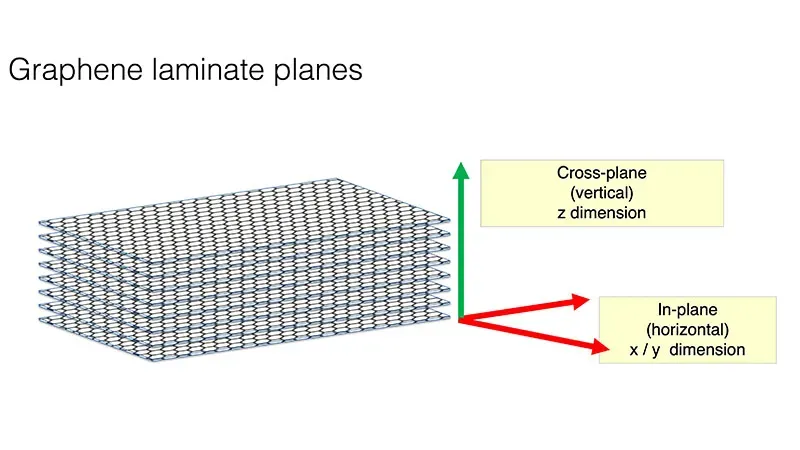
During high-load operation:
· Hotspots form quickly.
· Graphite Heat dissipation for new energy vehicle batteries helps move heat away from critical cells.
· Better heat removal contributes to stronger thermal management performance.
Resulting benefits:
· Enhanced dissipation efficiency.
· More consistent thermal performance during charging and discharging.
· Reduced thermal stress on surrounding components.
In practical EV use, graphite heat dissipation and battery heat management work together to keep temperatures more even, which is a big deal when power demand suddenly rises.
Lightweight Design for EV Package Optimization
For vehicle designers, every kilogram matters. Graphite Heat dissipation for new energy vehicle batteries supports weight reduction without sacrificing cooling capability.
Design value:
· lightweight material properties help lower pack mass.
· Improved mass efficiency supports vehicle range goals.
Integration advantages:
· Easier EV battery packaging.
· Better vehicle integration in space-constrained platforms.
· Greater design optimization flexibility.
A thinner thermal layer can contribute to a more compact design, allowing graphite thermal solutions to fit modern battery architectures while maintaining effective heat control.
Scalable Manufacture with Cost-Effective Materials
Production pathway:
· Raw graphite is prepared through efficient material sourcing channels.
· Materials are converted into films or composites through a scalable manufacturing process.
· Components move into volume manufacturing with consistent quality.
Business advantages:
· Strong production efficiency.
· Support for industrial scale deployment.
· Reduced reliance on heavier metal alternatives.
Because Graphite Heat dissipation for new energy vehicle batteries can be produced through scalable production methods using cost-effective materials, manufacturers can expand output without dramatically increasing costs. Graphite Heat dissipation for new energy vehicle batteries therefore offers a practical route toward broader adoption of advanced battery cooling systems in the growing EV market.
Need a closer match for your project? Browse related application pages to see how graphite sheets and graphene thermal pads are used in EV battery packs, battery management systems, power electronics, energy storage systems, and other high-power thermal management applications.
Fast Charging: Graphite’s Rapid Heat Dissipation
Fast charging puts extra thermal pressure on electric vehicle batteries, so heat control becomes a big deal. In practical battery design, Graphite Heat dissipation for new energy vehicle batteries helps spread heat quickly and evenly. This approach supports battery stability, improves charging behavior, and keeps temperatures under better control when charging speeds climb.
Preventing Hot Spots during High-Rate Charging
During high-rate charging, heat can build up rapidly inside battery cells. Effective graphite pathways improve thermal conductivity and encourage balanced heat distribution.
Heat generation stage
· Rising current increases internal resistance heating.
· Sharp temperature gradients may appear near active regions.
Heat spreading stage
· Graphite layers transfer energy across neighboring areas.
· Reduced localized overheating lowers stress on cell materials.
Result
· Fewer hot spots.
· Better support for Graphite Heat dissipation for new energy vehicle batteries and related battery thermal dissipation strategies.
Maintaining Optimal Cell Temperature Consistency
Consistent cell temperature improves charging efficiency across a battery pack. Through enhanced heat transfer inside graphite layers, thermal energy moves more evenly.
| Condition | Temperature Difference (°C) | Relative Charge Acceptance (%) |
| Limited heat spreading | 8.5 | 88 |
| Moderate heat spreading | 5.2 | 92 |
| Enhanced graphite design | 2.8 | 97 |
| Optimized thermal control | 1.5 | 99 |
A well-designed thermal management system promotes thermal uniformity, helping cells operate closer to optimal performance. In everyday terms, the pack stays more balanced instead of having a few cells working much harder than others. Graphite Heat dissipation for new energy vehicle batteries contributes directly to that balance.
Extending Cycle Life under Fast-Charge Conditions
Frequent fast charging can accelerate battery degradation if heat remains concentrated.
· Lower thermal stress:Reduces expansion and contraction damage.
· Improved electrode stability:Protects the graphite anode during repeated charging cycles.
Long-term effects
· Better performance retention.
· Increased cycle life and overall longevity.
This is one reason graphite heat dissipation systems are widely considered in modern electric vehicle battery designs.
Safety Benefits of Stable Thermal Management
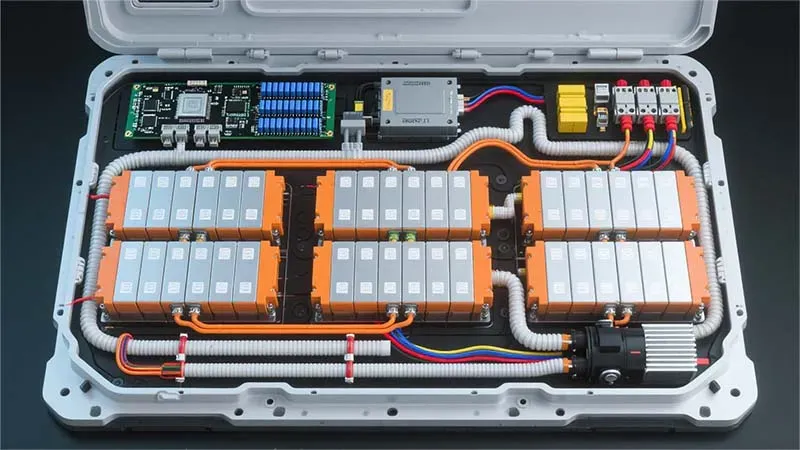
Reliable battery safety depends heavily on temperature control.
· Reduced overheating prevention challenges during rapid charging.
· Lower probability of conditions associated with thermal runaway.
· Improved resistance to fire risk and explosion prevention concerns.
At a deeper level:
Stable operation
· Effective stable thermal management keeps temperatures within safer ranges.
· Advanced graphite materials distribute heat before dangerous accumulation occurs.
System outcome
· Higher system reliability.
· Safer use of Graphite Heat dissipation for new energy vehicle batteries under demanding charging conditions.
【Request a Custom Quote】 Not sure which graphite sheet or graphene thermal pad is best suited for your EV battery pack, battery management system, energy storage project, or power electronics application? Send us your battery architecture, operating temperature range, target thickness, and thermal performance requirements, and we can help recommend the right thermal management solution for your project.
Sheen Thermal
Dongguan Sheen Electronic Technology Co., Ltd · Founded in 2008
Manufacturer of thermal interface materials and silicone foam for automotive electronics, energy storage, power electronics, communications and consumer electronics.
Certified
- ISO 9001:2015
- ISO 14001:2015
- IATF 16949:2016
What we supply
- Thermal conductivity Up to 90 W/m·K
- Thickness 0.3–10.0 mm
- Custom & samples Die-cut to drawing, 3–7 days