
 English
 usheenthermal

How to Decide Between Thermal Pads vs Thermal Paste for Optimal Cooling
Date:2026-07-25
When it comes to cooling electronics at production scale, the thermal pads vs thermal paste decision carries significant implications — engineering teams and procurement departments weigh cost efficiency against long-term reliability in every new product design. The choice isn't binary. It depends on thermal design parameters, manufacturing scalability, and projected lifecycle performance.
As noted in Sheen Technology's 2025 Q2 engineering report, TIM material selection directly impacts both thermal performance and production yield rates across automated assembly lines. This is a business-critical engineering decision affecting product reliability, warranty costs, and time-to-market.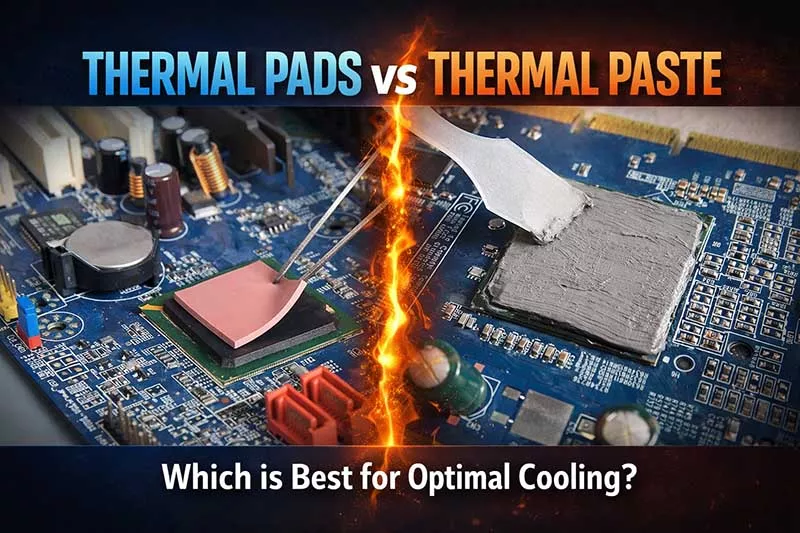
Thermal Pads vs Thermal Paste: Core Differences Explained
From a manufacturing engineering standpoint, thermal pads offer repeatable thickness and simple integration with pick-and-place automation — critical for high-throughput SMT assembly lines. Thermal paste provides superior conformability to surface irregularities but requires controlled dispensing parameters (pressure, speed, nozzle geometry) to maintain consistency across production units.
Understanding Thermal Interface Materials: Pads and Paste Compared
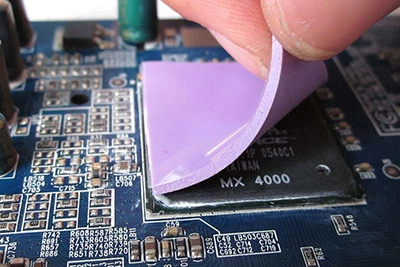
.webp "Thermal pad")
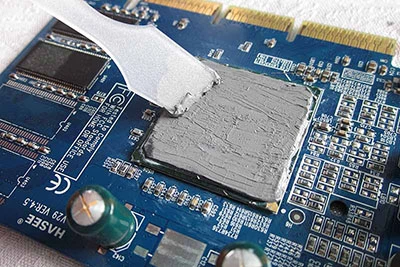
.webp "thermal paste")
- Thermal pads are semi-solid sheets made to bridge gaps between chips and heatsinks.
- Thermal paste, on the other hand, is a gooey compound that fills microscopic surface imperfections.
Engineering Comparison Table:
| Parameter | Thermal Pad | Thermal Paste |
| Application method | Peel-and-place (automation-friendly) | Dispensing / screen printing / stencil |
| Gap-filling capability | Pre-defined thickness; limited compressibility | Fills micron-level irregularities |
| Rework complexity | Low (removable, replaceable) | Requires solvent cleaning |
| Process control | Incoming QC on thickness & hardness | In-line viscosity monitoring |
| Min bondline | Typically >= 0.2 mm | Can achieve < 25 um |
| Electrical insulation | Available (ceramic-filled variants) | Generally non-insulating |
| Shelf life | 24+ months stable | 6-12 months (FIFO required) |
Both are types of Thermal Interface Materials (TIMs) used to boost heat transfer efficiency. Now, when you're comparing these two, think about this: pads are easy to slap on, but pastes need careful handling.
Key Attributes: Thermal Paste vs Phase Change Material
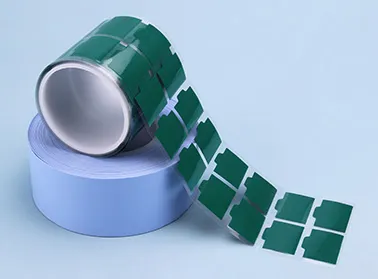
- Silicone Thermal Paste offers reliable results over time but takes finesse during application.
- Phase Change Material, though more forgiving at first touch, needs heat cycles to kick into full performance mode.
Phase change materials (PCMs) occupy a distinct middle ground. At room temperature they handle like a solid thermal pad for easy positioning and alignment. Upon reaching activation temperature (typically 45-65 ℃), the material softens and flows into surface asperities, achieving paste-level wetting without the application complexity.
This dual-state behavior makes PCMs particularly suited for: automotive power modules where thermal cycling is extreme and long-term pump-out resistance is essential; IGBT and MOSFET assemblies requiring consistent bondline thickness across high-volume production; and applications where paste dispensing introduces lot-to-lot variability. Sheen Technology's phase change thermal pads are engineered with precisely controlled phase-transition temperatures.
TIM Selection by Industry: Engineering Application Scenarios
- Power Electronics & Automotive: Power modules in EV inverters, onboard chargers, and DC-DC converters operate under extreme thermal cycling (-40 to +150 ℃). Electrically insulating thermal pads with UL 94 V-0 and high dielectric strength serve dual-function thermal management and electrical isolation. Phase change materials are increasingly adopted for IGBT and SiC MOSFET modules where 10+ year pump-out resistance is critical.
- Telecom & 5G Infrastructure: Base station power amplifiers and RF modules demand TIMs maintaining performance across 7-10 years of outdoor operation. Silicone-free thermal pads are preferred in sealed enclosures where siloxane outgassing could contaminate optical surfaces or relay contacts.
- Server & Data Center: CPU/GPU management favors high-performance thermal paste (5-8 W/m-K) at the die level; thermal pads handle VRMs, memory, chipset. Decision factors: thermal resistance under 50-80 psi, liquid cooling cold plate compatibility, and field serviceability.
- LED Lighting & Display: Mid-power LED arrays rely on electrically insulating thermal pads between MCPCB and aluminum housing. Critical specs: UL 94 V-0, consistent thickness across large-area applications, and cost efficiency at 100K+ units/month.
- Medical Devices & Instrumentation: TIMs for diagnostic imaging, patient monitors, and lab analyzers require documented biocompatibility and 7+ year stability. Silicone-free formulations often mandated where outgassing interferes with optical or chemical sensors.
When Should You Replace Your TIM?
- Pump-out failure: Paste migrates from interface under repeated thermal cycles. Dominant failure in power-cycling. PCMs and cross-linked pads show lower rates (validated per JEDEC/AEC-Q200).
- Dry-out: Volatile components evaporate; high cross-link density silicone pads resist dry-out for 3,000+ hours at 125 ℃.
- Accelerated life testing: 1,000-3,000 cycles between -40 and +125 ℃. Rth drift >20% from baseline = inadequate for 5+ year service life.
- Production rework: Pads lift off cleanly; paste removal adds labor cost and requires validated cleaning procedures.
- Shelf life management: Paste: 6-12 months (FIFO with lot traceability); Pads: 24+ months stable.
Common Process Defects in TIM Application — Manufacturing Quality Control
- Over-dispensing: Implement automated vision inspection or weight verification at dispensing stations. Target volume: +/-5% of spec.
- Pad compression variance: Specify Shore 00 hardness; validate with pressure-sensitive film during prototype builds.
- Surface contamination: Documented cleaning protocols; verify with dyne testing.
- Material incompatibility: Enforce material segregation on production floor.
- Storage-induced defects: Audit incoming viscosity against CoA before releasing to production.
How to Applying Thermal Paste → https://www.sheenthermal.com/how-to-properly-apply-thermal-paste.html
Thermal Interface Material Selection Framework — An Engineer's Decision Matrix
| Design Requirement | Recommended TIM | Rationale |
| High conductivity (>6 W/m-K) | Performance paste or carbon fiber pad | Max heat transfer at die/power device level |
| Electrical insulation needed | Boron nitride or ceramic-filled pad | Dual-function: thermal + dielectric >6 kV/mm |
| Automated high-volume assembly | Die-cut pad or PCM | Pick-and-place compatible; zero cure time |
| Large gap tolerance (>1 mm) | Thermal gel / gap filler | Conformable without component stress |
| Silicone-free required | Silicone-free pad or grease | Prevents siloxane contamination |
| Rework-intensive product | Thermal pad | Clean removal; no solvent or residue |
| Thin bondline (<25 um) | Low-viscosity paste | Minimal Rth at cost of tighter process control |
| Extreme cycling (-40 to +200 deg C) | PCM or high-temp silicone pad | Resists pump-out and dry-out |
Sheen Technology application engineers can provide material samples, thermal simulation, and on-site process validation.
Thermal Conductivity: Heat Transfer Performance of Pads and Paste
Getting the best heat transfer? It’s all about choosing right between thermal pads and thermal paste.
Measuring Thermal Conductivity Performance: Testing Methods & Standards
When it comes to comparing thermal paste vs thermal pads, standardized testing is the only way to separate guesswork from real data. Here’s how it’s done:
- ASTM D5470 is the gold standard for measuring thermal resistance under pressure.
- Other common standards include ISO 22007 and ASTM E1530, especially when dealing with thin-film materials.
- Lab setups simulate real-world mounting pressures, making results more relevant for electronics.
- Test results are usually expressed in watts per meter-kelvin (W/m·K)—higher is better.
Sheen Electronic Technology uses calibrated equipment that aligns with global benchmarks, ensuring performance data you can trust.
The Role of Viscosity and Consistency in Heat Transfer
Viscosity isn’t just a fancy ter, it decides how your material behaves under pressure. For example:
- A thick thermal paste might resist spreading, but fills micro gaps better than rigid pads.
- Low-viscosity pastes can be messy but are easier to apply evenly across CPUs or GPUs.
And here's the kicker—viscosity also affects reusability. Pastes dry out over time; pads tend to stay stable longer unless exposed to high temps or compression cycles.
Comparing Electrical Insulation Capability in Thermal Solutions
Let’s talk safety—not just heat flow. Some applications need electrical isolation as much as thermal conductivity.
Specify: dielectric breakdown voltage (6-15 kV/mm, with safety margin per IEC 60950/IEC 62368), volume resistivity (>10^12 ohm-cm), PDIV for traction inverters, halogen-free per IEC 61249-2-21, UL 94 V-0. Sheen Technology's Boron Nitride Thermal Pad and Thermal Conductive Insulating Pad offer isolation combined with conductivity up to 6 W/m-K.
How Operating Temperature Range Affects Material Performance
- Thermal pastes, especially those loaded with metal oxides or ceramics, handle extreme temps above 150°C without breaking down.
- But they can dry out over time if exposed too long at peak loads.
- In contrast, most thermal interface pads maintain integrity between –40°C to +125°C—ideal for moderate environments like laptops or embedded boards.
- High-temp silicone variants exist but often sacrifice flexibility or insulation quality.
- Choosing wrong means degraded performance over time—even if things seem fine at first boot-up.
So next time you're balancing cost vs performance in the "thermal pads vs thermal paste" debate, remember: temps don't lie—and neither does degraded silicone.
Long-Term Stability: Thermal Pads vs Thermal Paste
Thermal interface materials age differently. Let’s unpack how each holds up under pressure, time, and heat.
Long-Term Stability Reliability: What to Expect from Each Material
When comparing thermal pads vs thermal paste, durability is where things get interesting:
Thermal Pads
- Hold their shape over time with minimal degradation.
- Offer steady conductivity across years of use.
- Less prone to air gaps forming due to hardening or shrinkage.
- Often rated for long-term reliability in industrial environments.
Thermal Paste
- Can dry out depending on ambient temperature and humidity.
- May require reapplication every few years—especially under heavy loads.
- Some high-end pastes retain performance better but still face gradual decline.
- Susceptible to pump-out effect, reducing effective surface contact.
If you want a “set it and forget it” solution, pads win the long-game. But if you’re chasing peak thermal performance now—even if it means redoing things later—paste holds its own.
Curing Process Impacts: The Importance of Quality Inspection Protocols
Not all thermal compounds are ready right out of the tube—or pad.
- Some phase-change materials need a heat cycle to fully activate their bonding properties. This “curing” process ensures optimal surface adhesion and fills microscopic voids between surfaces.
- Without proper manufacturing oversight, inconsistencies like uneven thickness or trapped air can cause early failures. That’s why rigorous inspection protocols during production matter more than most realize.
So whether you're using a pad or paste, make sure your supplier has solid QC practices baked into their production line—and always keep an eye out for voids and irregularities post-installation.
Storage and Handling Guidelines for Optimal Longevity
Step 1 – Store thermal paste in an airtight container at room temperature (ideally below 25°C). Exposure to oxygen leads to premature drying and loss of viscosity.
Step 2 – Keep away from direct sunlight or fluctuating humidity levels; both can mess with chemical stability over time.
Step 3 – For thermal pads? Way easier. Just avoid folding them sharply or exposing them to dust before installation—they’re much less sensitive overall when it comes to storage conditions.
In short, when comparing thermal pads vs thermal paste in terms of shelf life and ease-of-use before deployment, pads are practically foolproof while pastes need babysitting if you're planning on keeping them around awhile.
Cost Analysis: Thermal Pads vs Thermal Paste at Scale
Understanding the price-performance tradeoffs in large-scale cooling solutions helps teams make smarter procurement calls.
Bulk Packaging Solutions: Evaluating Cost-Effectiveness
When you're buying thermal interface materials in bulk, every cent counts—and packaging plays a bigger role than you'd think.
Storage Efficiency & Format Variety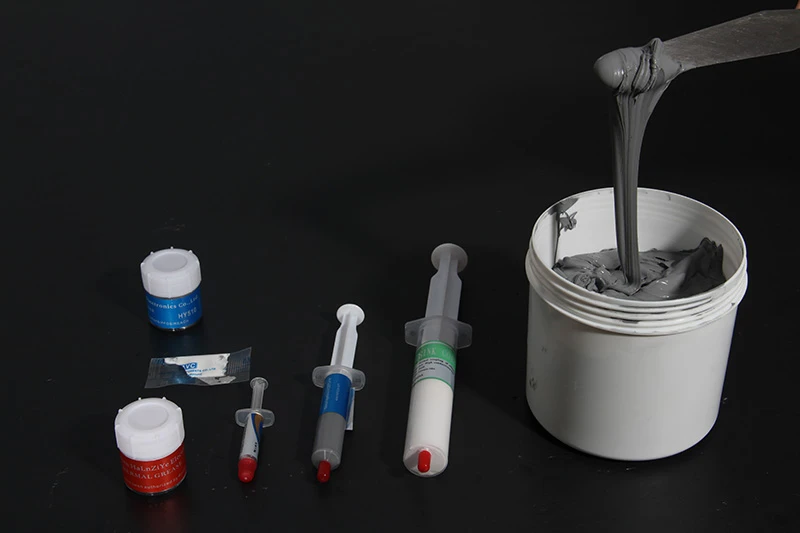
- Thermal paste often comes in jars, syringes, or industrial cartridges, each offering different cost-per-use ratios.
- Thermal pads, on the other hand, are usually pre-cut and stacked—less mess but less flexible sizing.
Waste Reduction & Labor Costs
- Bulk paste containers reduce individual packaging waste but may require skilled application tools.
- Pre-sized pads minimize trimming time and errors during installation.
Shipping & Handling
- Paste in bulk weighs less per gram of usable material due to minimal packaging overhead.
- Pads can be heavier and more rigidly packed, increasing freight volume costs over time.
Total Cost of Ownership (TCO) Framework:
| Cost Factor | Thermal Paste | Thermal Pad |
| Material unit cost | Lower per gram | Moderate to higher |
| Application equipment | Dispensing robot ($15K-80K) | Standard pick-and-place (existing) |
| Assembly labor/unit | Medium (setup + cleaning) | Low (automation-ready) |
| Rework cost/incident | High (solvent + re-dispense) | Low (peel and replace) |
| Scrap/waste rate | 3-8% | <2% |
| QC inspection cost | Medium (coverage check) | Low (presence/absence) |
| Field failure risk (5yr+) | Higher pump-out/dry-out | Lower degradation |
| Inventory write-off risk | Higher (6-12mo shelf) | Lower (24+mo shelf) |
Custom Packaging Requirements: What Matters for Large Purchases
Big orders don’t just need more product—they need smarter delivery formats that scale with production needs.
- Want clean application? Syringe-style dispensers with precision tips help avoid overuse.
- Need speed? Stencil-based paste deployment reduces human error and boosts throughput.
- Prefer zero waste? Go for pre-cut thermal pads tailored to your device specs—no trimming needed.
- Concerned about shelf life? Vacuum-sealed cartridges preserve thermal paste longer under factory conditions.
Sheen Electronic Technology offers both customizable cartridge systems and die-cut pad kits that simplify integration into automated workflows—ideal for OEMs scaling up without sacrificing performance or consistency across batches.
Ready to optimize your thermal management design?
- Download Thermal Pad Datasheet Selection Guide: https://www.sheenmaterials.com/resource/datasheet-download/
- Refer to The Application Page for Details: https://www.sheenmaterials.com/applications/
- Schedule Technical Consultation: https://www.sheenthermal.com/feedback.html
FAQs about Thermal Pads vs Thermal Paste
1. How are thermal pads and thermal paste used differently in electronics manufacturing?
- Thermal Pads – pre-cut sheets with repeatable thickness for automated assembly, large-area heat spreading, and electrical isolation. Preferred in power electronics, automotive, LED, telecom. Thermal Paste – conformable TIM via dispensing/stencil for finely machined surfaces requiring bondline
- Thermal Pads – solid, ready-cut sheets that bridge uneven gaps; suited to GPU thermal management, larger spreads, or spaces where quick application replaces delicate handiwork.
Thermal Paste – a pliable thermal interface material spread with care through a precise application method, perfect for finely honed CPU surfaces needing intimate contact for peak thermal conductivity performance.
2. Which has better long-term reliability under constant operation?
- Conductive silicone grease (paste) can dry with age unless stored following strict storage and handling guidelines, often in sealed syringe packaging options.
- Phase change materials and pads tend to hold form longer—resisting creep during years of service in power amplifier cooling or LED setups where reapplication is undesirable.
3. Why does viscosity matter when ordering large batches?
- For automated dispensing systems or stencil application machines, consistent viscosity keeps distribution even across thousands of units per shift.
- High-viscosity pastes hug microscopic grooves—a trait prized by those fine-tuning CPU heat dissipation, while pads arrive already “fixed” in thickness but lack fluid adaptability on micro scales.
4. How should operating temperature range guide choice at scale?
A clear branch line separates uses: wide-range paste formulations endure extreme cycling—think heavy-load GPUs bouncing between hot benchmarks and idle cool-downs—while fixed-form pads excel within moderate windows like steady LED lighting panels or modest semiconductor device cooling projects.
5. Why consider electrical insulation features when buying thousands of units?
- Halogen-free insulating pads shield against shorts while managing heat on tight boards.
- Pastes vary; certain formulas lack inherent insulation, requiring an added epoxy bonding adhesive barrier if brushing close to live traces during assembly near high-voltage paths.
Sheen Thermal
Dongguan Sheen Electronic Technology Co., Ltd · Founded in 2008
Manufacturer of thermal interface materials and silicone foam for automotive electronics, energy storage, power electronics, communications and consumer electronics.
Certified
- ISO 9001:2015
- ISO 14001:2015
- IATF 16949:2016
What we supply
- Thermal conductivity Up to 90 W/m·K
- Thickness 0.3–10.0 mm
- Custom & samples Die-cut to drawing, 3–7 days