
 English
 usheenthermal

How to Select the Right IGBT Module Thermal Interface Material
Date:2026-08-21
Choosing the right IGBT module thermal interface material can make or break performance; flashy conductivity numbers tell only half the story.
Grease, pads, phase-change films, graphite, and adhesives behave differently under pressure, heat, and production. Buyers need dielectric fit, aging stability, and factory-friendly packaging.
IEA’s Global EV Outlook 2025 reports that electric-car sales continued growing globally, with emerging markets becoming increasingly important growth centers.
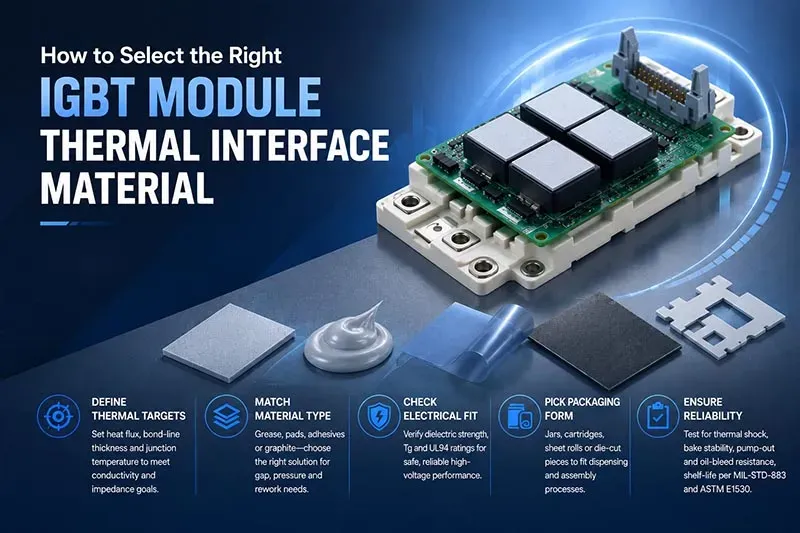
This image is a conceptual illustration and does not represent the actual appearance, size, or internal structure of the product.
Key Insights into IGBT Module Thermal Interface Material
-> Define thermal targets: calculate heat flux, bond-line thickness, and allowable junction temperature to set conductivity and impedance goals.
-> Match material type: choose grease, pad, adhesive, or graphite based on gap size, pressure, and rework needs.
-> Check electrical fit: verify dielectric strength, glass transition temperature, and UL94 ratings for safe high-voltage use.
-> Pick packaging form: select jars, cartridges, sheet rolls, or die-cut pieces to suit dispensing and assembly methods.
-> Ensure reliability: test for thermal shock, bake stability, pump-out and oil-bleed resistance, and shelf-life per MIL-STD-883 and ASTM E1530.
5 Crucial Steps To Pick Your IGBT Module Thermal Interface Material
Choosing the right IGBT module thermal interface material starts with heat and electrical needs, then gets practical fast. The right thermal interface helps an IGBT module run cooler without making production a headache. Sheen Technology can support material selection around performance, assembly, insulation, and long-term service demands.
| Step | Action | Key Spec | Standard |
| 1 | Define thermal targets (heat flux, BLT, junction temp) | Conductivity, impedance | ASTM D5470 |
| 2 | Select material type (grease/pad/ adhesive/graphite) | Gap size, rework needs | — |
| 3 | Verify dielectric + glass transition | Dielectric strength, Tg | ASTM D149 |
| 4 | Choose packaging form | Jar/cartridge/roll/die-cut | — |
| 5 | Confirm reliability (aging, pump-out, thermal shock) | MIL-STD-883, thermal shock, oil bleed | IEC 60068-2-14 |
Step 1: Define Required Thermal Conductivity and Impedance Targets
Start with the thermal load.
- Calculate heat flux, bond-line thickness, and allowable junction temperature.
- Compare thermal conductivity, thermal impedance, and resulting thermal resistance using ASTM D5470, ASTM E1530, or ISO 22007 data. That keeps heat dissipation targets grounded in measured performance.
Step 2: Select Appropriate Material Type (Grease, Pad, Adhesive, Graphite)
IGBT module thermal interface material choices depend heavily on the physical gap.
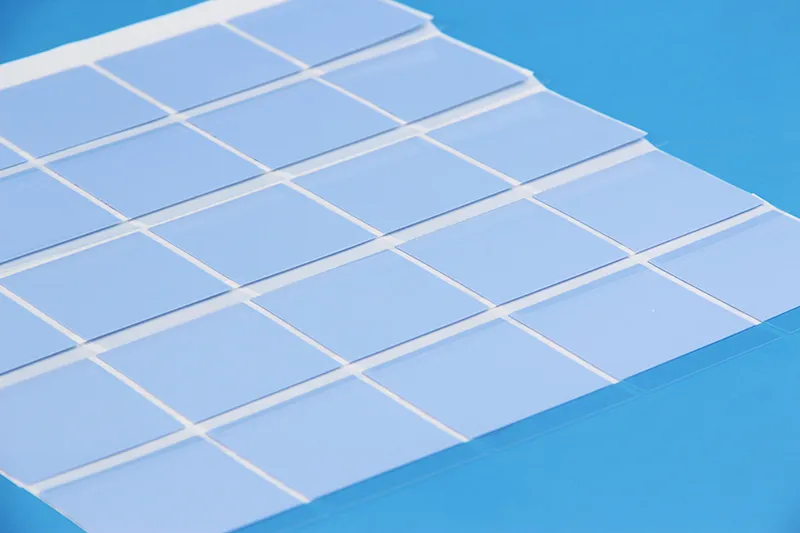
For thin interfaces:
- thermal grease or phase change material can provide close surface contact.
- A graphite sheet suits applications needing high in-plane heat spreading.
For larger gaps:
- A thermal pad, silicone elastomer, or gap filler handles tolerance changes.
- Conductive adhesive adds bonding when rework is less important.
Step 3: Verify Dielectric Strength and Glass Transition Temperature
Check electrical safety.
- Match dielectric strength, breakdown voltage, and withstanding voltage to module voltage.
Check heat limits.
- Review glass transition temperature, thermal stability, operating range, polymer matrix, and UL94 rating when electrical insulation is required.
Step 4: Choose Optimal Packaging Form: Jar, Cartridge, Sheet Roll, or Die-Cut Piece
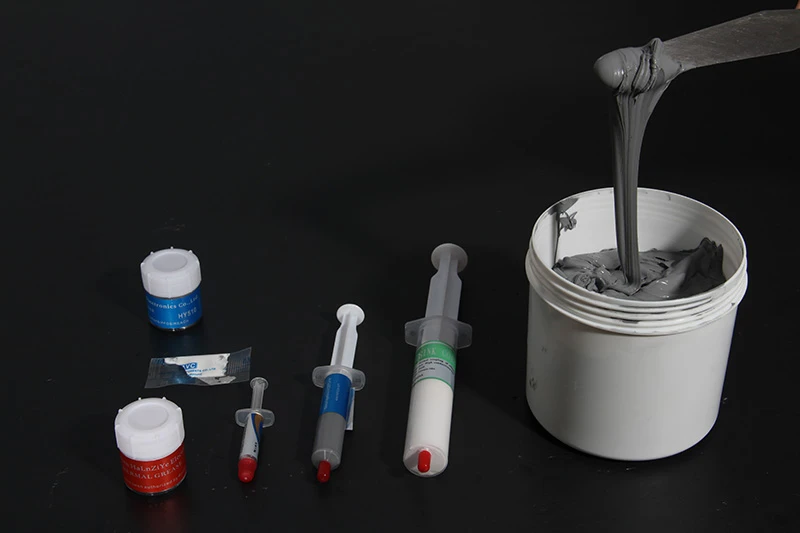
Match packaging form to the application method: a dispensing jar or cartridge supports printing and dispensing, while a sheet roll or die-cut piece makes interface thickness easier to repeat.
Step 5: Confirm Reliability Parameters in MIL-STD-883 and ASTM E1530
Validate the IGBT module thermal interface material over time.
- Review thermal aging, pump-out, oil bleed, bake stability, shelf life, and cyclic durability.
- Apply MIL-STD-883 for relevant environmental testing and ASTM E1530 as a standard test method for thermal resistance where technically applicable, tying reliability parameters to real service conditions.
4 Key Factors In IGBT Module Thermal Interface Material
Choosing an IGBT module thermal interface material comes down to more than a headline conductivity number. In day-to-day production, IGBT cooling also depends on thickness, electrical safety, curing, and aging. Sheen Technology evaluates these factors together, helping engineers match thermal interface material properties with real operating needs.
Thermal Conductivity vs. Thermal Impedance Trade-Offs
The best IGBT module thermal interface material balances thermal conductivity with low thermal impedance.
Interface design
- Keep material thickness controlled; a thicker layer adds resistance.
- Reduce interface resistance by improving surface contact.
Cooling target
- Match the TIM to expected heat flux and required heat dissipation.
- Use ASTM D5470-style testing under application-relevant pressure rather than chasing conductivity alone.
Comparison of thermal conductivity and thermal resistance of some Sheen Technology products:
| TIM case | Conductivity (W/m·K) | Thickness (mm) | Thermal resistance (cm²·K/W) |
| Thermal paste | 1-5 | - | 0.016-0.05 |
| Phase Change thermal pad | 3-8 | 0.13-0.5 | 0.015-0.05 |
| Silicone thermal pad | 1-15 | 0.2-10.0 | 0.1-0.9 |
| Boron Nitride thermal pad | 16 | 0.2-5.0 | 0.05-0.26 |
The parameters above are for reference only. Parameters may vary for different product models due to different testing conditions.
Viscosity and Dielectric Strength for High-Voltage Modules
For a high-voltage IGBT module thermal interface material, application behavior and insulation need to work hand in hand.
Processing
- Tune viscosity, rheology, and flow behavior for dispensing, screen printing, or stenciling.
Electrical safety
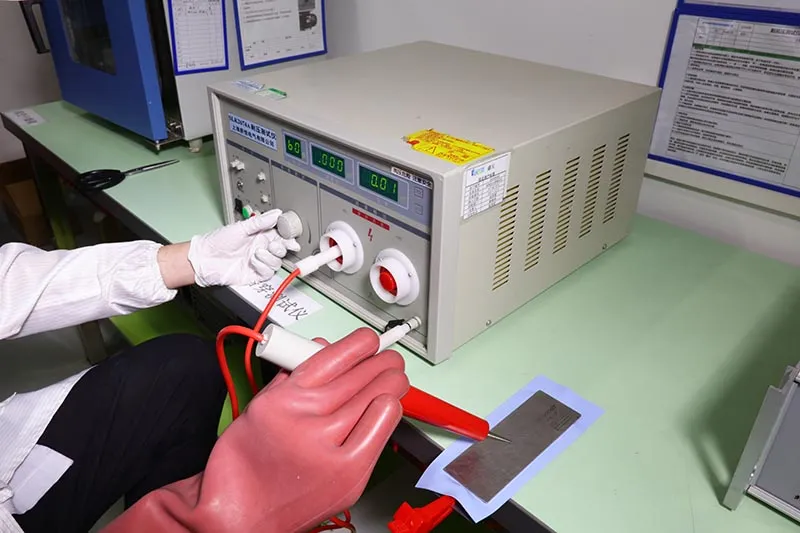
- Confirm dielectric strength and breakdown voltage at the intended thickness.
- Maintain suitable electrical insulation under high voltage without making the bond line needlessly thick.
That balance keeps production practical and cooling on track.
Impact of Curing Process on Bonding and Performance
A curable IGBT module thermal interface material needs a controlled curing process.
Cure control
- Set cure time and temperature according to supplier data.
- Apply pressure consistently where specified.
Performance checks
- Confirm polymerization and cross-linking are complete.
- Measure bonding strength and adhesive force afterward.
Over-curing or incomplete curing can shift thermal impedance and increase thermal stress. Sheen Technology can support thermal conductive adhesive selection around practical assembly conditions.
Long-Term Stability: Bake, Oil Bleed, and Pump-Out Resistance
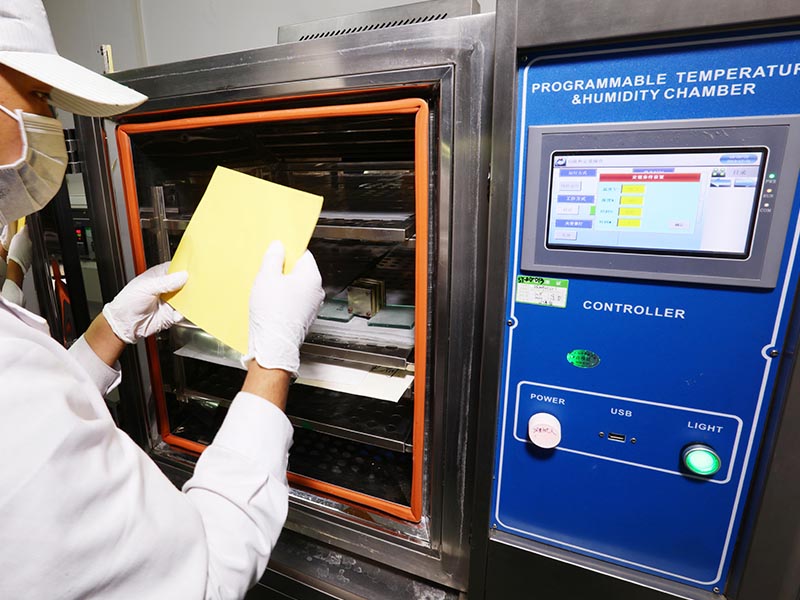
A good IGBT module thermal interface material must stay put after thousands of hot-cold changes, not just look great on day one.
Aging validation
- Run a bake test and extended thermal aging.
- Inspect for oil bleed after high-temperature exposure.
Cycling validation
- Check pump-out resistance through repeated mechanical cycling.
- Track adhesion and thermal performance for signs of drift.
These checks connect long-term stability with real IGBT reliability, while shelf-life testing helps keep production quality consistent.
Gap Pad Vs. Phase-Change Material: Which Works Better?
Choosing an IGBT module thermal interface material comes down to gap size, surface condition, mounting pressure, and insulation needs. Gap pads handle mechanical variation well, while phase-change options favor thin, low-resistance interfaces.
Gap Pad
For an IGBT module thermal interface material facing uneven hardware, a gap pad is often the practical pick. It combines useful thermal conductivity with physical compliance, so real-world assembly tolerances are less of a headache.

Gap handling
- Compressibility allows the material to conform around height differences without requiring extremely high mounting force.
- A generous thickness tolerance helps accommodate IGBT module, heat-sink, and housing variation.
Protection
- Electrical insulation can separate energized components from grounded cooling surfaces.
- A silicone elastomer base can absorb mechanical shock, although excess thickness may increase interface resistance.
Sheen Technology can match thermal pad thickness and insulation properties to motor-drive or converter assembly needs.
Phase-Change Material
Phase-change material takes a different route. Once the operating temperature approaches its melting point, the interface softens, lowering viscosity and improving surface wetting across microscopic rough spots.
During assembly
- The IGBT thermal interface remains easy to position.
- Controlled pressure creates a small bond line thickness.
During operation
- Heating activates the material; latent heat describes energy involved in its phase transition.
- Better contact can reduce thermal impedance, helping heat move from the module toward the cooler.
Across repeated cycles
- Good pump-out resistance matters because thermal expansion can otherwise shift interface material.
For tightly controlled surfaces, this IGBT module thermal interface material can beat a thick thermal pad on thermal resistance.
Overheating Issues? Choose High-Conductivity Thermal Interface Material
Selecting an IGBT module thermal interface material is about more than conductivity. Real thermal management depends on contact quality, pressure, thickness, and aging, so comparing practical thermal behavior keeps high-power hardware from running too hot.
Graphite Sheet for Ultra-High Thermal Conductivity
Graphite is a strong heat spreader, but its direction matters.
For IGBT module thermal interface material selection:
- Check in-plane thermal conductivity for lateral spreading,Flake graphite can support fast anisotropic heat transfer.
- Check through-plane performance too. High interface resistance can wipe out gains,Electrical insulation may be needed around high-power electronics.
So, a huge conductivity number alone doesn’t seal the deal.
Low-Impedance Thermal Grease Formulations
Grease fills microscopic voids, cutting thermal contact resistance at a very small bond-line thickness. For an IGBT module thermal interface material, that’s handy, but long-term behavior counts.

Sheen Technology Low-Impedance Thermal Grease performance properties:
| Properties | Color | Thermal Impedance (@30psi) | Thermal Conductivity | Minimum Interface Thickness |
| Unit | - | ℃*in2/W | W/m·K | mm |
| SG560-10 | White | ≤0.15 | 1.0±0.1 | 0.06 |
| SG560-20 | White/Gray | ≤0.045 | 2.0±0.2 | 0.05 |
| SG560-30 | Gray | ≤0.03 | 3.0±0.3 | 0.05 |
| SG560-40 | Gray | ≤0.02 | 4.0±0.4 | 0.05 |
| SG560-50 | Gray | ≤0.016 | 5.0±0.5 | 0.05 |
| Test Method | Visual | ASTM D5470 | ASTM D5470 | - |
Thin and stable usually beats thick and messy. Need thermal conductivity, thermal impedance, dielectric strength, viscosity, and glass transition temperature data for IGBT module TIMs? Download the product datasheets to compare thermal grease, gap pads, phase change materials, graphite sheets, and thermal conductive adhesives for IGBT modules, automotive inverters, and rail transit power supplies.
Phase-Change Materials Exceeding 5 W/mK
For IGBT module thermal interface material qualification:
Confirm conductivity above 5 W/mK.
- Match the phase-change temperature to operation.
- Review latent heat behavior.
Validate installation.
- Control mounting pressure and final thermal impedance.
- Track viscosity after melting.
Test aging.
- A paraffin matrix with ceramic fillers needs repeated thermal cycling before sign-off.
That keeps this thermal interface option practical, not merely impressive on a datasheet.
Automotive Inverter Design: Choosing The Right TIM
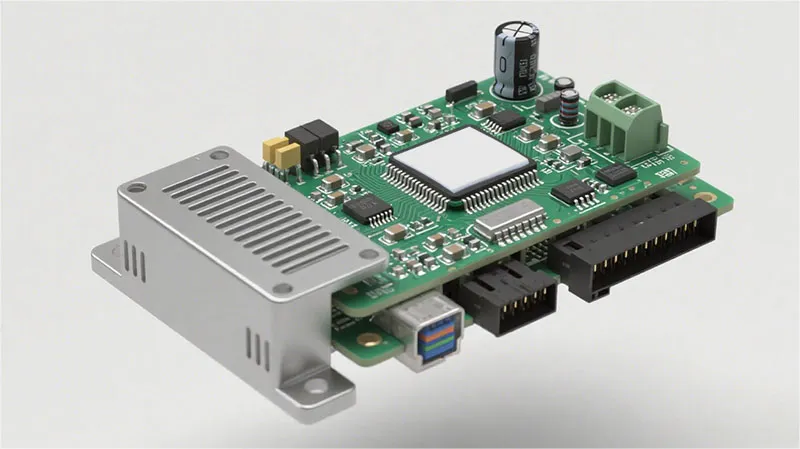
Selecting an IGBT module thermal interface material comes down to heat flow, assembly needs, electrical safety, and long-term durability. The right thermal interface material helps an IGBT module move heat into its cooling system without making production a headache. Sheen Technology offers practical TIM formats for EV, rail, wind, and solar power electronics, so engineers can match material behavior with real operating conditions.
Die-Cut Pieces for Compact Electric Vehicle Inverters
For an electric vehicle inverter, precision die-cut pieces make tight assembly easier.
Fit and cooling
- Controlled dimensions support compact design.
- Good thermal conductivity improves heat dissipation.
Production
- Pre-cut IGBT module thermal interface material supports repeatable automated placement with less trimming and fuss.
Dispensing Thermal Conductive Adhesive in Rail Transit Power Supplies
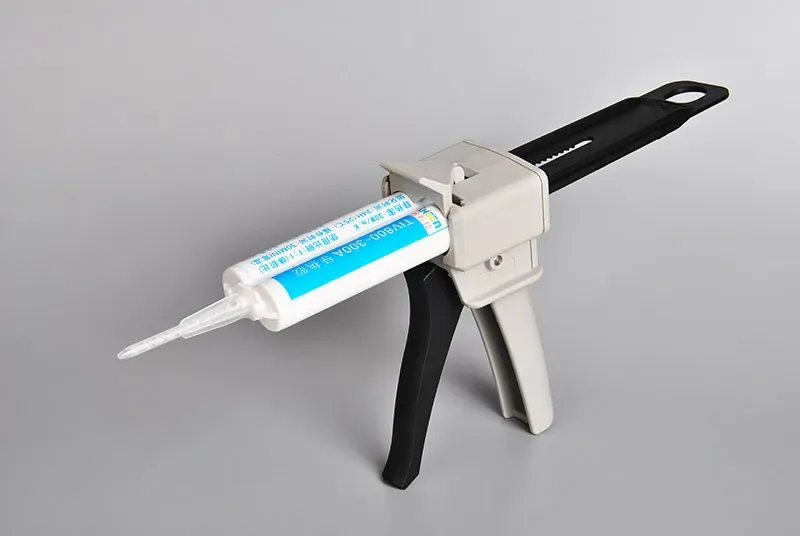
A thermal conductive adhesive can bond an IGBT module directly within a rail transit power supply.
Process control
- Tune the dispensing process for steady bond-line thickness and clean coverage.
Performance
- Check cure conditions for electrical isolation.
- Confirm thermal management and mechanical stability after vibration and temperature cycling.
Sheen Technology can support material selection around dispensing and cure needs.
Evaluating Sheet Roll Pads in Wind Power and Photovoltaic Inverters
For high-volume power electronics, sheet roll pads offer flexible cutting and sizing. Compare options before locking in the design:
- wind power inverter and photovoltaic inverter operating temperatures;
- thermal impedance and conductivity;
- dielectric strength and compression;
- UL94 flammability and long-term reliability.
This evaluation helps match each thermal interface material to its actual load.
Ensuring Thermal Shock Resistance and Shelf Life Stability
Long service life needs proof beyond initial specifications.
Qualification
- Test thermal shock resistance across expected temperature extremes.
- Verify shelf life stability under defined storage conditions.
Inspection
- Track cracking, pump-out, oil bleed, and adhesion loss.
- Measure impedance changes linked to material degradation.
For IGBT module thermal interface material, this reliability testing demonstrates environmental endurance before production. Sheen Technology can help align TIM choices with application and storage demands.
→ Contact Sheen Technology for IGBT TIM Selection Support
Sheen Thermal
Dongguan Sheen Electronic Technology Co., Ltd · Founded in 2008
Manufacturer of thermal interface materials and silicone foam for automotive electronics, energy storage, power electronics, communications and consumer electronics.
Certified
- ISO 9001:2015
- ISO 14001:2015
- IATF 16949:2016
What we supply
- Thermal conductivity Up to 90 W/m·K
- Thickness 0.3–10.0 mm
- Custom & samples Die-cut to drawing, 3–7 days