
 English
 usheenthermal

Advancing EV Battery Safety With Insulating Boron Nitride Thermal Conductive Material
Date:2026-06-23
Advancing EV Battery Safety With Insulating Boron Nitride Thermal Conductive Material
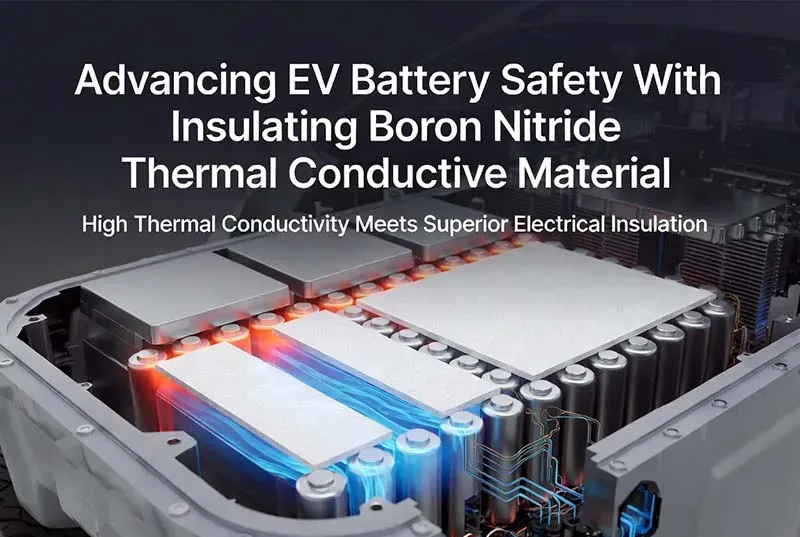
Insulating boron nitride thermal conductive material is the quiet fix for a loud problem: EV batteries getting hot, twitchy, and risky when heat and electricity refuse to play nice.
Most options force a trade, dump heat or block current, not both. This one keeps cool and insulated, fits production lines, and cuts safety headaches they blow up.
Quick Answers: Insulating Boron Nitride Thermal Conductive Material Essentials
1)High thermal conductivity in BN fillers spreads heat evenly, minimizing hotspots in EV batteries and power modules.
2)Superior dielectric strength blocks stray currents, preventing short circuits while maintaining efficient heat dissipation.
3)Hexagonal BN’s inertness and stability resist oxidation and high-temperature degradation for long-term reliability.
4)Optimal integration involves selecting the right BN form, ensuring uniform dispersion, compounding with polymers, plus coating or sintering to boost adhesion.
Can Insulating Boron Nitride Thermal Conductive Material Prevent Fires?
Electric vehicles and high-power electronics are running hotter than ever. With rising battery safety concerns and tighter safety standards, engineers are turning to Insulating boron nitride thermal conductive material to manage heat and cut fire risk. Let’s break down how this ceramic material supports thermal management, improves heat dissipation, and protects critical systems.
Understanding how thermal conductivity reduces hotspot formation
In electric vehicles, preventing thermal runaway starts with smart heat management.
Heat spread inside battery systems
1.1 Cell level
· Insulating boron nitride thermal conductive material enhances heat transfer between cells.
· Reduces localized overheating.
· Stabilizes battery performance.
1.2 Module level
· BN-based thermal interface materials lower contact resistance.
· Promote even temperature control.
With Insulating boron nitride thermal conductive material, heat doesn’t pile up in one weak spot. It spreads out fast, lowering battery degradation and reducing safety concerns in compact packs.
Dielectric strength and electrical insulation in boron nitride powder
Short circuits are silent troublemakers in battery technology.
• High dielectric strength blocks unintended current paths.
• Strong electrical insulation supports dense circuit layouts.
• Reliable performance in LEDs, IGBTs, and EV inverters.
Insulating boron nitride thermal conductive material works as both shield and highway: it blocks electricity while guiding heat away. That balance is rare in advanced materials. For EV designers focused on thermal insulation and cooling at once, this BN thermal conductive filler is a practical fix.
At Sheen Technology, tailored boron nitride formulations align filler loading with real-world temperature control demands.
Download Technical Datasheet to explore the thermal conductivity, dielectric strength, and formulation details behind Sheen Technology’s boron nitride thermal conductive solutions.
High temperature stability and chemical inertness of hexagonal boron nitride
Keeping cool is one thing. Staying stable is another.
Step 1: Endure extreme heat
• Hexagonal BN handles temperatures above 900°C in air, resisting oxidation.
Step 2: Maintain structure
• Its layered crystal form preserves material properties under stress.
Step 3: Support long-term safety
• Integrated into Insulating boron nitride thermal conductive material, it strengthens electric vehicle batteries against thermal runaway escalation.
For manufacturers chasing smarter material innovation, Sheen Technology provides BN solutions that meet rising battery safety targets without sacrificing heat dissipation.
4 Steps to Integrate BN Thermal Conductive Material
Insulating boron nitride thermal conductive material sounds technical, yet the idea is simple: move heat fast, block electricity, keep devices safe. When thermal management fails, hotspots grow, and nobody wants that in EV packs or power modules. Let’s break it down in a practical way.
Step 1: Choosing the optimal boron nitride filler form
Selecting the right Insulating boron nitride thermal conductive material starts with understanding application layers:
Filler geometry
· Powder → easy blending, stable electrical insulation
· Sheets → directional heat transfer
· Films → controlled thermal resistance
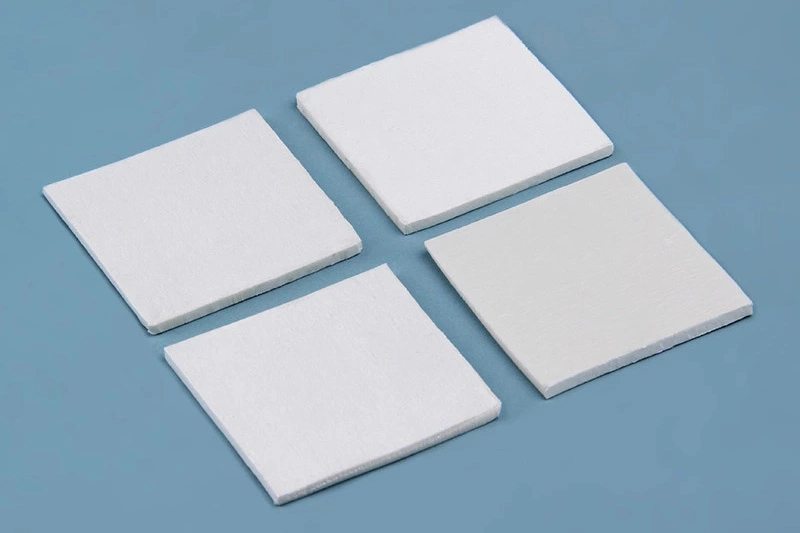
Sheen Technology Boron nitride Thermal Pad performance properties:
| Properties | Unit | BSF1600-03(0.3mm) | BSF1600-05(0.5mm) | BSF1600-07(0.7mm) | Test Method |
| Color | - | White | White | White | Visual |
| Thermal Conductivity | W/m·K | ≥15(linear fitting) | ≥15(linear fitting) | ≥15(linear fitting) | ASTM D5471 |
| Thermal Resistance (@40psi) | ℃*in2/W | ≤0.06 | ≤0.08 | ≤0.1 | ASTM D5470 |
| Thickness | mm | 0.3 | 0.5 | 0.7 | ASTM D374 |
| Breakdown voltage | KV,@AC | ≥3.5 | ≥6 | ≥8 | ASTM D149 |
| Dielectric constant | F/m, @ 1MHz | ≤4.2 | ≤4.2 | ≤4.2 | ASTM D150 |
| Flammability rating | - | V-0 | V-0 | V-0 | UL 94 |
| RoHS | - | PASS | PASS | PASS | IEC 62321 |
| Halogen | - | PASS | PASS | PASS | EN 14582 |
| REACH | - | PASS | PASS | PASS | EN 14372 |
Performance targets
· High dielectric strength for voltage protection
· Stable breakdown voltage
· Balanced dielectric constant
Environmental demands
· Strong thermal stability under extreme temperatures
· Reliable chemical resistance against oxidation
Short story? For compact electronics fighting localized heating, fine powder works. For layered substrates, BN sheets offer better in plane heat spreading.
Step 2: Achieving uniform dispersion to lower thermal resistance
Uniform mixing defines real heat dissipation results.
· Agglomeration increases thermal resistance.
· Surface treatment improves bonding.
· Controlled shear mixing reduces current leakage risks.
Within polymer matrices:
· Silicone systems focus on flexibility and temperature control.
· Epoxy systems emphasize structural strength and battery safety.
A stable dispersion network of Insulating boron nitride thermal conductive material builds continuous pathways for heat, limiting thermal runaway in dense battery packs.
Step 3: Compounding BN with polymer composites for EV modules
When compounding Insulating boron nitride thermal conductive material into EV polymers, balance is key.
| BN Loading (%) | Thermal Conductivity (W/m·K) | Dielectric Strength (kV/mm) |
| 20 | 1.8 | 18 |
| 35 | 3.2 | 16 |
| 50 | 5.6 | 14 |
Higher loading improves heat dissipation, yet excessive filler may affect electrical resistance and mechanical integrity.
For EV modules:
· Battery housings → focus on thermal management + insulation material reliability
· Power converters → prioritize breakdown voltage and oxidation resistance
Sheen Technology fine tunes composite ratios so insulating BN powder supports both heat transfer and long-term structural integrity.
Step 4: Coating and sintering to boost adhesion strength
Interface quality often decides product life.
Surface coating
· Enhances bonding
· Protects against material degradation
Controlled sintering
· Increases density
· Maintains structural integrity
Final inspection
· Check voltage protection levels
· Validate resistance to chemical reactions
Well processed Insulating boron nitride thermal conductive material doesn’t just move heat. It locks in electrical insulation, keeps temperature control steady, and quietly guards against failure in high power systems.
Comparing Boron Nitride vs. Ceramic Insulators
Insulating boron nitride thermal conductive material is getting serious attention in power electronics and EV systems. Engineers want better heat flow without losing insulation. So how does insulating boron nitride thermal conductive material stack up against classic ceramics? Let’s break it down in a clear, practical way.
Boron Nitride Thermal Conductive Material
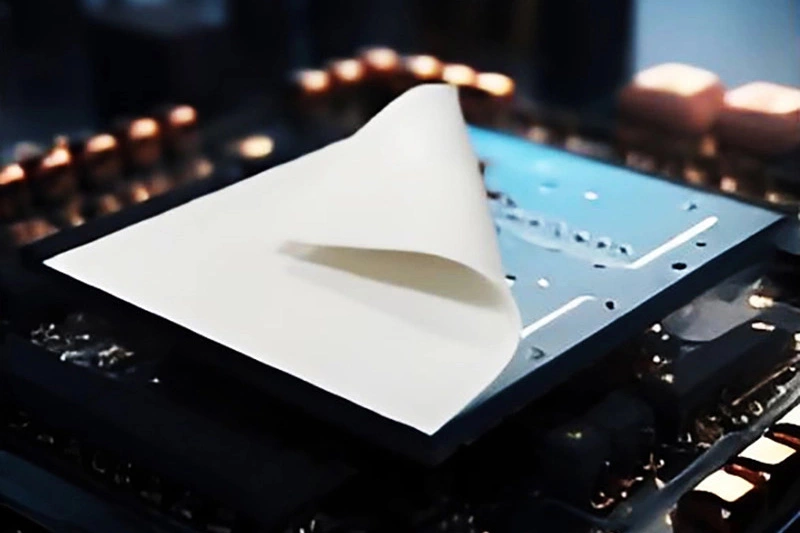
Insulating boron nitride thermal conductive material stands out because the boron nitride crystal structure pushes high thermal conductivity while keeping strong insulation. That balance is rare.
· High in-plane heat transfer
· Low dielectric constant
· Stable under high voltage
1)Optimized particle shape improves contact paths.
2)Controlled particle size reduces voids.
3)Tailored morphology boosts packing density.
In real applications, insulating boron nitride thermal conductive material often appears as:
◦ Hexagonal BN platelets
◦ Spherical agglomerates
◦ Hybrid filler blends
When integrated into a composite system, performance depends on:
Filler engineering
· Surface-treated boron nitride
· Functionalized interfaces
Thermal pathway design
· Aligned platelet networks
· Reduced phonon scattering
Electrical safety control
· Maintained dielectric strength
· Low leakage current
Short take: heat moves fast, current does not. That’s the sweet spot.
Compared with standard ceramic thermal pads, insulating BN thermal materials usually show lower density and easier machinability. For LED boards and EV inverters, insulating boron nitride thermal conductive material keeps temperatures steady without adding bulk.
Ceramic Insulators
Traditional ceramics—alumina, aluminum nitride, silicon nitride—still matter. Each ceramic insulator brings solid mechanical strength and proven insulation performance.
Here’s how they typically compare:
· Alumina: cost-effective, moderate thermal conductivity
· Aluminum nitride: higher conductivity, tighter processing window
· Silicon nitride: excellent fracture toughness
Performance depends on:
· Powder purity
· Sintering density
· Grain boundary control
Under demanding loads:
· Thermal expansion mismatch may stress interfaces.
· Rigid structures resist deformation.
· Long-term stability remains reliable.
For designers choosing between ceramic substrates and insulating boron nitride thermal conductive material, the decision often comes down to heat flux density, weight targets, and assembly method.
Ceramics feel traditional and tough.
Insulating boron nitride thermal conductive material feels adaptable and thermally agile.
Both insulate. Only one moves heat this efficiently while staying electrically quiet.
【Request a Custom Quote】 Share your voltage requirements, thermal targets, operating temperature, and module structure, and we will help evaluate the most suitable BN formulation.
Sheen Thermal
Dongguan Sheen Electronic Technology Co., Ltd · Founded in 2008
Manufacturer of thermal interface materials and silicone foam for automotive electronics, energy storage, power electronics, communications and consumer electronics.
Certified
- ISO 9001:2015
- ISO 14001:2015
- IATF 16949:2016
What we supply
- Thermal conductivity Up to 90 W/m·K
- Thickness 0.3–10.0 mm
- Custom & samples Die-cut to drawing, 3–7 days