
 English
 usheenthermal

Thermal Insulating Sheet Alternatives for Low-Pressure Assemblies: Sheen SC800-PI-2-K10 vs. BERGQUIST K10
Date:2026-10-19
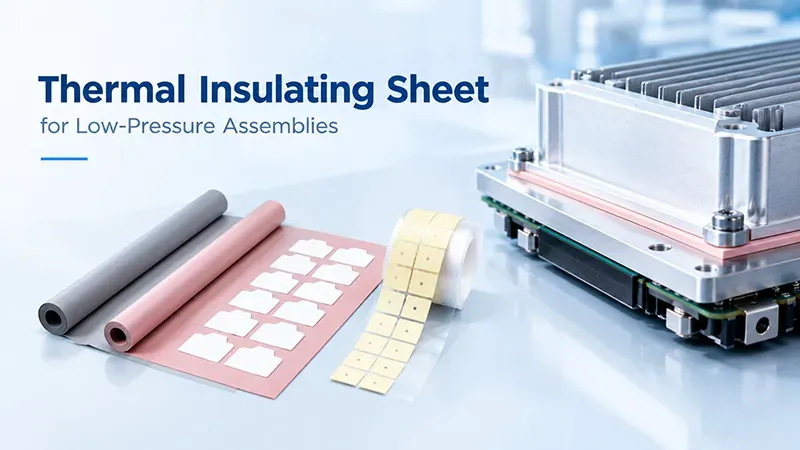
Here's a dirty little secret of thermal pad replacement: two insulating pads can sit at nearly the same thickness, spec nearly the same thermal conductivity, and still leave your device running measurably hotter after the swap. Why? Because the swap happens in the structure, not in the datasheet. Screw-torque pressure distribution, the flatness of that cast-aluminum surface, whether the material actually conforms to the interface — that's where replacement evaluations are won or lost.
For switch-mode power supplies, motor controllers, and power semiconductor assemblies, buying a material purely because its thermal conductivity looks similar is doing maybe half the homework. Sheen's positioning for SC800-PI-2-K10 is refreshingly specific: a thin, electrically isolating thermal interface that holds up under the real clamp loads your assembly can deliver. Compared against Bergquist K10,the two numbers that matter most are low-pressure thermal resistance and tear strength,because those decide whether the material can actually walk into your structure and onto your production line.
Start by Defining the Real Operating Window
Sheen SC800-PI-2-K10 is listed at 0.13–0.17 mm thick, with a Shore A hardness of 85–95. Color can be customized.
The material is intended for applications where small gaps, electrical isolation, and assembly integrity matter. It should not be treated like a highly compressible soft pad, and it should not be expected to bridge a large component-height difference.
The available test and datasheet materials list the following:
- Area-normalized thermal resistance of ≤0.5 °C·in²/W at 50 psi
- AC breakdown voltage of ≥4 kV
- Service temperature range of −40 to 150°C
If a project is currently using BERGQUIST K10, these conditions should first be checked against the component, heatsink, and operating environment. Only then does it make sense to move into the detailed thermal and processing comparison.
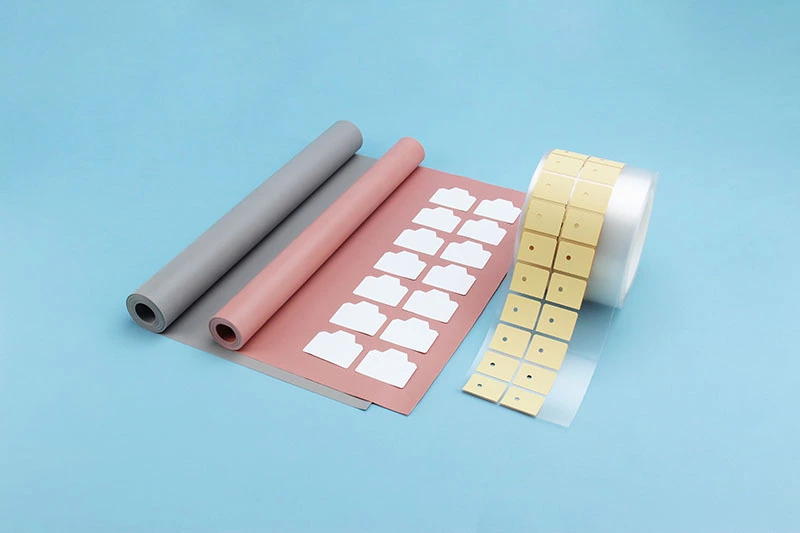
| Sheen SC800-PI-2-K10 Technical Specifications | |||
|---|---|---|---|
| Properties | Unit | SC800-PI-2-K10 | Test Method |
| Color | - | Yellow | Visual |
| Thickness | mm | 0.13~0.17 | ASTM D374 |
| Density | g/cm³ | 1.8±0.3 | ASTM D792 |
| Standard Hardness | Shore A | 85-95 | ASTM D2240 |
| Max Elongation | % | ≥5 | ASTM D412 |
| Tensile Strength | psi | ≥12 | ASTM D412 |
| Breakdown Voltage(@AC) | kV | ≥4 | ASTM D149 |
| Dielectric Constant (@1MHz) | - | ≤5 | ASTM D150 |
| Volume Resistivity | Ω·cm | 1*1014 | ASTM D257 |
| Operating Temp. | ℃ | -40 ~ 150 | - |
| Thermal Resistance | ℃·in²/W,@50 psi | ≤0.5 | ASTM D5470 |
| RoHS | - | PASS | IEC 62321 |
| Halogen | - | PASS | EN 14582 |
| REACH | - | PASS | EN 14372 |
Table 1. Selected parameters from the new TDS, 20260327 V1, page 1.
Low-Pressure Thermal Resistance Is Where the Comparison Gets Interesting
Both materials were listed at 0.15 mm thickness in the comparison. At 10 psi, Sheen's measured value for SC800-PI-2-K10 is 0.523 °C·in²/W versus K10's datasheet figure of 0.86 °C·in²/W — roughly a 39% lower resistance at low clamp pressure.
And that, right there, is the whole ballgame for a big chunk of real-world designs. Plenty of assemblies simply can't crank down the screws — device limits, structural limits, torque limits. For those projects, "wins at 10 psi" beats "wins on thermal conductivity" every single time. Because here's the uncomfortable truth: that beautiful low number your pad achieves at 50 psi? Your assembly might never see 50 psi. Screw torque fights friction, fastener path, and structural stiffness on its way to the interface — it doesn't arrive as a tidy, uniform pressure field.
Full disclosure, because we believe in it: at 50 psi, Sheen's sample measured 0.431 against K10's cited 0.41 °C·in²/W — essentially neck and neck, ours a hair higher, still within the new TDS's ≤0.5 spec. And that's a single-sample result, not a coronation. The low-pressure advantage is a real, evaluation-worthy data point — it is not a claim of dominance across every pressure.
And when you scale from coupon to full assembly, check pressure distribution like a hawk. Same fastening force spread over a bigger area means lower average pressure; heatsink warp and support-point placement throw local deviations on top.
So the practical takeaway is fairly simple: the low-pressure result is worth evaluating, but it should not be expanded into a claim of superiority across the full pressure range.
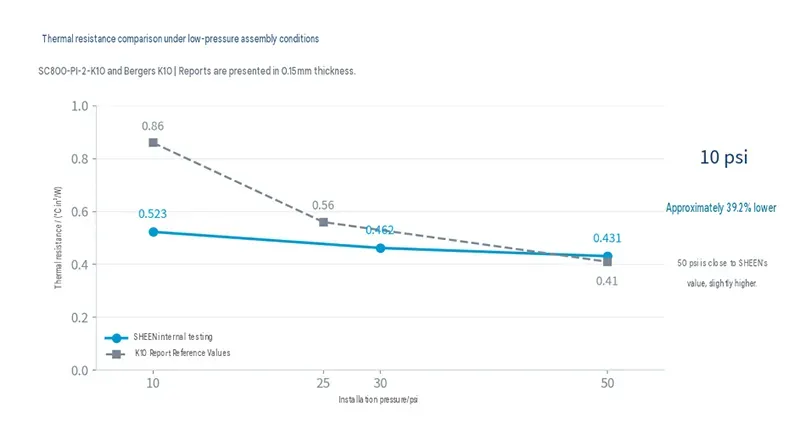
Figure 2. Comparison of pressure and area-normalized thermal resistance. The Sheen value is an internal measurement; the K10 value is cited reference data, not a side-by-side result from matched samples.
Tear Strength Matters Once the Material Meets the Production Line
Thin sheets often reveal their mechanical strengths and weaknesses during processing, not during a quick datasheet review.
Die cutting, release-liner removal, and hole-position assembly can all expose problems. Parts with holes, narrow edges, or irregular shapes are especially sensitive. A small nick at the wrong location can keep growing and affect positioning or leave part of the insulation coverage exposed.
That is why handling performance belongs in the sample evaluation alongside thermal performance. It should not be left for production operators to figure out after the material has already been approved.
The report puts SC800-PI-2-K10's tear strength at 21.93 kN/m against K10's cited 5 kN/m — about 4.4× higher. For thin-sheet processing and assembly where tear resistance is the thing that keeps a shift running, that's a very good reason to put it in the evaluation queue.
But — fair's fair — tear strength is not puncture resistance, and it's not all insulation reliability. Hole-edge dimensions, burrs, and installation method still need engineering control. And since we're laying all the cards on the table: on tensile strength and elongation from the same report, SC800-PI-2-K10's figures come in below K10's cited values. We tell you that because knowing what to verify is the entire point. Parts that see tensile assembly or repeated flexing need their own mechanical evaluation — tear strength alone doesn't get to speak for the whole mechanical case.
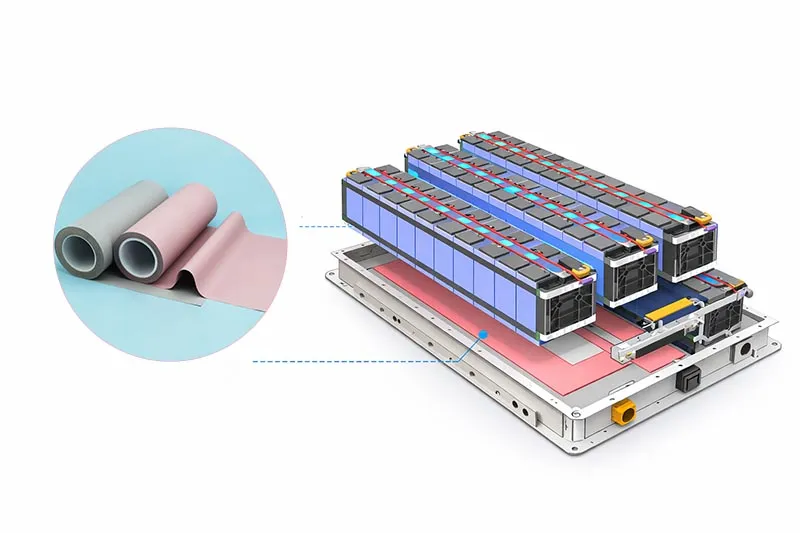
Figure 3. Example insulated thermal interface structure on a cast-aluminum part. This image is for structural illustration only.
Nominal Insulation Data Is Only the Starting Point
SC800-PI-2-K10 is listed with an AC breakdown voltage of ≥4 kV and a volume resistivity of ≥10¹⁴ Ω·cm.
For an engineer, those numbers lead to the next set of questions:
- Is the insulation coverage large enough?
- Are creepage distances sufficient?
- Are the edges clean and properly supported?
- How does the assembly perform after humidity exposure?
- What happens after thermal cycling?
Metal burrs, local compression damage, and assembly misalignment can all prevent the material’s nominal insulation performance from translating into reliable product performance.
That is why a replacement evaluation should look at more than the sheet itself. Check temperature rise, finished-part dielectric withstand, and the interface condition after disassembly.
The temperature boundary also needs to be confirmed early. SC800-PI-2-K10 is listed for −40 to 150°C, but the actual temperature near the interface still needs to be measured or calculated. Leave an appropriate design margin.
For equipment that runs hot for long periods or cycles frequently, evaluate the real operating profile. A catalog temperature range is not, by itself, a service-life conclusion for the complete system.
Turn the Sample Comparison into a Production-Ready Replacement Plan
If you're running this through procurement, a few moves make the difference between samples passed and line runs smoothly:
- Quote and trial from the same drawing. Same part geometry, same nominal thickness, same assembly requirements. Specify adhesive backing or surface treatment explicitly — an added adhesive layer can change total thickness and interface resistance, and that's a plot twist nobody wants mid-qualification.
- Lock down manufacturability before small-batch validation. Die-cut tolerances, hole positions, incoming-inspection items, batch traceability. The classic failure mode is: material passes, parts won't assemble consistently. Don't be that project.
- Separate the three tiers of numbers. Datasheet listed values, sample test reports, and mutually agreed acceptance requirements are three different documents. At sourcing approval, know which one you're signing against.
- Design the logistics while you're at it. Volume planning, sheet/roll format, inventory turns — then write the key inspection conditions into the technical agreement so sample evaluation and batch delivery don't end up judged by different rulers.
This is where Sheen tries to earn its keep: material formulation, film-reinforced structure, and custom die-cutting get discussed in the same selection conversation, not in three separate emails. You can start from your existing K10 part drawing and prototype constraints, and evaluate SC800-PI-2-K10 on those terms — no need to invent a composite score divorced from your assembly first.
【Request a Custom Quote】If your power assembly runs at limited clamp pressure, or your thin insulating sheets keep getting damaged in handling, send Sheen's team your working voltage, contact area, heatsink surface condition, and fastening method. Align on low-pressure thermal resistance and assembly integrity first, then complete prototype and batch validation. That's the only road that turns a material swap into a stable production decision.
Source Notes
- [1] Sheen SC800 Series Datasheet. Product parameters in this article are taken from this version.
- [2] Sheen SC800-PI-2-K10 and K10 test comparison report.
- [3] BERGQUIST SIL PAD TSP K1300. Henkel’s website identifies the original product as SIL-PAD K-10.
Sheen Thermal
Dongguan Sheen Electronic Technology Co., Ltd · Founded in 2008
Manufacturer of thermal interface materials and silicone foam for automotive electronics, energy storage, power electronics, communications and consumer electronics.
Certified
- ISO 9001:2015
- ISO 14001:2015
- IATF 16949:2016
What we supply
- Thermal conductivity Up to 90 W/m·K
- Thickness 0.3–10.0 mm
- Custom & samples Die-cut to drawing, 3–7 days
LAST:Nothing