
 English
 usheenthermal

How to Choose the Right Thermal Interface Material for Data Center Switches
Date:2026-09-03
Choosing thermal interface material for data center switch hardware can make datasheets look deceptively simple: high conductivity wins, right? Not quite.
Bond-line thickness, pressure, flatness, dispensing, rework, and consistency decide what survives production.
Uptime Institute’s 2025 cooling survey reports rising rack densities, sharpening thermal-management priorities and making careful TIM qualification increasingly relevant.
Key Points for Thermal Interface Material for Data Center Switch
➔ Ensure minimal thermal resistance by evaluating conductivity in the context of bond-line thickness, pressure, and surface flatness.
➔ Select grease, gap pads, or phase-change materials based on component geometry, dispensing needs, reworkability, and compressibility for ASICs and transceivers.
➔ Verify RoHS, REACH, UL94 V-0 compliance, precise die-cutting dimensions, and ISO 9001 traceability before mass assembly.
➔ Request standardized test data, oil bleed/volatility metrics, and filler matrix details to predict long-term reliability.
Request the Data Center Switch TIM Datasheet →
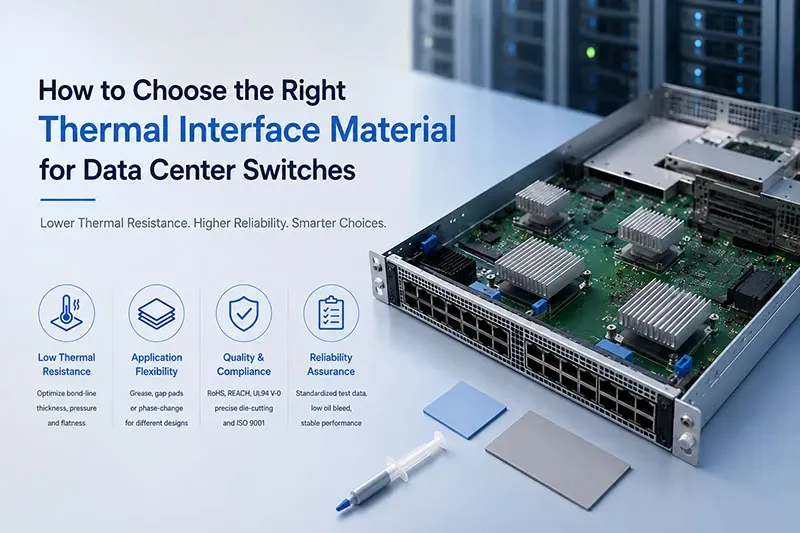
Thermal Interface Material For Data Center Switch: Overview
Choosing a thermal interface material for data center switch hardware comes down to heat, fit, assembly, and compliance. Sheen Technology supplies switch TIM options designed around these practical engineering needs.
Why TIM Matters for Network ASIC Heat Dissipation
A thermal interface material for data center switch designs fills tiny air gaps between the Network ASIC and cooler.
Heat path
- Higher Thermal Conductivity supports faster Heat Dissipation. Sheen Technology's graphene thermal pads offer through-plane thermal conductivity of up to 90 W/m·K.
- Lower Thermal Resistance helps control Junction Temperature as ASIC Power Density rises. The thermal resistance of Sheen Technology's phase-change thermal pads (@ 50 psi) can be as low as 0.007 °C·in²/W.
Good contact matters a lot when switch traffic keeps chips running hot.
Comparing Thermal Grease, Thermal Gap Pad, and Phase Change Material
Material choice balances Thermal Resistance, assembly, and rework.

| TIM | Conductivity (W/m·K) | Thermal Resistance (°C·in²/W) | Compression (%) |
| Thermal Grease | 1–5 | 0.016–0.15 | 0 |
| Silicone Thermal Pad | 1–15 | 0.07–0.95 | 10–50 |
| Phase Change Material | 3–8 | 0.05–0.007 | 0–10 |
*Typical engineering ranges; product datasheets govern final selection.
Grease needs controlled Viscosity and resistance to Pumping Out. Pads are easier to handle.
Application Contexts: From Heat Sink to Optical Transceiver
High-heat path
- ASIC → Interface Area → Heat Sink
Space-limited path
- Optical Transceiver → switch TIM → Switch Chassis
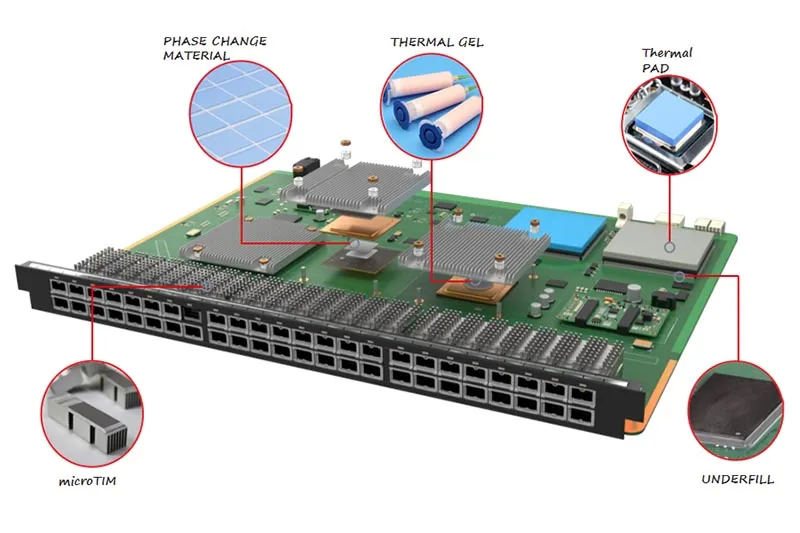
Each path has different Contact Resistance, pressure, insulation, and Thermal Management needs. Sheen Technology can match die-cut materials to these mechanical limits.
RoHS Compliance, UL94 V-0 and Die Cutting Considerations
For a thermal interface material for data center switch assembly, check:
- RoHS Compliance and applicable Environmental Regulation
- UL94 V-0 or other Flame Retardant needs
- Die Cutting dimensions and Tolerance
Those checks help keep high-volume assembly practical while meeting specified material requirements.
4 Key Properties Of Thermal Interface Materials
Choosing a thermal interface material for data center switch hardware takes more than checking one spec. Heat, electrical safety, fit, and aging all matter in day-to-day operation. Sheen Technology helps buyers compare these practical traits so a data center switch can keep cooling performance steady without making assembly a headache.
Thermal Conductivity vs. Thermal Resistance Performance
Heat-transfer basics:
- Thermal conductivity shows how readily the material carries heat, supporting heat dissipation and energy efficiency.
- Thermal resistance also reflects bond-line thickness and contact quality.
For a thermal interface material for data center switch applications, check actual junction temperature under realistic power dissipation. A great conductivity number alone doesn’t cut it.
Dielectric Strength and Viscosity Trade-Offs
| Dielectric Strength | Viscosity Trade-Offs |
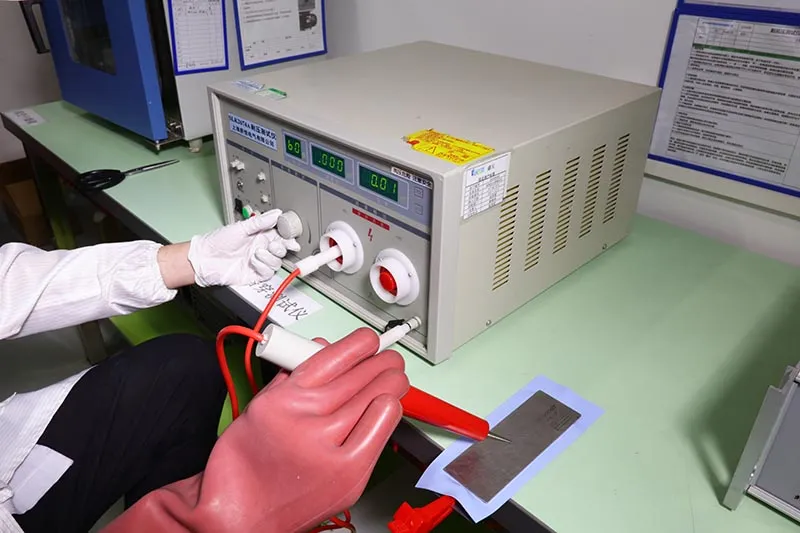 | 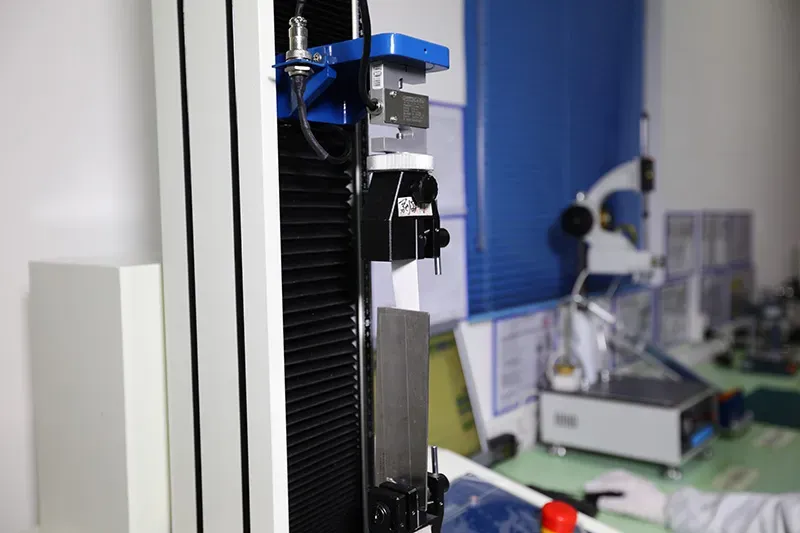 |
Dielectric strength indicates voltage breakdown resistance and supports electrical insulation near circuitry. Viscosity, meanwhile, changes flow behavior, bond-line control, and dispensing rate.
For a data center switch TIM, grease must spread well without getting all over the place. That balance makes thermal interface material for data center switch assembly more predictable.
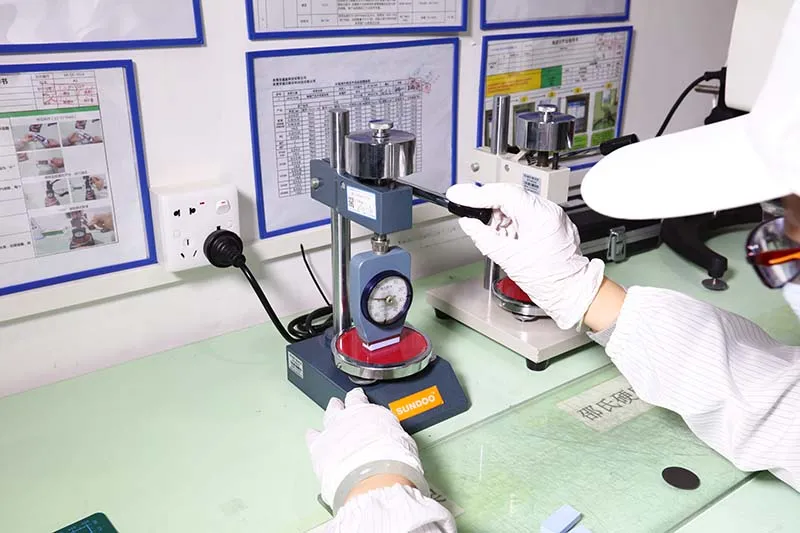
Hardness Durometer Impact on Compression and Contact
Pad fit
- Lower hardness durometer generally increases compliance.
- Greater deflection can fill uneven gaps.
Contact behavior
- Controlled compression improves surface contact.
- Suitable interface pressure helps reduce micro-voids without crushing nearby parts.
That makes thermal interface pads easier to match with real hardware tolerances.
Thermal Impedance, Oil Bleed and Volatility Metrics
Thermal impedance captures practical interface heat-transfer performance. It’s a handy reality check.
- Aging concerns include oil bleed, volatility, and outgassing.
- Low migration can support long-term reliability by limiting contamination and material degradation.
For thermal interface material for data center switch designs, also check how any phase change behavior affects repeated heating cycles.
4 Questions For Evaluating TIM Samples
Picking a thermal interface material for data center switch hardware takes more than checking one flashy number. Heat, handling, aging, and compliance all matter when racks run around the clock. Sheen Technology samples can be screened against clear test data, practical production needs, and documented thermal performance before qualification moves ahead.
How reliable is the claimed thermal conductivity?
Check the reported thermal conductivity.
- Match the test method, temperature, pressure, and bond-line thickness.
- Review measurement accuracy and sample preparation.
- Compare thermal resistance under realistic heat transfer conditions.
A thermal interface material for data center switch use should show repeatable results, not just a best-case datasheet figure.
What does the manufacturer report on oil bleed and shelf life?
Ask for numbers covering oil bleed, silicone oil loss, and exudation. Storage temperature and shelf life also deserve a close look.
- Check storage stability under stated conditions.
- Review material degradation after aging.
- Link those results to production reliability.
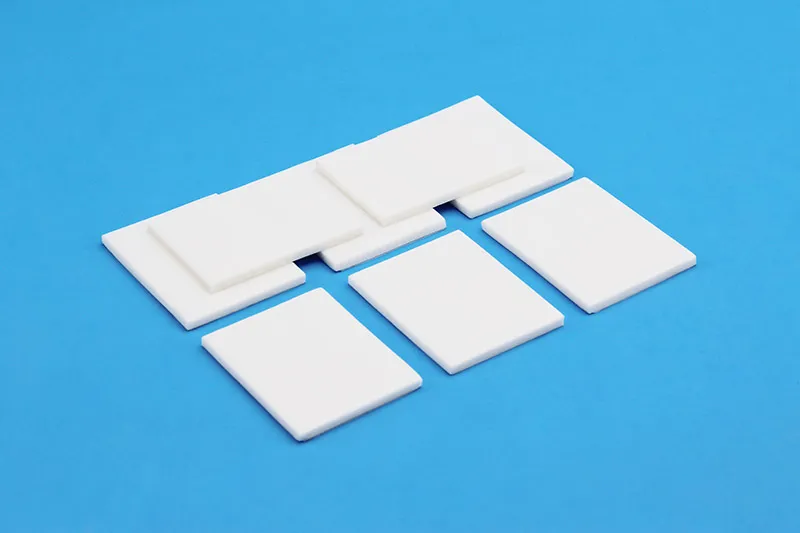
For a thermal interface material for data center switch design, unexpected bleed can create a real mess around sensitive parts. To address this, Sheen Technology offers non-silicone thermal pads that reduce the risk of silicone oil bleeding.
Can the silicone matrix or ceramic filler meet data center switch demands?
Evaluate the silicone matrix.
- Confirm thermal stability at high temperature.
- Check recovery after mechanical stress.
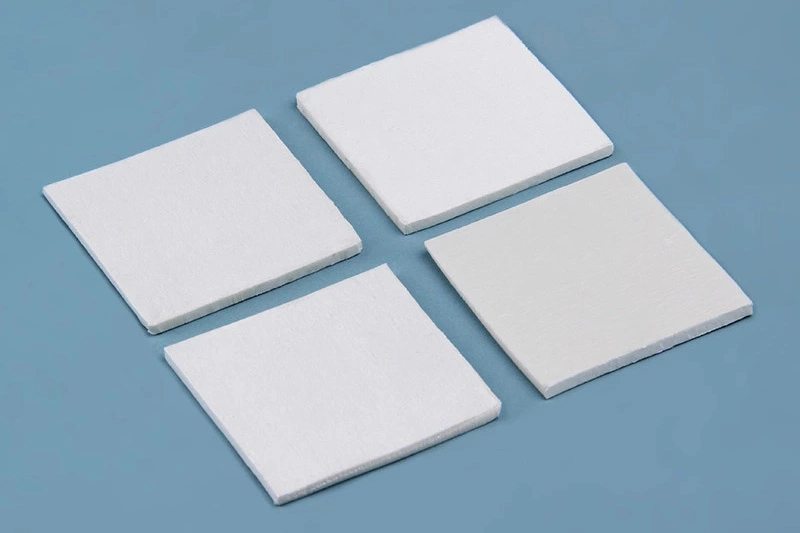
Review each ceramic filler.
- Verify dielectric strength.
- Match loading to the data center switch design.
R&D engineers at Sheen Technology believe that boron nitride thermal pads offer superior electrical insulation performance. A thermal interface material for data center switch applications may also use graphite or metal-based options when electrical and mechanical limits permit. Sheen Technology's graphene thermal pads, in particular, utilize a vertically oriented edge-sealing process. That keeps thermal interface choices tied to actual switch demands.
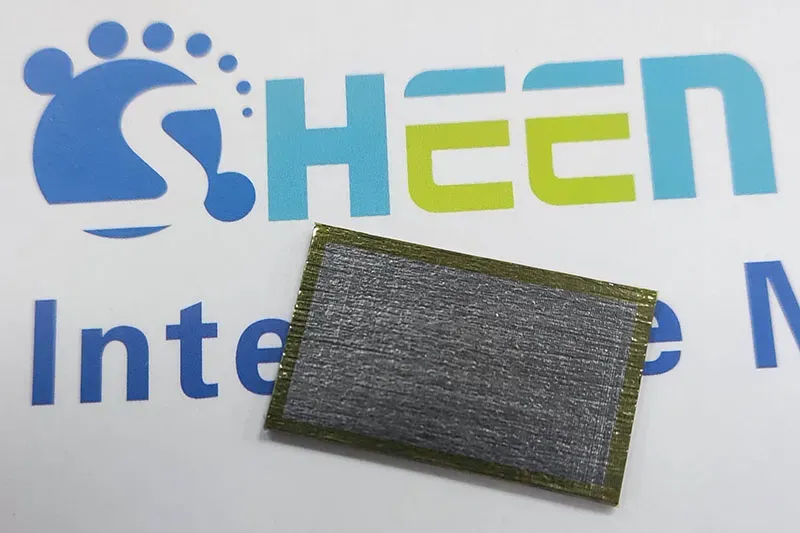
Is the sample’s cure process and REACH regulation status documented?
Confirm the cure process before production trials: time, temperature, dispensing, and screen-printing conditions should be clear. Then verify REACH regulation, RoHS compliance, chemical composition, and applicable environmental standards.
Supplier records:
- Current documentation
- safety data sheet
- Batch traceability and ISO 9001 controls
A thermal interface material for a data center switch program is much easier to qualify when paperwork matches the sample in hand.
Sheen Technology Provide Selection Decision Framework
The framework below maps switch scenarios to the preferred TIM type.
| Scenario | Preferred TIM | Reason |
| ASIC → heat sink, thin flat gap | Grease or PCM | Lowest BLT / lowest resistance |
| Optical transceiver → chassis, space-limited | Gap pad (die-cut) | Handles gap, easy placement |
| Uneven surfaces / large tolerance | Gap filler | High compliance, fills variance |
| Rework required | Gap pad or PCM | Cleaner removal than grease |
| High-volume automated assembly | Die-cut pad | Repeatable placement |
The framework and properties above should be tied to recognized standards.
| Property | Standard | What It Verifies |
| Thermal impedance / resistance | ASTM D5470 | Interface resistance at pressure |
| Dielectric strength | ASTM D149 / IEC 60243 | Electrical insulation |
| Hardness (durometer) | ASTM D2240 | Compliance / compression |
| Compression set | ASTM D395 | Permanent deformation |
| Outgassing / volatility | ASTM E595 | TML / CVCM in vacuum |
| Flammability | UL 94 (V-0) | Flame-retardant rating |
| Quality system | ISO 9001 | Process / traceability controls |
Choosing a TIM for data center switches requires balancing thermal impedance against bond-line thickness, mounting pressure, and assembly method — not simply picking the highest conductivity. Sheen Technology provides switch TIMs with datasheet data, die-cut options, and application engineering support.
Contact Sheen Technology for Switch TIM Selection Support →
Sheen Thermal
Dongguan Sheen Electronic Technology Co., Ltd · Founded in 2008
Manufacturer of thermal interface materials and silicone foam for automotive electronics, energy storage, power electronics, communications and consumer electronics.
Certified
- ISO 9001:2015
- ISO 14001:2015
- IATF 16949:2016
What we supply
- Thermal conductivity Up to 90 W/m·K
- Thickness 0.3–10.0 mm
- Custom & samples Die-cut to drawing, 3–7 days