
 English
 usheenthermal

Boron Nitride vs Alumina Thermal Conductivity: Choosing the Best Filler
Date:2026-07-02
Boron Nitride vs Alumina Thermal Conductivity: Choosing the Best Filler
Boron nitride vs alumina thermal conductivity comparison is not lab chatter—it is a budget and reliability call when heat starts cooking your product line.
Pick wrong, and you pay in throttled performance, warranty returns, and late nights. Pick right, and systems run cooler, longer, cheaper.
IEA and Deloitte analyses indicate electrification and density demands, pushing buyers toward higher conductivity fillers cost pressures keep alumina in volume.
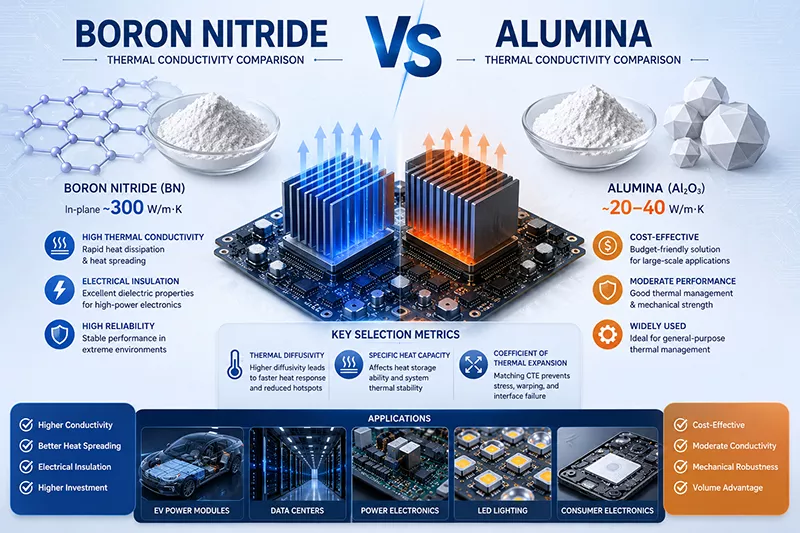
Harmonic Reading Notes: Boron nitride vs alumina thermal conductivity comparison
➔ Conductivity Contrast: Boron nitride (In-plane~300 W/m·K) outperforms alumina (20–40 W/m·K), delivering rapid heat spread with electrical insulation for high-power electronics.
➔ Cost–Performance Balance: Alumina powders are budget-friendly, offering moderate thermal management and mechanical robustness, while boron nitride demands higher investment for peak efficiency.
➔ Selection Metrics: Evaluate thermal diffusivity, specific heat capacity, and expansion coefficients to prevent hotspots, manage thermal budgets, and ensure long-term reliability in substrates and heat-dissipating components.
Comparing Boron Nitride Vs Alumina Thermal Conductivity
A solid Boron nitride vs alumina thermal conductivity comparison helps engineers pick the right ceramic for electronics, power modules, and heat-sensitive devices. In daily manufacturing talk, people usually shorten the discussion to BN vs alumina conductivity or thermal ceramic comparison. Still, the details matter because heat flow, insulation, and cost can shift product reliability fast.
Boron Nitride Thermal Conductivity
A typical Boron Nitride thermal ceramic can reach nearly 300 W/m·K under optimized orientation, making the Boron nitride vs alumina thermal conductivity comparison lean heavily toward BN for rapid heat transfer. Both hBN and cBN grades appear in electronics, though hBN dominates insulating thermal pads and substrates.
Thermal behavior in practical systems
· High conductivity allows faster chip cooling.
· Strong insulator performance reduces current leakage.
· Stable operation at high temperature supports semiconductor packaging.
Common material forms
· Sintered plates
· Thermal interface sheets
· Filler material compounds for polymers
Why engineers pick BN in a Boron nitride vs alumina thermal conductivity comparison
· Faster thermal spreading
· Lower hot-spot buildup
· Better reliability during thermal cycling
| Material Type | Typical Thermal Conductivity | Typical Use |
| hBN | 200–300 W/m·K | Electronic substrates |
| cBN | 250–740 W/m·K | Extreme thermal systems |
| Alumina 96% | 20–30 W/m·K | LED boards |
| Alumina 99% | 30–40 W/m·K | Power electronics |
In a direct Boron nitride vs alumina thermal conductivity comparison, BN handles aggressive cooling loads with less thermal resistance. That difference becomes obvious in compact EV electronics and AI server hardware where heat stacks up quickly.
Alumina Thermal Conductivity
Alumina, also called aluminum oxide, delivers lower but still useful thermal conductivity, usually around 20–40 W/m·K. In a Boron nitride vs alumina thermal conductivity comparison, alumina rarely wins on raw cooling speed, yet it stays popular because of price stability and dependable manufacturing.
Short practical notes from production teams:
· Strong electrical insulation
· Reliable mechanical strength
· Easy machining compared with advanced ceramics
· Good balance between performance and cost-effectiveness
For many LED modules and industrial controls, alumina works just fine. Heat dissipation remains acceptable, especially when airflow or metal heat sinks support the design. A Boron nitride vs alumina thermal conductivity comparison also shows that alumina survives rough handling better in some high-volume assembly lines.
Typical workflow in thermal ceramic selection:
· Measure device heat output.
· Compare target cooling limits.
· Evaluate dielectric requirements.
· Balance conductivity against manufacturing cost.
· Select either ceramic filler alumina systems or premium BN solutions.
The Boron nitride vs alumina thermal conductivity comparison often ends with a trade-off: BN pushes top-tier thermal control, while alumina keeps production budgets under control without sacrificing long-term durability.
How 300 W/m·K Vs 40 W/m·K Impacts Thermal Performance
Heat control changes everything in compact electronics. A practical Boron nitride vs alumina thermal conductivity comparison quickly shows why premium fillers dominate AI servers, EV modules, and telecom hardware, while lower-cost ceramics still hold a huge share of mainstream cooling products. Sheen Technology often evaluates these thermal filler choices around reliability, budget, and assembly speed.
300 W/m·K Fillers: High-Power Density Applications
A detailed Boron nitride vs alumina thermal conductivity comparison highlights how Boron Nitride and aluminum nitride outperform standard ceramic systems when heat flux spikes inside compact processors and fast-switching power modules.
Thermal pathway improvement
· Filler particles create shorter routes for Heat transfer
· Dense particle packing boosts High thermal conductivity
· Lower thermal resistance stabilizes sensitive chips
Device-level impact
· AI accelerators
· EV inverters
· RF communication units
Advanced Thermal interface materials
· Better handling of rising Power density
· Longer lifespan for Electronic devices
· Reduced hotspot formation
IDC’s 2025 thermal packaging outlook noted that high-conductivity ceramic fillers are seeing rapid adoption in data-center hardware because thermal limits are now constraining processor scaling more than board space.
The Boron nitride vs alumina thermal conductivity comparison becomes especially clear in stacked electronics. High thermal conductivity fillers pull heat away fast enough to prevent throttling during peak loads. Sheen Technology uses this approach in compact assemblies where every degree matters and airflow is already maxed out.
40 W/m·K Powders: Cost-Effective Heat Dissipation
The same Boron nitride vs alumina thermal conductivity comparison also explains why Alumina remains popular. Its Moderate thermal conductivity still supports practical Electronic cooling without pushing production costs too high.
Common uses inside Polymer matrices
· LED housings
· Consumer adapters
· Control boards
Steps often used in material selection:
· Define required Heat removal
· Balance insulation and thermal targets
· Adjust loading of Thermal fillers
· Verify processing flow and cost
Short notes from production teams:
· Easier sourcing
· Stable processing
· Strong Cost efficiency
A thermal conductivity comparison between boron nitride and alumina usually ends with compromise decisions rather than one “winner.” In moderate-power products, 40 W/m·K powders keep temperatures controlled while preserving manufacturing margins. Sheen Technology frequently recommends alumina blends when thermal budgets are reasonable, and scaling volume matters more than extreme cooling performance.
3 Key Thermal Conductivity Metrics To Evaluate
When engineers debate Boron nitride vs alumina thermal conductivity comparison, the talk usually goes beyond a single number. It’s about how heat moves, how much energy a material can hold, and how stable it stays under stress. From power modules to RF boards, choosing between boron nitride thermal conductivity and alumina thermal conductivity shapes long-term reliability and cost.
Thermal Diffusivity in Ceramic Substrates
In any Boron nitride vs alumina thermal conductivity comparison, thermal diffusivity defines how fast heat spreads across ceramic substrates. Quick heat propagation keeps hotspots under control in high-frequency modules.
· Diffusivity links thermal conductivity, density, and specific heat capacity.
· Higher diffusivity means shorter temperature spikes.
· Lower diffusivity may trap heat near active chips.
Typical Thermal Diffusivity Values
| Material | Thermal Conductivity (W/m·K) | Diffusivity (mm²/s) | Typical Use |
| Alumina (96%) | 24–30 | 7–9 | Standard substrates |
| Boron Nitride (h-BN) | 150–200 | 70–90 | High-power modules |
| AlN | 140–180 | 60–85 | LED packaging |
| Alumina + filler materials | 30–45 | 10–15 | Cost-balanced designs |
· Boron nitride shows rapid lateral spreading.
· Alumina offers stable, moderate performance.
· Added filler materials tweak performance.
★ Fast diffusion reduces thermal gradients.
The thermal conductivity comparison of boron nitride and alumina often highlights that BN wins in peak spreading speed, but alumina holds ground where cost and mechanical strength matter. At Sheen Technology, substrate tuning focuses on balancing material properties rather than chasing extreme numbers.
Specific Heat Capacity and Thermal Budget
In a practical Boron nitride vs alumina thermal conductivity comparison, engineers also check specific heat capacity. This tells how much heat storage happens before temperature rises.
· High energy absorption smooths load spikes.
· Lower heat capacity means faster temperature response.
· Stable temperature stability protects solder joints.
During device cycling:
· Power surge hits the die.
· Substrate absorbs part of the heat.
· Stored energy releases gradually.
· Thermal management system stabilizes equilibrium.
The BN vs Al₂O₃ conductivity debate sometimes overshadows this metric. Yet in power converters, managing thermal budget can extend lifespan more than chasing maximum boron nitride thermal conductivity.
“Advanced packaging materials with optimized thermal storage and conductivity will be critical for next-generation power density targets,” notes the 2025 Yole Group power electronics outlook.
Material choice is rarely isolated. Material selection must consider capacity, not just conduction speed. That’s where Sheen Technology supports clients comparing boron nitride vs alumina thermal conductivity comparison data under real load curves.
Thermal Expansion Coefficient for Reliability
The thermal expansion coefficient quietly shapes material reliability. In any serious Boron nitride vs alumina thermal conductivity comparison, expansion mismatch can drive thermal stress during thermal cycling.
Consider this layered structure:
· Semiconductor die:Low expansion silicon
· Solder layer:Moderate flexibility
· Ceramic substrate:Dimensional stability critical
If expansion differs too much:
· Micro-cracks form
· Interface fatigue grows
· Component integrity drops
Material compatibility matters as much as raw conductivity. Alumina’s expansion closely matches silicon, while boron nitride may need design compensation depending on structure grade.
The boron nitride vs alumina thermal conductivity comparison often starts with heat flow numbers, yet long-term survival depends on expansion harmony. Smart engineers look at conduction, storage, and stress together. That balanced view defines how Sheen Technology approaches advanced ceramic solutions for demanding electronics.
BN Vs Alumina: Cost-Performance Trade-Off
In the ongoing Boron nitride vs alumina thermal conductivity comparison, engineers often juggle budget limits with heat management goals. Some projects need peak thermal flow; others just need steady reliability. This Boron nitride vs alumina thermal conductivity comparison breaks down cost pressure and performance output in a practical, no-nonsense way—so sourcing teams and design leads can make smart calls.
Cost Analysis of Boron Nitride Fillers
The Boron nitride vs alumina thermal conductivity comparison usually starts with price, and Boron nitride sits at the premium end of filler materials.
Production costs
· Raw material sourcing requires high-purity feedstock.
· Energy-intensive manufacturing methods raise overhead.
· Tight particle control improves performance but adds expense.
Market-side pressures
a) Market dynamics shift with electronics demand.
b) Supply concentration affects bargaining power.
c) High-grade powders target niche thermal management sectors.
Economic viability layers
· Short-term: upfront material spend feels steep.
· Mid-term: better thermal paths reduce system failure risk.
· Long-term: improved device lifespan offsets initial cost.
Key cost drivers include:
· Purity level
· Particle size control
· Surface treatment steps
From a practical standpoint, companies like Sheen Technology help optimize formulation loading so the Boron nitride vs alumina thermal conductivity comparison is not just about raw price per kilogram but cost per watt dissipated. In advanced electronics, that shift in thinking changes procurement strategy fast.
Performance Efficiency of Alumina Powders
When the Boron nitride vs alumina thermal conductivity comparison shifts toward volume production, Alumina becomes attractive.
· Lower material price
· Stable electrical insulation
· Reliable material properties
Performance depends on several linked factors:
1) Particle morphology affects packing density.
2) Packing density influences heat dissipation paths.
3) Thermal paths determine overall thermal performance.
In everyday applications—LED housings, power modules, consumer devices—moderate conductivity works fine. The Boron nitride vs alumina thermal conductivity comparison often shows alumina delivering balanced output without pushing budgets too hard.
There’s also mechanical upside. Strong ceramic structure improves wear resistance. For large-scale builds with clear application requirements, that matters.
A quick breakdown:
· Cost-sensitive production → alumina advantage
· Extreme thermal load → boron nitride edge
· Hybrid filler systems → blended optimization
Many clients working with Sheen Technology run side-by-side trials during a Boron nitride vs alumina thermal conductivity comparison, testing insulation strength, filler loading limits, and molding flow. The takeaway? Alumina powders shine in steady, scalable projects, while boron nitride dominates when heat density climbs and performance simply can’t dip.
EV Battery Packs: Thermal Management Solutions
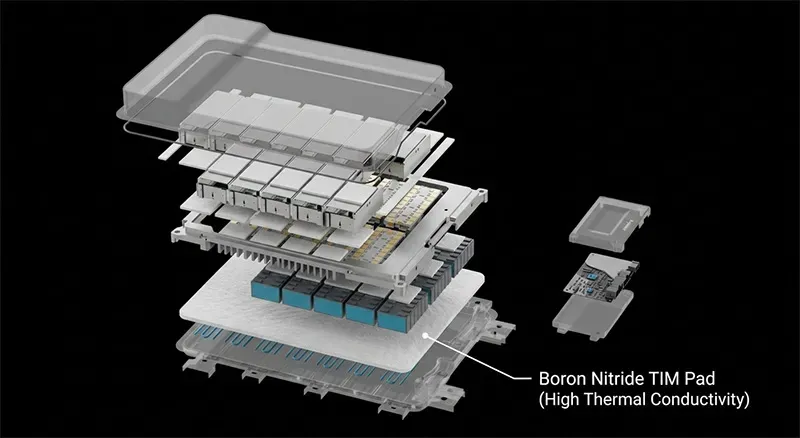
EV battery packs run hot, and heat is the quiet troublemaker. Choosing between boron nitride and alumina often comes down to a sharp thermal conductivity comparison. In real projects, engineers repeatedly revisit the Boron nitride vs alumina thermal conductivity comparison to balance safety, cost, and performance in every EV battery platform.
Integrating Boron Nitride Composites for Heat Sinks
When discussing Boron nitride vs alumina thermal conductivity comparison, heat sink design usually sits at the center.
Material Selection Logic
1.1 Core Objective
· Improve thermal management in high-density EV battery packs.
· Increase thermal conductivity without losing insulation.
1.2 Why boron nitride?
· High intrinsic thermal conductivity.
· Electrical insulation, ideal as a filler in polymer composites.
Integration into heat sinks
2.1 Composite Blending
· Disperse boron nitride particles evenly.
· Optimize filler loading to avoid brittleness.
2.2 Structural Design
· Align plate-like particles to guide heat flow.
· Pair with aluminum substrates for hybrid cooling.
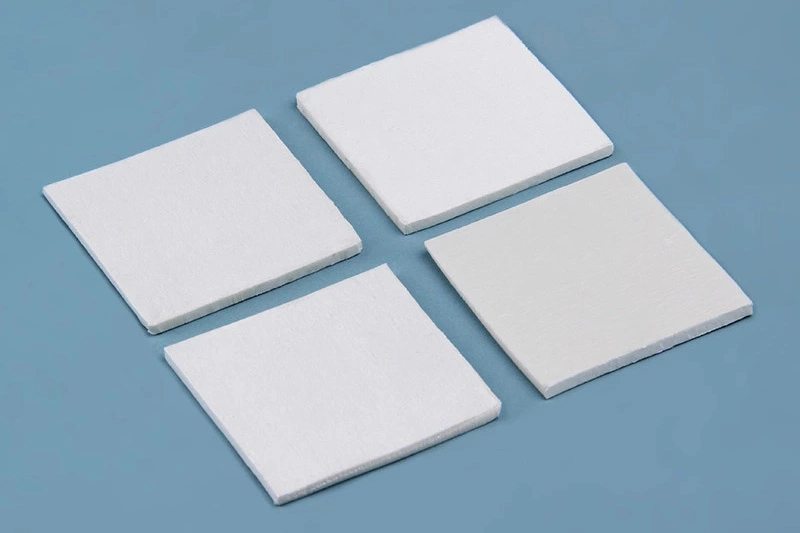
Sheen Technology Vertical orientation Boron Nitride Thermal pad Performance Snapshot
| Properties | Unit | SF1600-BN-sp-03(0.3mm) | Test Method |
| Color | - | White | Visual |
| Thermal Conductivity(Vertical orientation) | W/m·K | 16 | ASTM D5470 |
| Thermal Resistance (@40psi) | ℃*cm2/W | ≤0.3 | ASTM D5470 |
| Application temperature | ℃ | -40~150 | - |
| Thermal weight loss rate | % | ≤1 | - |
| Thickness | mm | 0.2~5.0 | ASTM D374 |
| Breakdown voltage | KV,@AC | ≥4 | ASTM D149 |
| Dielectric constant | F/m, @ 1MHz | ≤4.2 | ASTM D150 |
| Volume resistivity | Ω*cm, @250V | ≥1013 | ASTM D257 |
| Rebound rate | % | ≥90 | - |
| Density | g/cm³ | 1.6±0.2 | ASTM D792 |
| Hardness | shore 00 | 60~80 | ASTM D2240 |
| Flammability rating | - | V-0 | UL 94 |
In any serious Boron nitride vs alumina thermal conductivity comparison, boron nitride composites often win on heat spreading speed, while keeping dielectric safety intact. That balance makes integration practical, not just theoretical.
Alumina-Based Insulating Coatings in Cell Modules
Alumina remains a staple in cell modules, especially where insulating coatings must handle voltage stress and steady heat.
Key roles of alumina in EV battery design:
· Electrical dielectric barrier between cells.
· Controlled thermal insulation to prevent runaway spread.
· Chemical stability under cycling.
Now, let’s be real. In the Boron nitride vs alumina thermal conductivity comparison, alumina usually shows lower bulk thermal conductivity than boron nitride. But lower conductivity can be useful. Slowing heat transfer between adjacent cells buys reaction time during fault events.
1) Spray or dip coating preparation
2) Sintering to densify the ceramic layer
3) Adhesion testing inside full cell modules
Short takeaways:
• Alumina = strong insulation
• Boron nitride = faster heat spreading
• Thermal conductivity comparison = design decision, not a popularity contest
For manufacturers working with Sheen Technology, tuning coating thickness and composite ratios makes the Boron nitride vs alumina thermal conductivity comparison less about hype and more about fit-for-purpose engineering.
Advanced Ceramic Fillers for Enhanced Reliability
Reliability improves when ceramic fillers are chosen with intention.
Step 1: Define thermal target
• Set acceptable temperature rise in the EV battery under peak load.
Step 2: Run a focused thermal conductivity comparison
• Evaluate boron nitride, alumina, and other advanced materials like silicon carbide within polymer composites.
Step 3: Mechanical screening
• Check crack resistance, vibration tolerance, and long-term insulation stability.
Step 4: System validation
• Cycle-test modules under aggressive charge–discharge profiles.
In repeated Boron nitride vs alumina thermal conductivity comparison studies, teams notice a pattern: boron nitride boosts heat dissipation, while alumina strengthens structural and dielectric margins. Smart designs blend both. That mix—guided by real data, not guesswork—is where reliability truly levels up.
Sheen Thermal
Dongguan Sheen Electronic Technology Co., Ltd · Founded in 2008
Manufacturer of thermal interface materials and silicone foam for automotive electronics, energy storage, power electronics, communications and consumer electronics.
Certified
- ISO 9001:2015
- ISO 14001:2015
- IATF 16949:2016
What we supply
- Thermal conductivity Up to 90 W/m·K
- Thickness 0.3–10.0 mm
- Custom & samples Die-cut to drawing, 3–7 days