
 English
 usheenthermal

Silicone-Free vs Silicone-Containing Thermal Pads: A Deep Comparison
Date:2026-07-24
When overheating costs real money, the comparison between silicone-free and silicone-containing thermal pads reveals which choice saves your production line.
When heat starts cooking your hardware, the Comparison between silicone-free and silicone-containing thermal pads stops being a spec sheet debate and turns into a dollars-on-the-line call. One option hugs surfaces like soft clay for better contact; the other keeps things clean and stable when contamination could wreck sensitive parts.
Pick wrong and you'll pay in rework, failures, and angry customers; pick right and assembly runs much more smoothly, more coolly, and a lot less riskily. This guide provides a systematic comparison of silicone-free vs silicone-containing thermal pads across thermal performance, mechanical behavior, chemical inertness, and application suitability.
Swift Insights: Comparison between silicone-free and silicone-containing thermal pads
Thermal Efficiency: Silicone-containing pads deliver superior conformability and lower interface resistance for uneven gaps.
Contamination Risk: Silicone-free composites minimize VOCs and siloxane outgassing, protecting optics and sensors.
- Mechanical & Chemical Balance: Silicone variants offer softer gap filling but risk pump-out; silicone-free types demand higher assembly pressure yet ensure long-term inertness.
Types Of Thermal Pad Materials
Picking the right pad isn't just spec-sheet stuff — it shapes heat flow, reliability, and even contamination risk. In the ongoing Comparison between silicone-free and silicone-containing thermal pads, subtle material choices shift outcomes a lot. Below, the breakdown keeps it real, mixing performance talk with practical trade-offs you'll actually notice in builds.
Silicone-Based Pads: Polymer Base and Filler Material
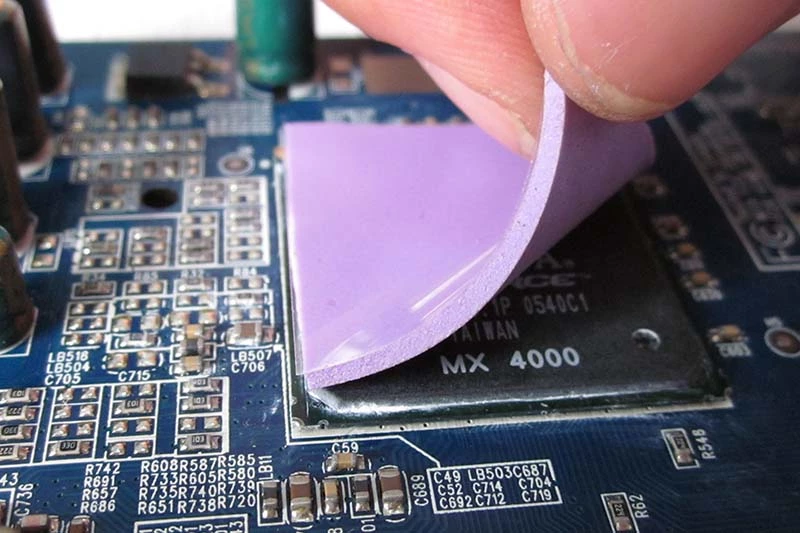
Core stack:
Silicone polymer or elastomer resin
- packed with filler particles to raise thermal conductivity
- while keeping strong dielectric properties
Sheen Technology Silicone thermal pad performance properties:
| Properties | Color | Thermal Conductivity | Thermal Impedance (1mm,@30psi) | Thickness | Standard Hardness | Customized Hardness |
|---|---|---|---|---|---|---|
| Unit | - | W/m·K | ℃*in²/W | mm | Shore 00 | Shore 00 |
| SF100 | Gray White | 1.5 | 0.90 | 0.3 ~ 10.0 | 40/60±5 | 10 ~ 90 |
| SF300 | Dark Gray | 2.0 | 0.70 | 0.3 ~ 10.0 | 40/60±5 | 10 ~ 90 |
| SF400 | Yellow | 2.5 | 0.50 | 0.3 ~ 10.0 | 40/60±5 | 10 ~ 90 |
| SF500 | Blue | 3.0 | 0.45 | 0.3 ~ 10.0 | 40/60±5 | 20 ~ 90 |
| SF600D | Gray | 4.0 | 0.40 | 0.3 ~ 5.0 | 40/60±5 | 30 ~ 90 |
| SF600 | Gray/Pink | 5.0 | 0.35 | 0.5 ~ 5.0 | 40/60±5 | 30 ~ 90 |
| SF600G | Gray | 6.0 | 0.30 | 0.5 ~ 5.0 | 40/60±5 | 30 ~ 90 |
| SF700 | Gray | 7.0 | 0.25 | 0.5 ~ 5.0 | 40/60±5 | 30 ~ 90 |
| SF800 | Gray | 8.0 | 0.22 | 0.5 ~ 5.0 | 40/60±5 | 30 ~ 90 |
| SF1000 | Gray | 10.0 | 0.18 | 0.5 ~ 5.0 | 40/60±5 | 30 ~ 80 |
| SF1200 | Gray | 12.0 | 0.15 | 0.8 ~ 5.0 | 40/60±5 | 30 ~ 80 |
| SF1500 | Gray | 15.0 | 0.10 | 1.0 ~ 5.0 | 40±10 | 30 ~ 60 |
Heat path logic
- Contact → soft polymer conforms
- Fillers bridge gaps
- Heat exits steadily
Trade-offs in the comparison between silicone-free and silicone-containing thermal pads
- Pros: gap filling, electrical safety
- Cons: siloxane bleed, surface contamination
Practical notes
- Works well on uneven IC stacks
- Popular in mass production (Sheen Technology offers tuned variants)
Ceramic-Filled Silicone-Free Composites
Short take: cleaner chemistry, tighter control.
- Uses ceramic blends like alumina, boron nitride, aluminum nitride inside a polymer matrix
- No silicone-free volatility issues — lower VOCs
- Stable thermal resistance over time
Now the comparison between silicone-free and silicone-containing thermal pads gets interesting:
1) Cleaner assembly lines
2) Less migration risk
3) Slightly stiffer feel
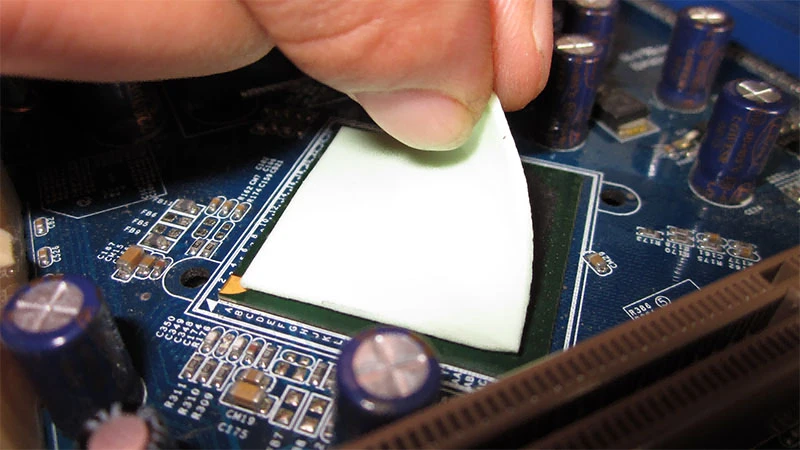
Performance snapshot
| Properties | Color | Thermal Conductivity | Thermal Impedance (1mm,@30psi) | Thickness | Standard Hardness |
| Unit | - | W/m·K | ℃*in²/W | mm | Shore 00 |
| AF100 | White | 1.0 | 1.1 | 0.25 ~ 5.0 | 50/70±5 |
| AF300 | White | 2.0 | 0.8 | 0.25 ~ 5.0 | 50/70±5 |
| AF500 | White | 3.0 | 0.6 | 0.25 ~ 5.0 | 50/70±5 |
| AF600 | White | 5.0 | 0.3 | 0.5 ~ 5.0 | 50/70±5 |
| AF600G | White | 6.0 | 0.25 | 0.5 ~ 5.0 | 50/70±5 |
| AF800 | White | 8.0 | 0.2 | 0.5 ~ 5.0 | 50/70±5 |
| AF1000 | Grey | 10.0 | ≤0.13 | 1.0 ~ 2.0 | 50~65 |
| Test Method | Visual | ASTM D5470 | ASTM D5470 | ASTM D374 | ASTM D2240 |
Sheen Technology positions these as a go-to when contamination control matters.
Graphite and Metalized Thermal Sheet Alternatives
Layer system:
Graphite or graphene sheets
- sometimes bonded with copper or aluminum
- forming ultra-thin thermal sheet paths
Step flow:
- Align flat surfaces
- Apply pressure evenly
- Let in-plane conduction dominate thermal dissipation
Key reality in the comparison between silicone-free and silicone-containing thermal pads:
- insane lateral heat spread
- almost zero compressibility
- needs precision machining
In short bursts:
- Fast heat.
- Tight tolerances.
- No forgiveness.
For high-end assemblies, Sheen Technology integrates these where traditional pads just can't keep up.
4 Key Factors In Thermal Pad Selection
Picking the right pad isn't just spec-sheet stuff; real-world performance gets messy. This guide compares silicone-free and silicone-containing thermal pads, breaking down what actually affects heat flow, durability, and reliability in daily use.
Thermal Conductivity vs. Interface Contact Resistance
Bulk thermal conductivity alone does not determine interface performance. Contact resistance — the additional resistance at the pad-to-surface interface — can add 0.1-0.5 °C·cm²/W depending on conformability.
- Silicone-containing pads: Lower contact resistance due to better surface wetting; the soft matrix deforms into asperities, reducing interfacial air gaps
- Silicone-free pads: Slightly higher contact resistance due to stiffer matrix; this gap shrinks as mounting pressure increases above 60 psi
As noted in a 2025 IPC materials brief: Thermal interface performance is increasingly dominated by contact efficiency rather than intrinsic conductivity. Engineers should evaluate total thermal impedance (bulk + contact), not bulk conductivity alone.
Compressibility and Gap Filling Capability
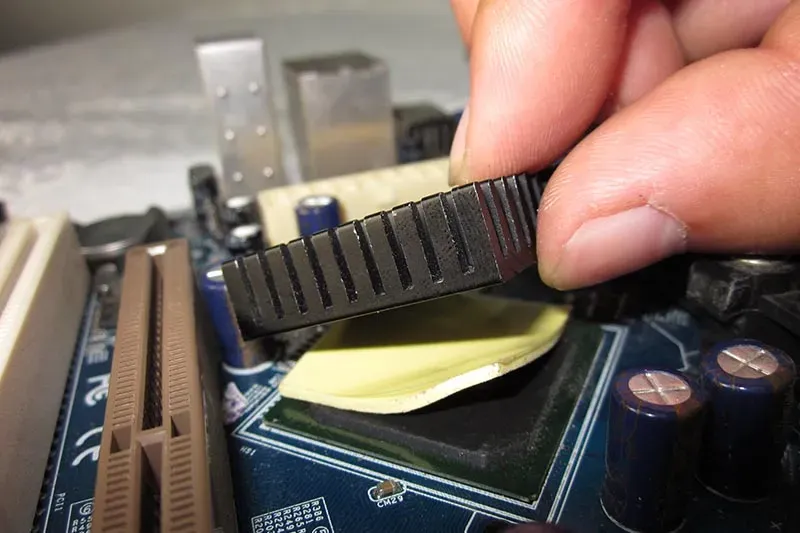
Compressibility determines how much of the surface area achieves solid-to-solid contact. Silicone pads typically achieve >95% contact area at 50 psi; silicone-free pads may require 70-100 psi to reach the same contact ratio.
- If the assembly provides 30-50 psi clamping force (typical for plastic-enclosure electronics): Silicone-containing pads are strongly preferred
- If the assembly provides 60-100 psi clamping force (typical for bolted metal-enclosure power modules): Either material family may be suitable
Sheen Technology provides both material families with compression-deflection curves to support accurate contact area prediction at the target mounting pressure.
Chemical Inertness: Outgassing Potential and VOCs
Key concern: contamination risk in tight electronics.
- Silicone-containing pads: Can release 0.5-1.5% volatile compounds by weight at 100-150 °C, dominated by cyclic siloxanes (D3-D6). These can condense on nearby surfaces, causing contact resistance in relays, lens fogging in optics, and adhesion failure in subsequent coating processes.
- Silicone-free pads: Total outgassing typically <0.1% by weight at 150 °C, with no siloxane species. Suitable for sealed enclosures containing sensors, lenses, or high-voltage contacts.
For applications where outgassing limits are specified (ASTM E595, TML <1.0%), Sheen Technology provides certified low-outgassing grades in both material families.
Long-Term Stability & Moisture Absorption
Short take: time and environment test everything.
- Silicone-containing pads: Excellent moisture resistance (absorption <0.5% after 1,000 hours at 85% RH); stable compression set at elevated temperatures. However, silicone can creep under sustained load, potentially reducing gasket pressure over multi-year periods.
- Silicone-free pads (polyurethane-based): May absorb 1-3% moisture in high-humidity environments, which can affect dielectric strength. Acrylic and epoxy-based silicone-free pads have better moisture resistance (0.5-1.5%).
Sheen Technology specifies moisture absorption data per ASTM D570 on all silicone-free grades and recommends polyurethane-free formulations for high-humidity operating environments.
Comparison Between Silicone-Free And Silicone-Containing Thermal Pads Performance
A clear comparison between silicone-free and silicone-containing thermal pads helps cut through the noise when picking materials for real-world thermal control. This comparison between silicone-free and silicone-containing thermal pads isn't just theory — it directly affects reliability, cleanliness, and long-term performance in electronics that run hot and tight.
Silicone-Free Thermal Pads

When looking at a comparison between silicone-free and silicone-containing thermal pads, this side leans heavily into cleanliness and durability, but with a few trade-offs that show up during installation.
Core traits
- Built from non-silicone materials with low outgassing
- Zero no silicone migration, which means serious contamination prevention
- Strong pump-out resistance, keeping interfaces stable over time
Performance flow
- Surface contact begins slightly limited due to stiffness
- Pressure increases — interface improves
- Stable thermal performance is maintained long term
Short snapshots:
Tough material. Clean operation. Reliable in sensitive optics and automotive electronics. Solid electrical isolation, though initial contact resistance can creep up if pressure is too low.
A quick note from field use — teams working with Sheen Technology often prefer this route where contamination risk simply isn't negotiable.
Silicone-Containing Thermal Pads

Now flip the comparison between silicone-free and silicone-containing thermal pads, and flexibility becomes the headline. These pads rely on silicone compounds to create excellent surface contact fast.
Functional layering
- Soft matrix enhances material flexibility
- Immediate gap filling reduces resistance
- High thermal conductivity boosts heat transfer
Benefits vs risks
- Strong interface contact
- Potential silicone migration
- Noticeable outgassing potential over time
- Vulnerable to pump-out effect in cycling conditions
In multiple short takes:
| Property | Silicone-Containing | Silicone-Free |
|---|---|---|
| Thermal Conductivity (W/mK) | 1.0-15.0 | 1.0-10.0 |
| Compression (%) | 30–70 | 10–40 |
| Outgassing Level | Medium–High | Very Low |
Soft feel. Easy install. Strong initial performance.
But over time? Stability can dip.
This comparison between silicone-free and silicone-containing thermal pads often lands on application needs. Sheen Technology solutions balance both ends, especially when designs demand both cleanliness and efficient heat flow.
And yes, in any serious comparison between silicone-free and silicone-containing thermal pads, the decision usually comes down to one thing — short-term efficiency versus long-term reliability.
Sheen Technology provides detailed technical datasheets for both silicone-containing and silicone-free thermal pads. Download the Thermal Pad Comparison Datasheet for complete specifications across both material families.
Scenario — High-Power LEDs: Pad Choice Guide
High-power LED builds live or die by thermal control, and yeah, pad choice really steers that outcome. This quick guide ties Comparison between silicone-free and silicone-containing thermal pads to real-world LED behavior, balancing heat flow, pressure, and long-term reliability without overcomplicating things.
Optimizing Junction Temperature Reduction in LED Modules
LED junction temperature directly affects luminous efficacy and lifetime. For a typical 10 W COB LED array:
- Silicone-containing pad (0.25 mm, 4 W/mK): Junction temperature 75 °C at 1 A drive current, 300 mA/mm² current density
- Silicone-free pad (0.25 mm, 5 W/mK): Junction temperature 78 °C at the same operating point, due to slightly higher contact resistance at the LED assembly's 40-50 psi clamping force
- The 3 °C delta narrows as clamping pressure increases, reaching parity at approximately 70 psi
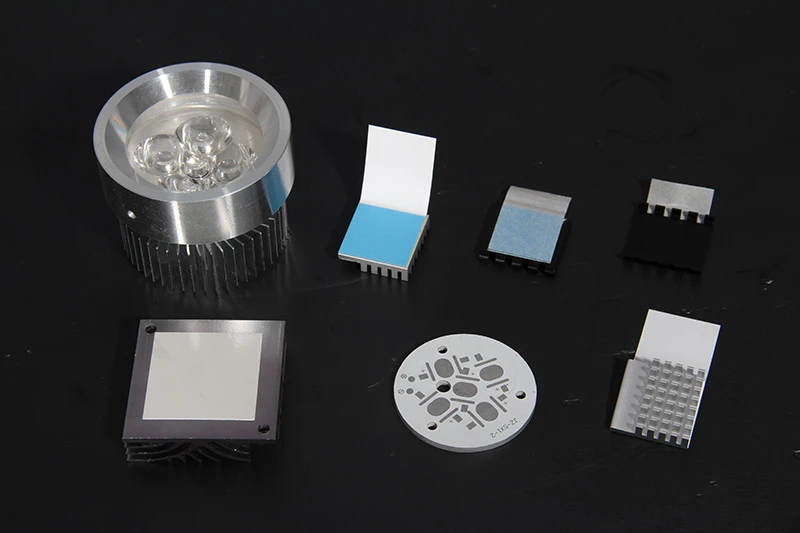
For LED assemblies with metal-housing bolted construction (60-100 psi), either material family performs comparably. For clip-on or plastic-housing LED modules (<50 psi), silicone-containing pads are the recommended choice.
Ensuring Power Dissipation Capability under High Current
At elevated drive currents (>500 mA/mm²), the thermal path becomes the limiting factor. A comparison of pad types under identical conditions:
- Silicone-containing (4 W/mK): Stable operation up to 1.2 A/mm²; gradual thermal drift beyond due to silicone creep
- Silicone-free ceramic-filled (5 W/mK): Stable operation up to 1.4 A/mm²; no creep, but stiffer matrix increases risk of die cracking if pressure is non-uniform
- Hybrid (silicone-free with conformable coating): Stable to 1.3 A/mm²; intermediate stiffness
Sheen Technology recommends silicone-free pads for LED assemblies operating above 1.0 A/mm² where long-term stability is prioritized over initial temperature delta.
Pressure Distribution and Component Stress in LED Arrays
In multi-chip LED arrays, uneven pad compression creates localized hot spots. The softer silicone matrix distributes pressure more evenly across the array, reducing the chip-to-chip temperature variation. Silicone-free pads require flatter heat sink surfaces to achieve equivalent temperature uniformity.
- Silicone-containing pads: Chip-to-chip delta T typically 2-4 °C across a 10-chip array at 50 psi
- Silicone-free pads: Chip-to-chip delta T typically 3-6 °C under the same conditions, improving to 2-4 °C when heat sink flatness is <25 μm
Sheen Technology provides pad flatness and compressibility data to support thermal simulation of both material families in LED array designs.
Explore Thermal Pad Applications. Sheen Technology silicone-free and silicone-containing thermal pads are deployed across automotive ECUs, optical sensor modules, medical electronics, power electronics, high-power LED lighting, and telecommunications base stations. Please visit applications page for application notes, selection guides, and case studies showing application-specific recommendations for both material families.
The choice between silicone-free and silicone-containing thermal pads is not a question of which is technically superior, but which is appropriate for the application constraints. Silicone-containing pads offer superior conformability and a wider operating temperature range at the cost of potential outgassing contamination. Silicone-free pads eliminate contamination risk entirely but require higher mounting pressure and flatter surfaces to achieve equivalent thermal performance.
Sheen Technology provides both material families with documented thermal, mechanical, and outgassing data, enabling engineers to select the correct pad type based on the specific contamination tolerance, clamping force, and thermal budget of each application. Contact our engineering team for a technical datasheet, free sample kit, or application-specific material recommendation.
Sheen Thermal
Dongguan Sheen Electronic Technology Co., Ltd · Founded in 2008
Manufacturer of thermal interface materials and silicone foam for automotive electronics, energy storage, power electronics, communications and consumer electronics.
Certified
- ISO 9001:2015
- ISO 14001:2015
- IATF 16949:2016
What we supply
- Thermal conductivity Up to 90 W/m·K
- Thickness 0.3–10.0 mm
- Custom & samples Die-cut to drawing, 3–7 days