
 English
 usheenthermal

Ultra-High Thermal Performance Graphene Pad: A Technical Review
Date:2026-07-24
Graphene thermal pads represent the highest-performance category of thermal interface materials, with through-plane thermal conductivity reaching 75-90 W/mK and interface thermal resistance as low as 0.12 °C·cm²/W at 50 psi mounting pressure.
This technical review examines the material properties, performance specifications, and application characteristics of ultra-high thermal performance graphene pads, with benchmark comparisons against silicone and phase-change thermal interface materials.
Harmonies of Ultra-High Thermal Performance Graphene Pad Guide Notes
Unmatched Heat Flux: Rapid thermal conductivity disperses power densities in CPUs, GPUs, and power modules for stable high-performance operation.
Perfect Surface Mating: Superior compressibility and conformity eliminate air gaps, boosting interface efficiency across uneven chip packages and heat sinks.
- Enduring Reliability: Exceptional resistance to thermal cycling preserves low thermal resistance over time, extending device lifetime and maintaining uptime.
Why Ultra-High Thermal Performance Graphene Pad?
Ultra-High Thermal Performance Graphene Pad solutions aren't just lab talk anymore — they're showing up in everyday devices. From gaming rigs to compact power modules, this graphene pad tech keeps heat under control without adding bulk or complexity.
Unmatched Thermal Conductivity and Heat Flux
Core behavior of an Ultra-High Thermal Performance Graphene Pad:
Heat moves fast due to high thermal conductivity
- Supports intense heat flux from CPUs and GPUs
- Speeds up heat transfer across the thermal interface
Graphene structure:
- Enhances dissipation under heavy loads
- Keeps performance stable during peak demand
Practical effect:
- Less throttling, smoother output
- Better efficiency in tight layouts using a graphene thermal pad
"High-conductivity interface materials are now essential for next-gen chip density and power scaling," notes a 2025 Yole Group thermal materials brief.
Ultra-Low Thermal Resistance for Hot-Spot Control
- Heat enters the Ultra-High Thermal Performance Graphene Pad
- Ultra-low thermal resistance reduces buildup
- Hot spot zones flatten out
- Lower junction temperature improves lifespan
- Stable temperature control enhances cooling
Sheen Technology Graphene thermal pad performance properties:
| Properties | Unit | GSF75-03 | GSF90-03 | Test Method |
| Color | - | Black | Black | Visual |
| Thermal Conductivity | W/m·K | 75 | 90 | ASTM E1461 |
| Thermal Resistance (@40psi) | ℃*cm2/W | ≤0.12 | ≤0.10 | ASTM D5470 |
| Thickness | mm | 0.3~2.0 | 0.3~2.0 | ASTM D374 |
| Density | g/cm³ | 0.3~0.7 | 0.3~0.7 | ASTM D792 |
| Rebound Rate | % | ≥90 | ≥90 | - |
| Tensile Strength | Mpa | ≥0.03 | ≥0.05 | ASTM D412 |
| Oil Bleeding Rate | % | ≤3 | ≤3 | / |
| Application Temperature | ℃ | -40~150 | -40~150 | / |
| Flame rating | - | V-0 | V-0 | UL 94 |
This ultra-high thermal graphene pad approach keeps thermal impedance low, which is exactly what high-power chips need when things get intense.
Superior Surface Conformity and Compressibility
Short and sweet:
- Strong surface conformity = better contact
- High compressibility = fills micro gaps
- Reduced contact resistance improves flow
- Easy gap filling with flexible structure
- Balanced interface pressure avoids damage
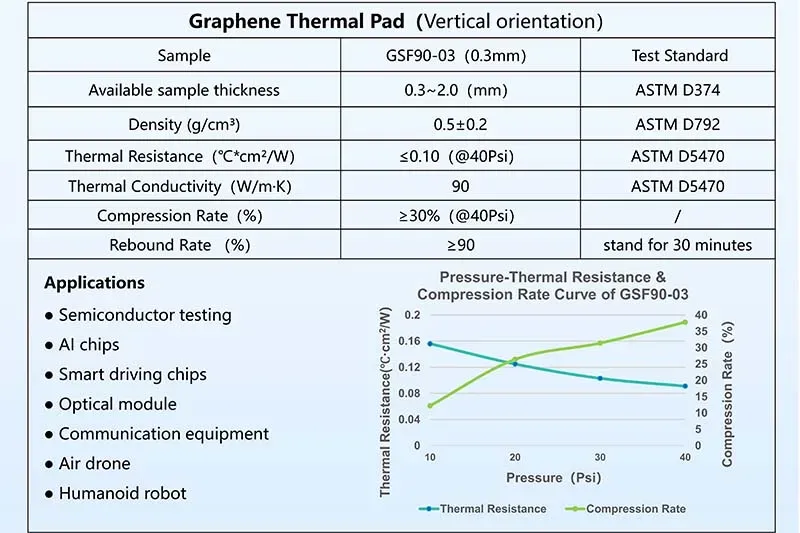
That soft-but-efficient feel helps the Ultra-High Thermal Performance Graphene Pad settle nicely into uneven surfaces without losing performance.
Long-Term Stability Under Thermal Cycling
A closer look at durability using an Ultra-High Thermal Performance Graphene Pad:
1) Material response over time:
- Handles repeated thermal cycling
- Resists performance degradation
- Maintains material integrity
- Adapts to temperature fluctuations
- Prevents cracking or drying
2) Reliability outcomes:
- Longer lifespan for electronics
- Consistent long-term stability in real-world use
Sheen Technology GSF90 Graphene thermal pad reliability test report:
- Test Conditions
| Test Item | Test Conditions | Test Equipment |
| High-Temperature Aging | 125 ℃, 1000 h | Constant-temperature Oven |
| High-Temperature High-Humidity | 85 ℃ / 85 %RH | Temperature & Humidity Chamber |
| Thermal Shock | -40 ℃ ↔ 150 ℃ | Thermal Shock Chamber |
- Criteria for Evaluation
| Property | Initial Value | Acceptance Criterion |
| Thermal Resistance(°C·cm²/W) | 0.094 | ±15% of initial value |
- High-Temperature Aging test results
| Aging time | Unit | 0 | 200 | 400 | 600 | 800 | 1000 | judge |
| Thermal Resistance | °C·cm²/W | 0.094 | 0.096 | 0.097 | 0.096 | 0.099 | 0.101 | OK |
- High-Temperature High-Humidity Aging test results
| Aging time | Unit | 0 | 200 | 400 | 600 | 800 | 1000 | judge |
| Thermal Resistance | °C·cm²/W | 0.095 | 0.096 | 0.096 | 0.097 | 0.096 | 0.098 | OK |
- Thermal Shock Aging test results
| Aging time | Unit | 0 | 200 | 400 | 600 | 800 | 1000 | judge |
| Thermal Resistance | °C·cm²/W | 0.094 | 0.095 | 0.096 | 0.095 | 0.096 | 0.097 | OK |
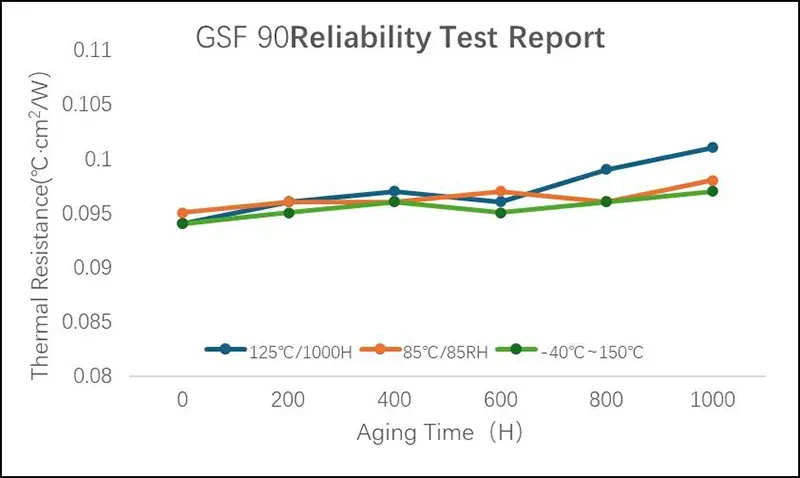
Test Conclusion: The GSF90 samples exhibited a performance variation of no more than 15 % after 1000 h exposure to the combined aging conditions (125 °C, 85 °C/85 %RH, and –40 ~ 150 °C thermal shock). Accordingly, the GSF90 reliability test is deemed conforming.
3 Engineering Advantages of Graphene Thermal Pads
A quick, real-world take: if heat is choking your design, an Ultra-High Thermal Performance Graphene Pad can shift the balance. From tighter thermal management to longer uptime, this graphene pad tech delivers where it counts.
Reason 1: Drastically Lower Junction Temperatures in Power Modules
Power stages push limits; the Ultra-High Thermal Performance Graphene Pad drops junction temperature fast and keeps it there.
Heat path refinement
- Interface: lowers thermal resistance between die and sink
- Bulk spread: accelerates heat dissipation across the pad
- Result: cooler power module and stable semiconductor device
Load behavior
- Peak spikes → flattened
- Continuous duty → fewer hot spots in each electronic component
Practical integration
- Pair with heatsinks, vapor chambers, or cold plates
- Works in compact stacks where airflow is tight
Sheen Technology tunes its Ultra-High Thermal Performance Graphene Pad for consistent contact, so gains aren't just lab numbers — they show up on your board.
Reason 2: Ultra-Low Interface Resistance for Heat Sink Coupling
Short take: better fit equals better cooling. The Ultra-High Thermal Performance Graphene Pad flows into micro-gaps, improving surface contact and lowering thermal impedance without cranking interface pressure.
- Conformity boosts thermal conductivity where it matters: the interface
- Acts as a high-grade thermal interface material with strong gap filling
- Plays nicely with copper, aluminum, and composite heat sink bases
Data snapshot:
| Material | Interface Thermal Resistance (°C·cm²/W) | Compression @ 40 psi (%) |
|---|---|---|
| SF1000 Silicone pad | 0.83 | - |
| SP205-30 Phase-change | 0.32 | - |
| Ultra-High Thermal Performance Graphene Pad | 0.10 | 30 |
Sheen Technology keeps thickness uniform, so assembly repeatability stays tight across batches.
Reason 3: Thermal Cycling Stability and Device Lifetime Extension
Graphene pads maintain stable thermal performance through repeated temperature excursions. Accelerated life testing results:
- Thermal impedance change after 1,000 cycles (−40 °C to +125 °C): <5% for graphene pads vs 8-15% for standard silicone pads
- No material migration, pump-out, or phase separation observed in graphene pads after cycling
- Solder joint thermal fatigue reduced by approximately 40% due to lower peak die temperature and reduced delta-T per cycle
Sheen Technology graphene pads are qualified to JEDEC JESD22-A104 thermal cycling standards for automotive and industrial applications.
Performance Benchmarks: Graphene vs. Silicone Pads
Quick heads-up before diving in — thermal pad choice can make or break heat flow in tight electronics. From an Ultra-High Thermal Performance Graphene Pad to classic silicone, the difference shows up fast in real builds.
Graphene Pads
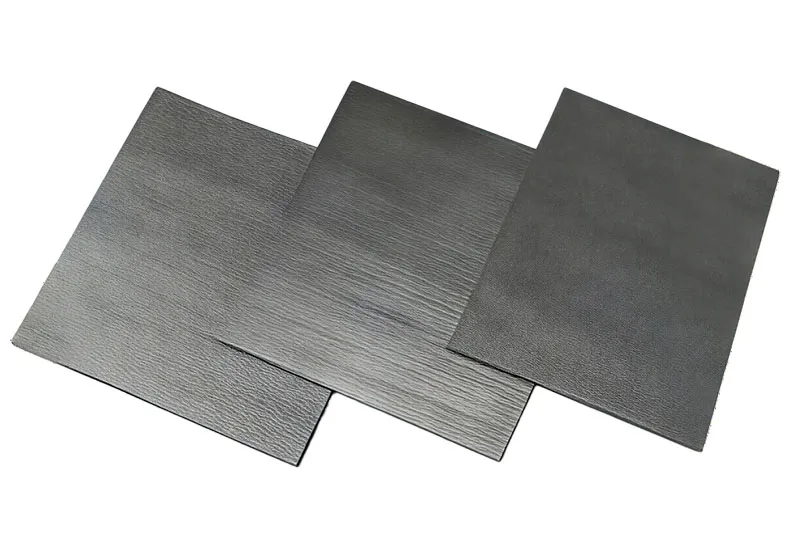
When pushing serious heat loads, an Ultra-High Thermal Performance Graphene Pad behaves less like a filler and more like a high-efficiency heat highway. The material structure drives exceptional thermal conductivity and stable performance across demanding conditions.
Core performance layers
Heat intake
- Direct surface contact improves interface material efficiency
- Rapid though-plane spreading boosts heat dissipation efficiency
Heat transfer
- Ultra-high thermal graphene pad enables dense heat flux handling
- Reduced hotspots across chips and modules
Output stability
- Maintains consistent flow under pressure and temperature swings
Mechanical traits
- Flex pattern — Balanced flexibility avoids cracking under compression
- Long-term use — Strong durability resists pump-out and degradation
Application impact
- High-density GPUs, AI chips, EV modules
Sheen Technology integrates ultra-high thermal graphene pad designs to stabilize peak loads without overengineering cooling stacks.
"Advanced carbon-based interface materials are setting new benchmarks in thermal management efficiency for next-gen electronics." — 2025 thermal materials outlook, IDTechEx
In short bursts or sustained loads, Ultra-High Thermal Performance Graphene Pad solutions consistently outperform, especially where every degree counts.
Silicone Pads

Silicone pads play it safer, trading peak performance for adaptability. The thermal interface is softer, leaning on compressibility and conformability to fill uneven gaps quickly.
Here's how that plays out in practice:
Quick advantages
- Easy installation
- Strong dielectric strength for electrical safety
- Reliable gap filling across varied surfaces
Limitations that show up under load
- Higher thermal impedance slows heat transfer
- Moderate heat transfer struggles with concentrated hotspots
- Material fatigue can impact long-term consistency
Real-world use rhythm
- Works fine in low-to-mid power devices
- Starts lagging in high-density systems where ultra-high thermal graphene pad options shine
Sheen Technology still supports silicone solutions where flexibility matters more than raw performance, but once systems scale, Ultra-High Thermal Performance Graphene Pad upgrades become the smarter call.
Short version? Silicone adapts. Graphene performs.
Application Scenario: GPU Cooling with Graphene
Fast GPUs run hot, no surprise there. The fix isn't just bigger fans — it's smarter contact and cleaner heat paths. That's where Ultra-High Thermal Performance Graphene Pad tech steps in, tightening the thermal loop without adding bulk.
Integration with High-Power GPU Heat Sinks
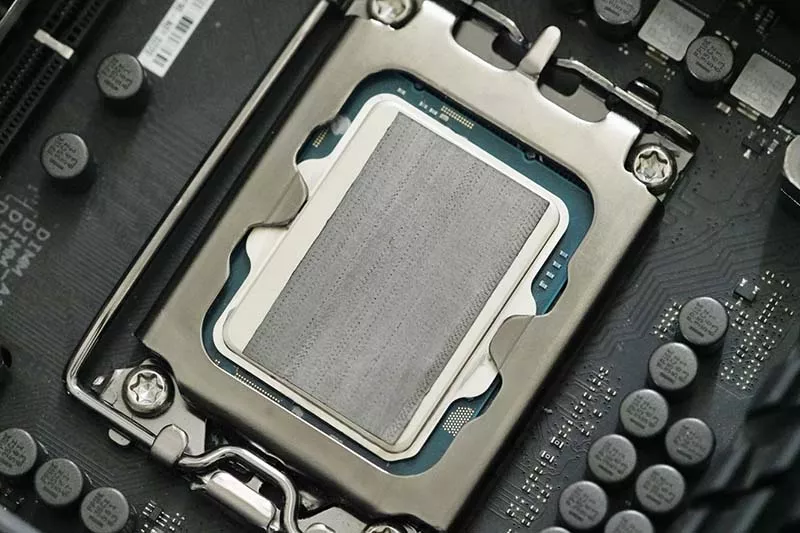
Core path
Contact layer
- graphene pad sits between GPU die and heat sink, reducing interface resistance
- boosted thermal conductivity drives faster heat transfer
Mechanical fit
- precise mounting pressure keeps the thermal interface uniform
- avoids air gaps that choke performance
Material behavior
- Ultra-High Thermal Performance Graphene Pad adapts under load
- Ultra High Thermal Graphene Pad maintains consistency during spikes
Practical gains
- cooler hotspots, smoother boost clocks
- fewer throttling events during gaming or compute bursts
Sheen Technology tunes each Ultra-High Thermal Performance Graphene Pad for tight tolerance, so the contact layer behaves predictably even when the GPU is pushed hard.
Achieving Lower Operating Temperature in Data Centers

Mixing airflow, rack layout, and better interfaces changes the whole vibe in a data center.
1) Swap legacy pads for Ultra-High Thermal Performance Graphene Pad
2) Optimize server racks spacing and ambient temperature
3) Track PUE and energy consumption as temps drop
"Thermal interface upgrades can cut server operating temperature by several degrees, translating into measurable PUE gains," notes a 2025 IDC data center efficiency brief.
Short takes:
- Better cooling efficiency = fewer fan spikes
- Lower operating temperature stabilizes workloads
- Graphene thermal pad tech scales cleanly across racks
Sheen Technology deployments often pair pad upgrades with airflow tuning, squeezing more out of existing infrastructure without major rebuilds.
Reliability Gains Under Continuous Load Testing
Steps that matter during continuous load and stress testing:
- Apply Ultra-High Thermal Performance Graphene Pad with calibrated pressure
- Run thermal cycling to expose weak contact zones
- Monitor degradation and performance stability over time
- Validate lifespan under long-term operation
Results stay consistent: fewer thermal swings, less material fatigue, and steadier clocks.
Sheen Technology ultra-high thermal performance graphene pads are deployed across high-power GPU assemblies, data center server boards, automotive traction inverters, RF power amplifiers, and high-performance computing modules. Please visit relate applications pages for application notes, reference designs, and case studies showing integration across different power levels and thermal budgets.
Ultra-high thermal performance graphene pads deliver thermal conductivity 3-5x higher than standard silicone pads and interface resistance 50-65% lower, in an ultra-thin format that integrates into tight layouts.
Sheen Technology provides ultra-high thermal performance graphene pads in thicknesses from 0.3 mm to 2.0 mm, with custom die-cutting, roll formats, and isolated/conductive grade options. Contact our engineering team for a technical datasheet, free sample kit, or application-specific material recommendation.
Sheen Thermal
Dongguan Sheen Electronic Technology Co., Ltd · Founded in 2008
Manufacturer of thermal interface materials and silicone foam for automotive electronics, energy storage, power electronics, communications and consumer electronics.
Certified
- ISO 9001:2015
- ISO 14001:2015
- IATF 16949:2016
What we supply
- Thermal conductivity Up to 90 W/m·K
- Thickness 0.3–10.0 mm
- Custom & samples Die-cut to drawing, 3–7 days