
 English
 usheenthermal

How Custom Die Cut Silicone-Free Thermal Pads Enhance Performance
Date:2026-01-28
How Custom Die Cut Silicone-Free Thermal Pads Enhance Performance
When the temperature of your circuit board is higher than the temperature of the road surface, and your off-the-shelf thermal solution? It’s flaking out like a cheap umbrella in a thunderstorm. That’s where the custom die cut silicone-free thermal pad slides into the picture—no gunk, no ghosting on sensitive surfaces, just clean-cut precision designed for high-temp hustle. Engineers from telecom to EVs are swapping out those greasy old solutions faster than you can say “overheating shutdown.”
According to Yole Intelligence's 2023 Thermal Interface Material report, demand for non-silicone pads is climbing fast across sectors needing contamination-free performance—think aerospace optics and next-gen automotive sensors.
The Importance of Custom Die Cut Silicone-Free Thermal Pads
A well-designed custom die cut silicone-free thermal pad isn’t just a component—it’s the unsung hero in heat management for electronics.Why Customization Matters for Thermal Interface Materials
- A custom TIM adapts to every curve and corner of your hardware, unlike one-size-fits-all solutions. That means more surface contact and less trapped air.
- Engineers can tweak for exact thickness, compressibility, or even layered designs—giving you real control over thermal impedance and fit.
- With application-specific tailoring, you're not just improving heat transfer; you're unlocking smarter system design with better airflow paths and lower fan speeds.
Advantages of Silicone-Free Thermal Solutions in Electronics
Silicone-free TIMs eliminate the risk of outgassing that can fog lenses or corrode circuitry. They’re also ideal where volatile organic compound (VOC) limits are strict—think medical devices or aerospace.As noted by Yole Intelligence in its Q1 2024 report on advanced packaging materials: “The shift toward silicone-free materials is accelerating due to contamination concerns in high-density systems.”
The Role of Design in Heat Management Efficiency
You don’t need fancy software to know that good design beats brute force cooling every time.- When you optimize your thermal design with smart placement of components and precision-shaped pads, you minimize resistance across the entire thermal path.
- Proper interface pressure ensures better conductivity between surfaces.
- Tailored cooling solutions reduce hotspots without overengineering the rest of the system.
Essential Features of Custom Die Cut Silicone-Free Thermal Pads
These pads are engineered for next-gen cooling, electrical safety, and long-term reliability in demanding environments.High Thermal Conductivity Performance of Advanced Materials
- Built with advanced materials like graphite composites and ceramic-filled polymers that boost thermal conductivity to exceptional levels.
- Heat flows fast—these pads lower junction temperatures significantly, which means better performance and longer component life.
- The way they handle heat dissipation is no joke; these things keep CPUs and power modules from frying under pressure.
Excellent Electrical Insulation Properties for Safety
- High dielectric strength prevents current leakage even at elevated voltages.
- Non-conductive surface ensures safe separation between live circuits and metal enclosures.
- These thermal pads don’t just cool—they protect.
Reliable Long-Term Thermal Stability: Key to Durability
It’s not enough to perform well on day one—these silicone-free thermal pads stay stable even after thousands of hours under stress testing conditions. With strong resistance to oxidation, UV exposure, and mechanical wear, their thermal stability ensures minimal degradation over time.Custom-Fit Design Enhances System Integration
Each pad is precisely die-cut to match unique device geometries—no trimming needed after install. – Whether it’s a tight PCB layout or irregular-shaped housing, the custom fit avoids air gaps that kill efficiency. – That perfect alignment improves both contact resistance and system assembly time.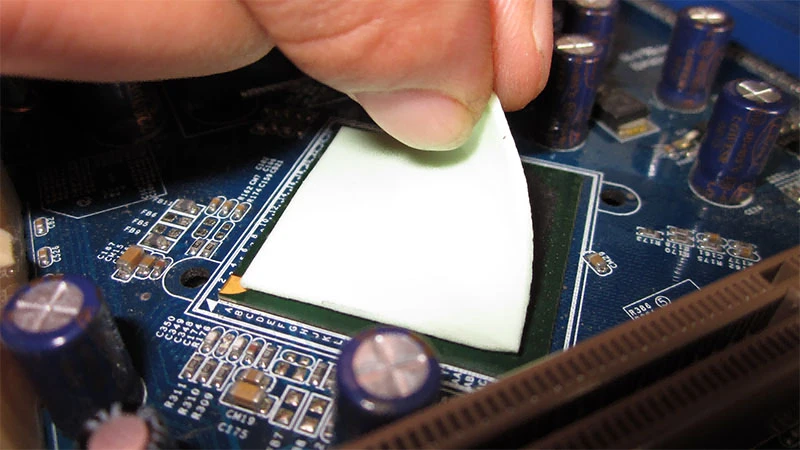
Material Science Drives Innovation in Pad Composition
- Ceramic fillers boost both heat transfer and insulation.
- Polymer matrices balance flexibility with mechanical durability.
- Surface coatings enhance wet-out on rough surfaces.
Electrical Isolation Meets Mechanical Compliance
High-voltage isolation ratings (>5 kV/mm) prevent arc faults even in compact layouts. Simultaneously soft enough to compress around uneven components without damaging them. This combo of electrical safety + mechanical compliance makes them perfect for multi-layer board assemblies where spacing is tight but protection can’t be compromised.Enhanced Lifespan Through Aging Resistance Technologies
- Anti-oxidative additives reduce material breakdown over time.
- UV-stabilizers extend outdoor usability without yellowing or cracking.
- Low outgassing formulas prevent contamination inside sealed electronics housings.
With all these stacked advantages—from killer thermal management to top-tier safety—the custom die cut silicone-free thermal pad isn’t just a component; it’s an unsung hero keeping tech alive behind the scenes.
How Custom Design Enhances Thermal Pad Performance
Tailored thermal pad engineering delivers smarter heat control and tighter mechanical fit, especially in high-performance electronics.Precision die-cutting improves performance
- Automation ensures uniform cuts across thousands of units.
- Precision tooling allows intricate geometries without compromising material integrity.
- Material processing is optimized to reduce edge fray and thickness variance.
- Tolerances stay within ±0.05 mm, ensuring tight-fitting pads every time.
Optimized Thermal Interface Design for Maximum Efficiency
The difference between “meh” and “wow” in heat transfer often comes down to how the interface is built. A well-designed thermal interface design isn’t just about slapping on material—it’s about tailoring it to the device’s quirks:- High thermal conductivity materials like graphite composites or ceramic-filled polymers push heat out faster.
- Silicone-free variants reduce outgassing risks in sensitive environments like optics or aerospace boards.
- Gap fillers are customized to match component spacing, ensuring zero air pockets—because even tiny voids kill performance.
Specific Thickness Dimension Requirements in Customization
Getting the right thickness isn’t just cosmetic—it’s critical to function. Here’s why:| Application Type | Ideal Thickness Range | Compression Force Needed | Common Material Used |
| Automotive ECUs | 0.5–2 mm | Medium | Graphite-infused polymer |
| High-frequency RF boards | <0.5 mm | Low | Ceramic elastomer |
| Power modules | >2 mm | High | Soft foam composite |
| LED lighting systems | ~1 mm | Low-Medium | Silicone-free gel sheet |
Picking the wrong thickness? That can lead to uneven pressure distribution or poor contact with heatsinks—which means higher temps and shorter lifespans for your gear.
Each custom material thickness, when matched precisely with compression specs, forms a seamless bridge between hot spots and cooling elements—no waste, no wiggle room.
With Sheen Electronic Technology's customization capabilities, every custom die cut silicone-free thermal pad meets both dimensional accuracy and tailored application requirements down to the micron level.
Critical Applications for Custom Silicone-Free Thermal Management
When electronics push limits, thermal solutions must follow suit. Here's how custom die cut silicone-free thermal pad tech keeps things chill and reliable.Electronic Device Thermal Management Strategies
- Smartphones, tablets, and wearables are shrinking—yet their power demands keep rising. That’s a heat trap waiting to happen.
- To tackle this, engineers are turning to silicone-free TIMs that stay stable under pressure. Unlike thermal greases or thermal gels, these pads don’t ooze or degrade over time.
- A custom die cut silicone-free thermal pad can be shaped precisely around tight components. It’s like giving your PCB a fitted jacket that wicks away heat without bulk.
- Want better signal integrity? Keeping chips cool with custom thermal pads also minimizes electrical noise caused by overheating.
Power Electronics Heat Dissipation Techniques
Thermal Interface Materials- High-conductivity fillers in thermal interface materials ensure consistent contact between hot surfaces and heatsinks.
- Silicone-free variants eliminate outgassing risks in sealed systems like EV battery packs.
- Ideal for high-voltage converters and industrial drives where contamination can’t be tolerated.
- A custom die cut silicone-free thermal pad ensures full coverage on irregular component layouts.
.webp "silicone Thermal pad")
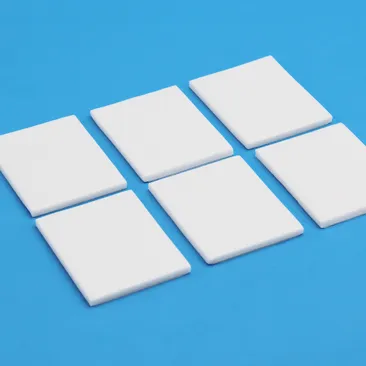

| Product Series | SF1500 Thermal Pad |
AF800 Silicone-free Thermal Pad |
CSF45 Carbon fiber thermal pad |
SE100 thermal gel |
SG560-50 thermal paste |
SP205A-60 phase change thermal pad |
| Thermal Conductivity (W/mK) |
15.0 | 8.0 | 45.0 | 10.0 | 5.0 | 6.0 |
| Thermal Resistance (°C·in²/W) @30psi |
0.1 | 0.2 | 0.07 | 0.045 | 0.015 | 0.015 |
| Thickness Range (mm) |
1.0~5.0 | 0.5~5.0 | 0.3~12.0 | - | - | 0.2~0.5 |
| Density (g/cm³) |
3.2 | 3.4 | 2.6 | 3.4 | 2.8 | 3.0 |
| Operating Temperature (°C) |
-40~120 | -40~125 | -50~160 | -50~150 | -50~150 | -40~125 |
With power systems demanding more juice than ever, these innovations aren't optional—they're essential for maintaining uptime and trust in critical environments.
Performance at High Temperatures: What to Expect
Understanding how materials behave when things heat up is key. Here's what you should know about performance, tolerance, and thermal choices.Defined Operating Temperature Ranges for Optimal Function
- Most operating temperature windows fall between –20°C and +100°C, but high-demand applications may push that ceiling higher.
- A typical temperature range for a quality silicone-free thermal pad spans from –40°C up to +125°C without degradation.
When choosing a custom die cut silicone-free thermal pad, don’t just wing it—check those specs! Heat tolerance isn’t just a number; it’s your system's survival plan.
Comparison of Thermal Solutions for High-Temperature Applications
Silicone-free? Grease? Phase change? Let's break it down real quick:- Silicone-free pads are mess-free, easy to handle, and offer solid mid-range performance—perfect when you want clean assembly without compromising on heat dissipation.
- Traditional thermal grease gives excellent contact but can dry out over time under prolonged high-temp exposure—especially beyond its rated upper limit (~150–180°C).
- Phase change materials adapt well during cycling but may suffer from pump-out issues if not properly contained.
So if you're working on something where reliability trumps all else—like EVs or aerospace—you’ll want a custom die cut silicone-free thermal pad that balances stable contact with long-term durability across variable temperatures.
FAQs about Custom Die Cut Silicone-Free Thermal Pad
Why are silicone-free thermal interface materials chosen for sensitive electronics?Silicone-free pads, especially when precision die cut, avoid oil migration that can cloud optical paths or weaken semiconductor bonds. With superior heat transfer capabilities, they keep crucial parts balanced between temperature extremes—perfect for tasks like electronic device thermal management and LED lighting thermal solutions.
How does high thermal conductivity performance affect power electronics cooling?
A sharp rise in load means heat builds fast. Materials like custom die cut thermal pads, paired with high performance thermal grease, rapidly pull that warmth into safer zones. Consistent flow prevents stress fractures in boards and keeps drivetrains humming inside the automotive electronics assembly industry.
Can specific thickness requirements really be met during large-scale production?
Yes—thanks to a controlled thickness tolerance production process, backed by automated die cutting machinery systems and inspected with high resolution measurement devices. This ensures every pad slips into place without forcing a redesign mid-production run.
What role does excellent electrical insulation play on printed circuit boards?
It’s not just about avoiding shorts—it’s peace of mind over time:
- Shields copper traces from micro-arcs under surge conditions.
- Maintains reliable long-term stability even through thousands of cycles.
- Works alongside an electrically insulating thermal potting compound, keeping circuits calm while temperatures spike during assembly reflows.
Why does operating temperature range matter when sourcing bulk quantities?
Defined boundaries protect projects from environmental surprises—cold-field installations in aerospace or high-humidity industrial floors alike benefit here:
- Match product properties to location demands instantly using manufacturer data sheets.
- Avoid costly recalls by ensuring compatibility before mass deployment across the globe via precise assessments from advanced testing instruments used in supply vetting processes.
Sheen Thermal
Dongguan Sheen Electronic Technology Co., Ltd · Founded in 2008
Manufacturer of thermal interface materials and silicone foam for automotive electronics, energy storage, power electronics, communications and consumer electronics.
Certified
- ISO 9001:2015
- ISO 14001:2015
- IATF 16949:2016
What we supply
- Thermal conductivity Up to 90 W/m·K
- Thickness 0.3–10.0 mm
- Custom & samples Die-cut to drawing, 3–7 days