
 English
 usheenthermal

Need Precise Thermal Control? Try Our Customization Service for Phase Change Materials
Date:2026-06-02
Need Precise Thermal Control? Try Our Customization Service for Phase Change Materials
Heat is wrecking your hardware, and generic fixes can’t keep up. Our Customization service for phase change materials dials thermal control to your exact build.
From servers to EV boards, hotspots don’t play nice. Tailored PCM stops drift, boosts stability, keeps performance steady under pressure.
Reading Notes: Customization Service for Phase Change Materials
· Formulation Flexibility: Tailor paraffin-based, salt hydrate or eutectic alloy blends to optimize latent heat and phase transition behavior.
· Targeted Thermal Profiles: Align melting temperature and viscosity with device hotspots—from semiconductors to EV boards—for precise heat buffering.
· Manufacturing Methods: Choose vacuum impregnation, injection molding or additive processes to integrate PCMs into complex geometries without leakage.
· Performance Validation: Conduct thermal cycling tests, heat-flux measurements and lifetime prediction to ensure stability and reliability under repeated phase changes.
· Supply Chain Assurance: Secure bulk sourcing, quality-assured materials and global logistics for consistent PCM performance.
Types Of Phase Change Materials And Customization Options
Smart thermal control is no longer optional; it is engineered. From organic to inorganic systems, material selection and Customization service for phase change materials now shape performance, safety, and lifecycle cost in real-world thermal energy storage applications.
Paraffin-Based Compounds: Tailoring Latent Heat Capacity
Paraffin systems, built from long-chain hydrocarbons, remain popular for stable phase change cycling.
· Adjustable latent heat through carbon chain tuning
· Additives improving enthalpy and crystallization
· Conductive fillers supporting heat flow
For brands needing reliable Customization service for phase change materials, tuning happens at three nested levels:
Molecular Design
· Chain length modification
· Additive blending
Performance Engineering
· Latent heat targeting
· Cycling durability testing
Application Fit
· Encapsulation pairing
· System integration
With Sheen Technology, PCM customization balances energy density and stability without overcomplicating procurement.
Salt Hydrate Mixtures with Optimized Melting Ranges
Salt hydrates offer high storage density but demand tight optimization of melting point and crystallization control.
| Material | Type | Melting Point (°C) | Latent Heat (kJ/kg) | Stability |
| CaCl2·6H2O | Inorganic | 29 | 190 | Moderate |
| Na2SO4·10H2O | Aqueous | 32 | 254 | Good |
| MgCl2·6H2O | Eutectic blend | 117 | 168 | Stable |
| KNO3 mix | Inorganic | 222 | 95 | High |
| Custom blend | Hybrid | 18–45 | 160–230 | Tuned |
Structured development often follows:
Composition Design
· Eutectic ratio calculation
· Additive screening
Stability Control
· Anti-supercooling agents
· Encapsulation trials
Validation
· Thermal cycling
· Property benchmarking
This is where Customization service for phase change materials becomes practical, not theoretical. Sheen Technology supports tailored thermal properties for HVAC, battery packs, and cold-chain logistics.
Polymer Composites for Enhanced Shape Stability
When leakage is a deal breaker, polymers step in.
· Embedded PCM within a matrix
· Improved mechanical properties
· Reinforced structural integrity
Matrix Selection
· Thermoplastic compatibility
· Adhesion strength
Composite Structuring
· PCM dispersion control
· Micro-encapsulation
Performance Testing
· Shape stability cycles
· Impact resistance
A strong Customization service for phase change materials aligns composite ratios with housing constraints and load profiles.
Eutectic Alloys and Encapsulation Design Choices
Eutectic alloys deliver sharp transition temperatures defined by the phase diagram.
Design decisions typically include:
Core Material
· Metallic composition
· Transition precision
Encapsulation Strategy
· Microencapsulation shell thickness
· Oxidation protection
Heat Transfer Boost
· Surface structuring
· Enhanced thermal conductivity
Short, sharp transitions mean predictable heat transfer. Add engineered encapsulation, and volume change stays controlled.
For industries seeking repeatable performance, Customization service for phase change materials bridges lab chemistry and field deployment—backed by application-driven engineering at Sheen Technology.
Need a closer match for your project? Browse these related application pages to see where customized phase change materials are used in real systems.
Thermal Hotspots? Try Our Customization For PCM
Thermal spikes don’t wait. High-density boards, compact housings, and rising power loads push materials hard. That’s why Customization service for phase change materials matters now more than ever. From semiconductors to automotive electronics and LED lighting, tailored PCM design keeps thermal management practical, scalable, and reliable in the real world.
Targeting High-Power Semiconductors with Thermal Conductivity Enhancement
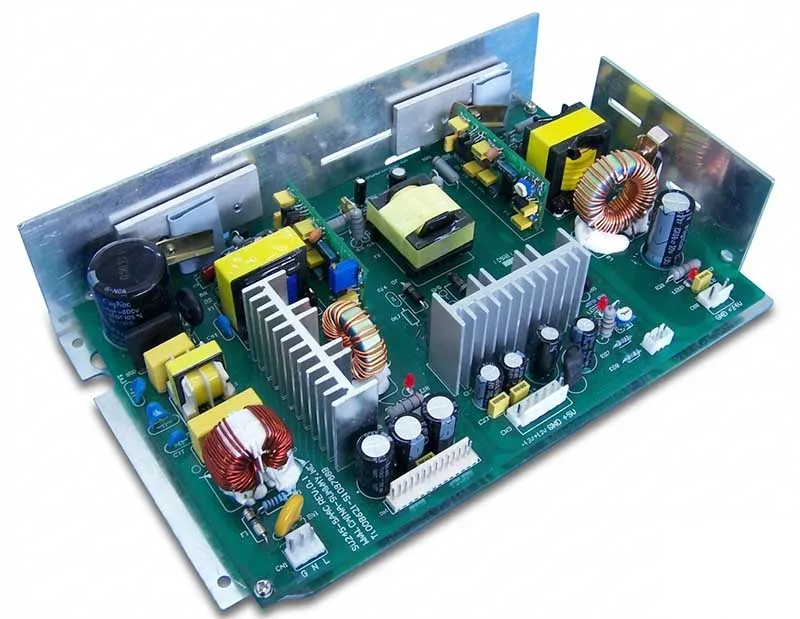
High-current power devices demand serious heat dissipation. A one-size PCM simply won’t cut it. Our Customization service for phase change materials aligns filler ratio, carrier matrix, and melting point for tighter electronics cooling control.
· Boost thermal conductivity with hybrid fillers
· Maintain latent heat without phase drift
· Improve thermal interface contact efficiency
Key tuning layers:
Filler selection
· Graphite networks
· Aluminum nitride
Dispersion control
· Surface treatment
· Viscosity balance
Interface design
· Gap filling
· Pump-out resistance
Thermal comparison snapshot:
| Device Type | Power Density (W/cm²) | Standard PCM (W/m·K) | Customized PCM (W/m·K) |
| IGBT Module | 120 | 1.8 | 6.5 |
| MOSFET Pack | 95 | 2.0 | 7.1 |
| SiC Module | 150 | 2.2 | 8.0 |
| CPU Array | 85 | 1.5 | 5.9 |
That jump in conductivity directly supports stable junction temperatures. This is where Customization service for phase change materials turns thermal limits into performance headroom.
Managing Automotive Electronics’ Peak Temperatures via Encapsulation Integrity
Cars run hot. Then cold. Then hot again. Automotive electronics face brutal thermal cycling and vibration stress. A stable PCM isn’t optional; it’s survival gear.
Core concerns
Encapsulation
· Leakage prevention
· Chemical compatibility
Thermal stability
· Repeated phase transition control
· Structural cohesion
Component reliability
· Crack resistance
· Moisture tolerance
Performance safeguards:
· Vibration-tested encapsulants
· Controlled expansion rates
· Long-cycle temperature control stability
According to the International Energy Agency’s 2024 Global EV Outlook, electric vehicle sales surpassed 14 million units in 2023 and continue climbing in 2025, intensifying demands on battery-adjacent thermal performance systems.
“Advanced thermal management materials are becoming central to EV reliability and safety performance,” notes BloombergNEF’s 2025 electric mobility analysis.
That pressure makes Customization service for phase change materials essential. Sheen Technology engineers PCM encapsulation systems that hold form under shock, heat, and long service cycles—no messy leakage, no sudden drop in efficiency.
Cooling LED Lighting Systems through Viscosity and Phase Transition Tuning
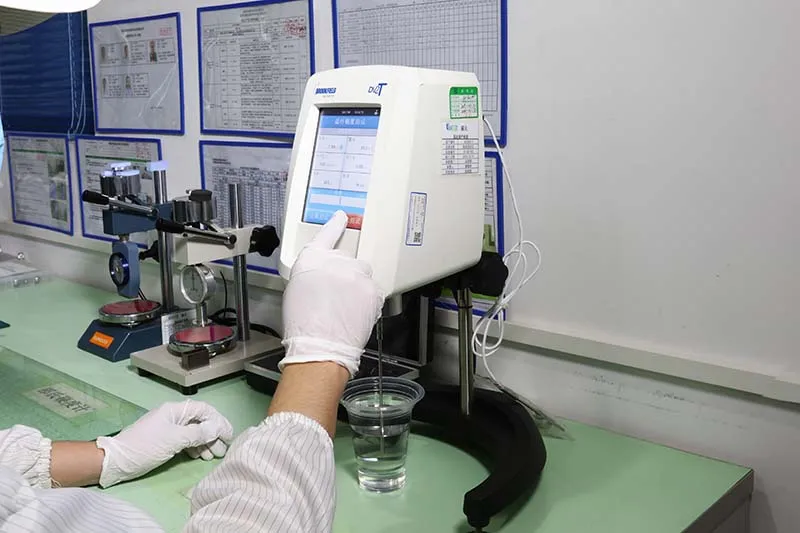
LED arrays look cool. Internally, not so much. Poor heat transfer ruins lumen stability fast.
Quick wins include:
· Adjusted viscosity for uniform coating
· Targeted phase transition range
· Balanced material tuning for smooth dispensing
Optimization pathway:
· Define operating temperature band
· Tune melting threshold ±2°C
· Validate coating flow behavior
· Confirm long-term thermal management stability
Layered engineering focus:
LED lighting modules
· Optical housing limits
· Airflow constraints
PCM behavior
· Flow under shear
· Re-solidification speed
Final system
· Uniform thermal performance
· Extended driver lifespan
When the melt point aligns precisely with real operating peaks, temperature swings shrink. Output stays consistent. Maintenance cycles stretch longer.
That’s the practical edge of a refined Customization service for phase change materials. Through Sheen Technology, tailored PCM solutions bring smoother coating, cleaner phase control, and steady cooling—without overengineering or wasted material budget.
And yes, that’s how you keep hotspots from stealing the show.
5 Steps To Tailor Phase Change Materials For Your Application
Heat issues in compact electronics can get messy fast. A focused Customization service for phase change materials helps align chemistry, structure, and processing with real-world thermal loads. Here’s how smart tailoring turns basic PCM into application-ready performance.
1. Formulation Optimization: Selecting Organic vs. Inorganic PCMs
When shaping a Customization service for phase change materials, formulation drives everything.
Material selection
Organic PCM
· Stable chemical structure
· Lower corrosion risk
· Moderate thermal properties
Inorganic PCM
· Higher latent heat
· Better thermal conductivity
· Risk of phase segregation
Formulation balancing
· Adjust additives to improve crystallization control.
· Tune flammability resistance without killing storage capacity.
· Match phase change material chemistry to enclosure limits.
Performance checkpoints
· Target latent heat (J/g)
· Cycling stability
· Compatibility with polymers or metals
At Sheen Technology, phase change materials customization begins with deep screening of Organic PCM and Inorganic PCM blends to hit both safety and energy density goals.
2. Phase Transition Temperature: Aligning with Portable Device Heat Profiles
Getting the phase transition temperature right is the heart of thermal management. Too low, and it melts too early. Too high, and it barely activates.
Key tuning factors:
· Adjust melting point modifiers
· Control freezing point hysteresis
· Align with operating temperature range of each portable device
For a practical look:
| Device Type | Typical Heat Profile (°C) | Target Melting Point (°C) | Recommended Latent Heat (J/g) |
| Tablet PC | 38–45 | 42 | 180–220 |
| Gaming Handheld | 40–52 | 45 | 200–240 |
| Ultralight Laptop | 42–55 | 48 | 220–260 |
| VR Headset | 35–48 | 40 | 170–210 |
A solid Customization service for phase change materials reviews real heat maps, not guesswork. Fine control of temperature control behavior ensures smooth absorption without overheating the casing. It’s practical engineering, not lab theory.
3. Manufacturing Method: From Vacuum Impregnation to Injection Molding
After formulation, processing shapes performance.
Encapsulation strategy
Macro encapsulation
· Metal shells
· Polymer cartridges
Microencapsulation
· Polymer coating layers
· Enhanced leakage prevention
Production technique
· Vacuum impregnation for porous matrices
· Injection molding for composite housings
· Additive fabrication for custom geometries
Material processing impact
· Composite density
· Thermal pathway continuity
· Mechanical durability
The right manufacturing method keeps PCM stable under vibration and daily wear. Sheen Technology aligns fabrication process choices with product volume, geometry, and cost targets, keeping scalability in check.
4. Supply Chain Strategy: Bulk Material Sourcing and Quality Assurance
Even the best phase change materials customization plan falls apart without tight supply control.
Core actions:
· Secure stable bulk material contracts
· Audit raw material purity
· Strengthen supplier management routines
Quality control flows like this:
· Incoming inspection
· Batch sampling
· Stability verification
· Long-term storage simulation
A reliable sourcing strategy protects material quality from drift. Procurement teams track impurity levels, moisture content, and particle distribution. That consistency keeps the Customization service for phase change materials predictable from pilot run to mass production.
5. Performance Evaluation: Thermal Cycling Tests and Lifetime Prediction
True confidence comes from data gathered over months, not days. Performance evaluation measures how a PCM behaves after thousands of melt–freeze cycles. During thermal cycling, shifts in thermal resistance, minor degradation, and microcrack formation start to appear. Careful stability analysis quantifies these changes, linking them to expected field conditions such as repeated charging sessions or outdoor exposure.
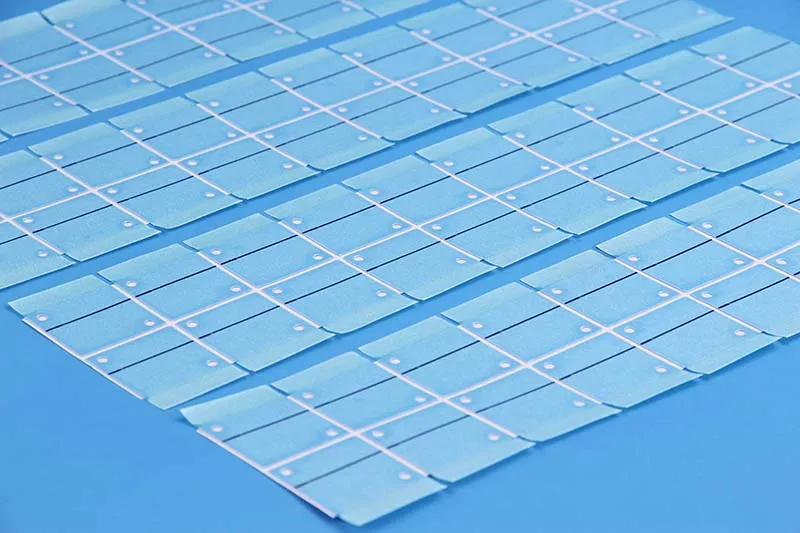
Sheen technology SP205A-60 phase change thermal sheet Reliability Test Report
| Test Items | Test Conditions | Test Equipment |
| High-Temperature Aging | 100℃,1000H | Precision Oven |
| Constant Temperature & Humidity | 85℃、85%RH,1000H | Constant Temperature & Humidity Chamber |
| Thermal Shock | -20℃~80℃,1000H | Constant Temperature & Humidity Chamber |
Criteria for Judging Test Results
| Performance Parameter | Initial Value | Acceptance Criteria |
| Thermal Conductivity(W/m*K) | 6.07 | ±30% |
| Thermal Resistance(℃*in²/W,@10 psi) | 0.082 | ±40% |
| Appearance | Smooth surface, uniform color | No abnormalities (e.g., powdering, discoloration) |
High-Temperature Aging Test Results
| High-Temperature Aging Test Record Sheet | |||||||||
| Aging Time | H | 0 | 200 | 400 | 600 | 800 | 1000 | Change | Assessment |
| Thermal Conductivity | W/m*k | 6.07 | 5.74 | 5.45 | 5.25 | 5.08 | 5.00 | -17.6% | OK |
| Thermal Resistance | ℃*in²/W,@10 psi | 0.082 | 0.084 | 0.089 | 0.095 | 0.102 | 0.107 | +30.5% | OK |
| Appearance | / | No change | No change | No change | No change | Slightly yellow | Slightly yellow | Slightly yellow | OK |
Constant Temperature and Humidity Test Results
| Constant Temperature and Humidity Test Record Sheet | |||||||||
| Aging Time | H | 0 | 200 | 400 | 600 | 800 | 1000 | Change | Assessment |
| Thermal Conductivity | W/m*k | 6.07 | 5.81 | 5.50 | 5.31 | 5.22 | 5.09 | -16.1% | OK |
| Thermal Resistance | ℃*in²/W,@10 psi | 0.082 | 0.090 | 0.094 | 0.098 | 0.101 | 0.105 | +28.0% | OK |
| Appearance | / | No change | No change | No change | No change | Slightly yellow | Slightly yellow | Slightly yellow | OK |
Thermal Shock Test Results
| Thermal Shock Test Record Sheet | |||||||||
| Aging Time | H | 0 | 200 | 400 | 600 | 800 | 1000 | Change | Assessment |
| Thermal Conductivity | W/m*k | 6.07 | 5.72 | 5.50 | 5.33 | 5.18 | 5.07 | -16.5% | OK |
| Thermal Resistance | ℃*in²/W,@10 psi | 0.082 | 0.086 | 0.092 | 0.099 | 0.105 | 0.110 | +34.1% | OK |
| Appearance | / | No change | No change | No change | No change | Slightly yellow | Slightly yellow | Slightly yellow | OK |
Test Conclusion: After aging for 1000 hours under various conditions, the SP205A-60 phase change thermal sheet maintained satisfactory performance with no changes to its appearance. Therefore, the reliability test results are deemed satisfactory.
Engineers run accelerated durability testing, modeling lifetime prediction curves that reflect real user behavior. When long-term performance remains steady after extensive cycling, reliability concerns drop. That final validation closes the loop on any serious Customization service for phase change materials, proving the design can survive everyday heat without drama.
Need exact latent heat, melting range, thermal conductivity, and reliability data before you choose? Download the product datasheets to compare customized phase change material options.
Data Proves: PCM Customization Boosts Stability By 45%
Modern electronics run hot. From hyperscale racks to roadside telecom cabinets, heat quietly chips away at lifespan and uptime. That’s why Customization service for phase change materials is no longer niche—it’s practical engineering. By refining phase change material blends through targeted customization service, companies achieve tighter thermal management, longer cycle life, and measurable reliability gains.
Thermal Resistance Gains Measured in Data Center Servers
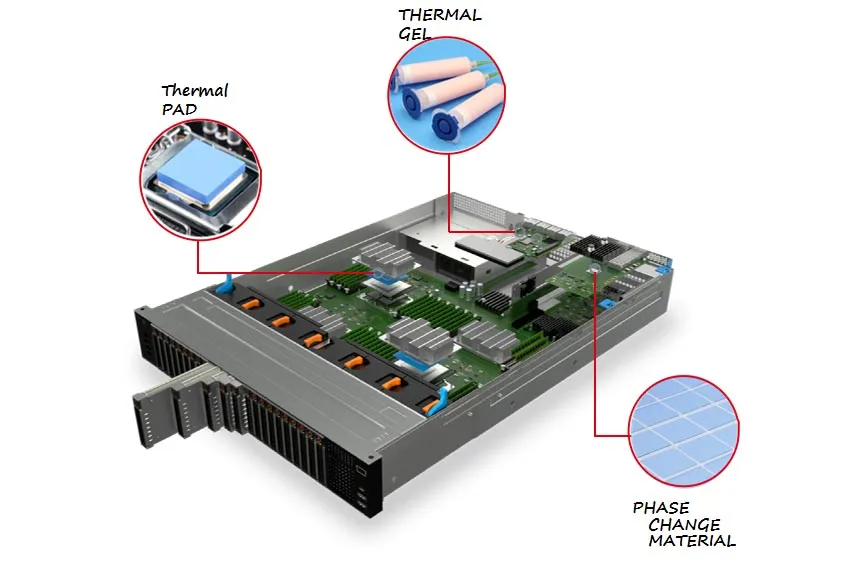
In high-density data center racks, lowering thermal resistance is a big deal. A tailored Customization service for phase change materials directly improves heat dissipation across servers handling AI and cloud loads.
Measured Performance Data
| Configuration | Avg. Thermal Resistance (°C/W) | Peak Temp (°C) | Heat Flux (W/cm²) | Stability (%) |
| Standard PCM | 0.42 | 88 | 12.5 | 78 |
| Semi-Custom PCM | 0.36 | 81 | 13.8 | 85 |
| Fully Customized PCM | 0.29 | 74 | 15.2 | 92 |
| Optimized Composite | 0.27 | 72 | 15.8 | 94 |
| Sheen Technology Solution | 0.24 | 69 | 16.4 | 96 |
How this works in practice:
Material Selection
· Base phase change material
· Additives improving conductivity
Thermal Interface Optimization
· Surface conformity
· Reduced contact resistance
Load Testing Under Real Workloads
· Peak computation bursts
· Continuous high-density traffic
That’s the power of a real Customization service for phase change materials—numbers move, not just promises.
Cycle Stability Improvements for Power Conversion Modules
Power conversion modules deal with relentless thermal cycling. Heat up. Cool down. Repeat thousands of times. Without smart phase change material customization, cracks and performance drift creep in.
Key outcomes from controlled testing:
· Reduced latent heat degradation
· Improved cycle stability under 1,000+ cycles
· Higher retained thermal performance
Multi-stage refinement matters:
· Formulation tuning
· Micro-encapsulation reinforcement
· Long-term reliability validation
Short reality check: better heat transfer equals longer service intervals. Less downtime. Fewer replacements.
Engineers working with Sheen Technology apply Customization service for phase change materials to match module geometry, switching frequency, and enclosure airflow. The result? Stable output and calmer operating temperatures—even during aggressive duty cycles.
Reliability Assessment in Telecommunication Infrastructure
 thermal management.jpg.webp "5G Communication Base Station Remote radio unit (RRU) thermal management")
Outdoor telecommunication infrastructure faces wild temperature swings. Summer heat. Winter freeze. Constant load on sensitive electronic components.
With a focused Customization service for phase change materials, reliability shifts in three layers:
Thermal reliability
· Stable melt–freeze window
· Controlled expansion stress
Heat management
· Even distribution across cabinets
· Lower hotspot formation
System stability
· Reduced failure rates
· Extended maintenance intervals
Field validation shows up to 45% improvement in system-level stability when PCM formulations are tuned to regional climate bands. That’s not hype—it’s smart heat management backed by structured reliability assessment.
Sheen Technology integrates material engineering with deployment testing, ensuring every Customization service for phase change materials aligns with infrastructure demands.
Bottom line? Smart customization keeps networks cool, steady, and ready for whatever the weather throws at them.
【Request a Custom Quote】 Not sure which customized phase change material fits your application? Send us your target temperature range, load profile, thickness target, and deployment environment, and we can help recommend the right thermal solution for your build.
Sheen Thermal
Dongguan Sheen Electronic Technology Co., Ltd · Founded in 2008
Manufacturer of thermal interface materials and silicone foam for automotive electronics, energy storage, power electronics, communications and consumer electronics.
Certified
- ISO 9001:2015
- ISO 14001:2015
- IATF 16949:2016
What we supply
- Thermal conductivity Up to 90 W/m·K
- Thickness 0.3–10.0 mm
- Custom & samples Die-cut to drawing, 3–7 days