
 English
 usheenthermal

Top Benefits of a High Compressibility Carbon Fiber Thermal Pad
Date:2026-04-03
Top Benefits of a High Compressibility Carbon Fiber Thermal Pad
Heat is the silent troublemaker in modern electronics—the kind that creeps in, slows everything down, and then fries your ROI. A High compressibility carbon fiber thermal pad steps in like a seasoned firefighter, squeezing into uneven gaps and pulling heat out fast. For engineers staring at overheating CPUs or power modules that run hotter than a summer sidewalk, this isn’t a luxury add-on. It’s damage control.
“Thermal density in compact electronics has doubled in recent design cycles,” notes a 2024 IPC industry outlook, and Sheen Technology’s senior materials engineer echoes it: “If your interface can’t flex, your system pays the price.” In data centers and EV control units, that price shows up as downtime, warranty claims, and late-night troubleshooting.
This pad bends without backing down—strong conductivity, steady insulation, and resilience under pressure. Fewer hotspots. Longer lifespans. Less drama on the production floor.
Quick Insights on High Compressibility Carbon Fiber Thermal Pad
➔ Superior Heat Dissipation: Carbon fiber and graphite network delivers exceptional thermal conductivity, minimizing hotspots in CPUs, GPUs, and power electronics.
➔ Adaptive Gap Filling: Engineered polymer matrix ensures high compressibility for uniform pressure distribution and effective thermal interface across uneven surfaces.
➔ Reliable Durability & Safety: RoHS- and REACH-compliant insulation resists pump-out and thermal cycling, offering long-term stability in data centers, EV units, and industrial modules.
5 Reasons to Choose High Compressibility Carbon Fiber Thermal Pad
When heat keeps climbing and devices get packed tighter every year, picking the right High compressibility carbon fiber thermal pad isn’t just smart—it’s survival. Here’s why this carbon fiber thermal pad makes real-world cooling easier and safer.
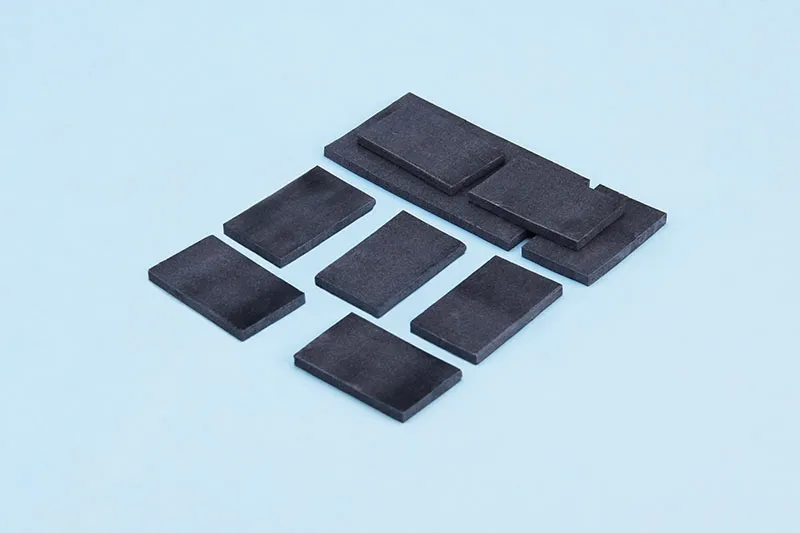
Exceptional Thermal Conductivity for Superior Heat Dissipation
| Product name | Color | Thermal Conductivity | Thermal Impedance (1mm,@20psi) | Thickness | Standard Hardness |
|---|---|---|---|---|---|
| Unit | - | W/m·K | ℃*in2/W | mm | Shore 00 |
| CSF15 | Black | 15.0 | 0.28 | 0.3 ~ 12.0 | 40/60±5 |
| CSF20 | Black | 20.0 | 0.18 | 0.3 ~ 12.0 | 40/60±5 |
| CSF25 | Black | 25.0 | 0.12 | 0.3 ~ 12.0 | 40/60±5 |
| CSF30 | Black | 30.0 | 0.10 | 0.3 ~ 12.0 | 40/60±5 |
| CSF35 | Black | 35.0 | 0.09 | 0.3 ~ 12.0 | 40/60±5 |
| CSF40 | Black | 40.0 | 0.08 | 0.3 ~ 12.0 | 40/60±5 |
| CSF45 | Black | 45.0 | 0.07 | 0.3 ~ 12.0 | 40/60±5 |
| Test Method | Visual | ASTM D5470 | ASTM D5470 | ASTM D374 | ASTM D2240 |
A High compressibility carbon fiber thermal pad built on carbon fiber and graphite networks focuses on one thing: fast heat transfer with low resistance. That means better temperature management and stable thermal performance in tight spaces.
Core performance advantages
Advanced conductive pathways
· Dense carbon fiber layers improve thermal conductivity across the interface.
· Graphite alignment enhances lateral heat dissipation.
Optimized interface behavior
· Reduced air gaps lower total resistance in a thermal interface material stack.
· Stable output under continuous CPU and GPU load.
Where it shines
High-power chips
· AI servers
· Gaming graphics modules
Power electronics
· Inverters
· DC-DC converters
Sheen Technology fine-tunes fiber orientation so the High compressibility carbon fiber thermal pad keeps cool even when heat flux spikes.
Unmatched Compressibility and Gap Filling Capability
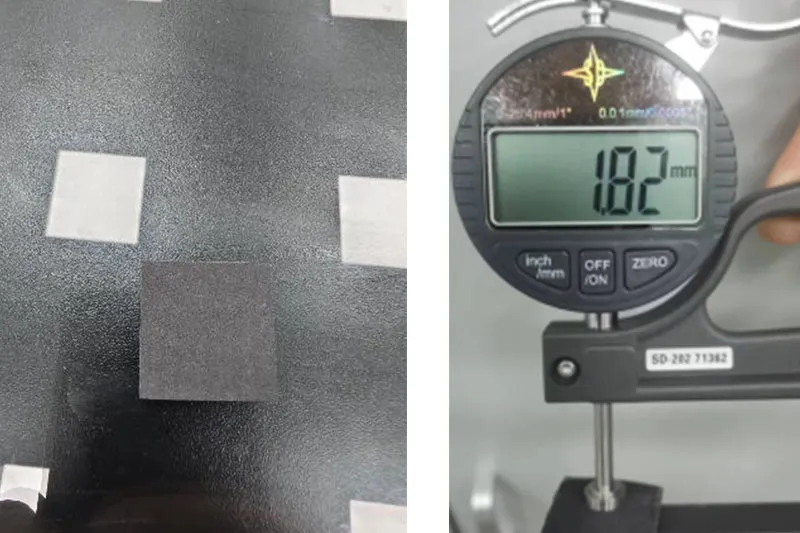
CSF20 Carbon Fiber Thermal Pad Compression Recovery Test Data:
| Test Item | Test Equipment | Test Conditions |
| Recovery Rate | Compression Recovery Tester | Compressed by 50% for 30 minutes, followed by a 30-minute rest period. |
Test Data:
| D0: Initial Thickness(mm) | 2.02 |
| D1: Thickness After Compression(mm) | 1.01 |
| D2: Thickness After Rest(mm) | 1.82 |
| Recovery Rate(%) | 80.4 |
A carbon fiber thermal pad must do more than conduct heat; it has to adapt. High compressibility carbon fiber thermal pad designs focus on compressibility, gap filling, and strong interface contact.
Material structure
Engineered polymer matrix
· Balances softness and rebound.
· Maintains stable contact pressure.
Controlled density
· Improves conformability over surface irregularities.
Real assembly benefits
Easier mounting
· Less torque stress on boards.
· Better consistency
· Uniform thickness after compression.
High compressibility means the pad flows slightly, settles in, and locks into place. No drama. Just steady cooling from a reliable carbon fiber thermal interface pad.
Electrical Insulation Meets Rigorous Safety Standards
Heat control is pointless without safety. A High compressibility carbon fiber thermal pad must deliver strong electrical insulation alongside cooling.
Electrical protection framework
Insulating resin system
· Supports high dielectric strength.
· Enhances voltage resistance.
Binder optimization
· Prevents leakage paths.
· Improves circuit protection.
Global requirements
· RoHS compliance
· REACH compliance
· Meets key safety standards and flammability ratings.
Sheen Technology designs its High compressibility carbon fiber thermal pad to support both thermal and electrical safety, so engineers don’t have to trade one for the other.
Durability: Long-Term Stability and Cycle Life Performance
CSF20 Carbon Fiber Thermal Pad Fatigue Resistance Test Data:
| Test Item | Test Equipment | Test Conditions | Product Model | Sample Thickness |
| Fatigue Resistance | Compression-Recovery Tester | Compressed at 20 psi for 40 cycles; pressure held for 3 minutes. | CSF20 | 1mm |
Test Data:
| Compression Cycles | 0 | 1 | 2 | 3 | 4 | 5 | 6 | 7 | 8 | 9 | 10 |
| Thickness(mm) | 1.00 | 0.980 | 0.975 | 0.970 | 0.969 | 0.968 | 0.966 | 0.968 | 0.968 | 0.970 | 0.966 |
| Compression Cycles | 11 | 12 | 13 | 14 | 15 | 16 | 17 | 18 | 19 | 20 | 21 |
| Thickness(mm) | 0.965 | 0.965 | 0.963 | 0.965 | 0.963 | 0.970 | 0.965 | 0.964 | 0.964 | 0.959 | 0.959 |
| Compression Cycles | 22 | 23 | 24 | 25 | 26 | 27 | 28 | 29 | 30 | 31 | 32 |
| Thickness(mm) | 0.958 | 0.958 | 0.956 | 0.954 | 0.96 | 0.962 | 0.950 | 0.958 | 0.957 | 0.950 | 0.958 |
| Compression Cycles | 33 | 34 | 35 | 36 | 37 | 38 | 39 | 40 | |||
| Thickness(mm) | 0.944 | 0.946 | 0.945 | 0.943 | 0.953 | 0.945 | 0.941 | 0.945 | |||
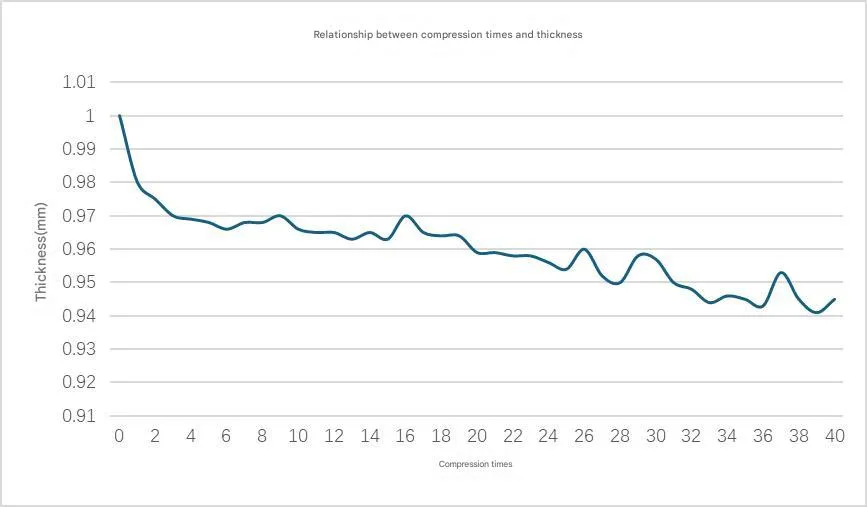
Conclusion: After undergoing 40 compression cycles at a pressure of 20 psi, the CSF20 carbon fiber thermal pad exhibited no significant deformation or cracking, and its thermal resistance did not increase; therefore, it meets the requirements for fatigue resistance.
Thermal cycling can wreck weak materials. A High compressibility carbon fiber thermal pad must resist material degradation and maintain performance retention.
Advanced curing
· Strengthens internal bonding.
· Lamination control
· Reduces pump-out during expansion and contraction.
Lifecycle confidence
· Thermal cycling endurance
· Stable cycle life under repeated heating.
Proven reliability
· Consistent long-term stability in automotive electronics.
In daily use, that means fewer replacements and fewer headaches. High compressibility carbon fiber thermal pad solutions from Sheen Technology are built to last, not just pass lab tests.
Lightweight Design with Low Density and High Flexibility
Modern devices hate extra bulk. A High compressibility carbon fiber thermal pad keeps weight down while maintaining strong mechanical properties.
Structural design
· Low material weight
· Supports portable devices.
· Optimized low density fiber layers
· Maintain shape without stiffness.
Mechanical adaptability
· Easy cutting and shaping
· Boosts design freedom.
· Natural high flexibility
· Fits curved or compact layouts.
From consumer gadgets to automotive control units, this high compressibility pad delivers cooling without adding mass. That balance—light, flexible, and thermally efficient—is exactly why engineers stick with a High compressibility carbon fiber thermal pad when performance really counts.
Comparative: Carbon Fiber vs Silicone Thermal Pads
Modern electronics run hot, plain and simple. Choosing the right Thermal Interface Material can make or break device lifespan, and that’s where material science gets real.
Carbon Fiber Thermal Pad
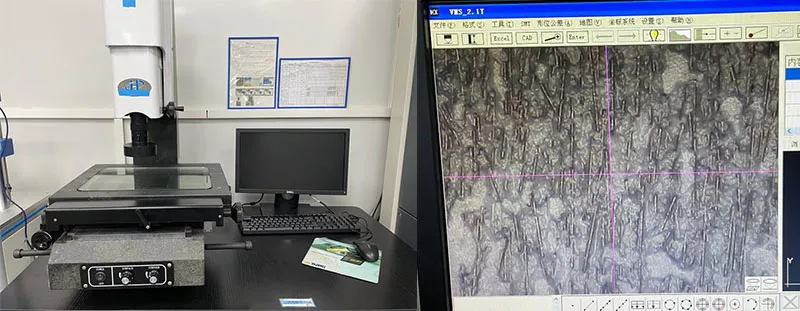
When engineers ask for a High compressibility carbon fiber thermal pad, they usually mean four things working together: carbon fiber, graphite, compressibility, and thermal control. This isn’t hype; it’s physics doing its job.
Material Architecture
Carbon Fiber Network
· Creates continuous heat pathways
· Boosts Thermal Conductivity
Graphite Reinforcement
· Reduces hotspots
· Maintains Low Thermal Resistance
Polymer Matrix
· Ensures Electrical Insulation
· Enhances Durability
Performance Attributes
Mechanical
· High Compressibility adapts to uneven heat sinks
· Strong Surface Conformability under low mounting pressure
Thermal
· Stable carbon fiber thermal pad structure under cycling
· Reliable high compressibility carbon fiber thermal pad behavior above 150°C
Electrical
· Safe insulation even with dense PCB layouts
Measured Data Comparison
| Material Type | Thermal Conductivity (W/m·K) | Compression Rate (%) | Thermal Resistance (°C·cm²/W) | Operating Temp (°C) |
| Standard Silicone Pad | 1.5~15 | 25 | 0.1~0.9 | -50~2000 |
| High compressibility carbon fiber thermal pad | 25~45 | 50 | 0.07~0.28 | -50~160 |
For brands like Sheen Technology, the high compressibility carbon fiber thermal pad isn’t just a spec sheet win. It handles pressure shifts in EV modules and power supplies without performance drop. A true carbon fiber heat pad earns its keep over years, not months.
Silicone Thermal Pad
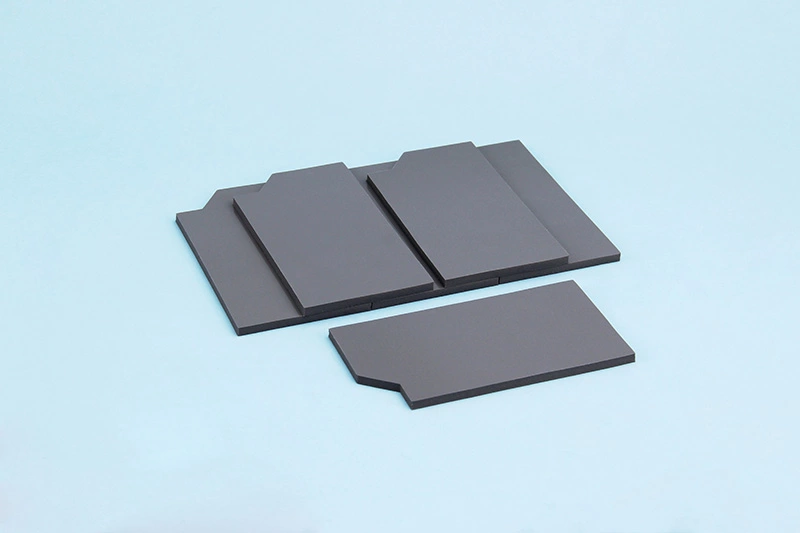
Silicone pads are the old reliable choice. Soft, flexible, easy to trim. That’s why this classic Thermal Interface Material still dominates cost-driven builds.
• Strong Flexibility for fragile components
• Simple die-cut shapes for mass production
• Solid Cost-Effectiveness
Material Composition
Silicone matrix blended with ceramic fillers provides insulation and decent heat transfer.
Core Properties
· Respectable Dielectric Strength
· Wide Temperature Range
· Quick installation on assembly lines
High-temperature cycling can cause pump-out. Over time, Durability may drop compared to a high compressibility carbon fiber thermal pad. Thermal conductivity also trails behind a carbon fiber thermal pad or high compressibility carbon fiber thermal pad in demanding systems.
In consumer routers or LED drivers, silicone works fine. In compact power electronics pushing higher loads, engineers often upgrade to a High compressibility carbon fiber thermal pad from Sheen Technology for better long-term thermal stability.
Short version? Silicone is easy. Carbon fiber is serious performance. And when heat gets intense, high compressibility carbon fiber thermal pad solutions tend to stay cool under pressure.
Scenario: Industrial Cooling with Carbon Fiber Pads
Industrial cooling is getting serious as devices shrink and power climbs. A High compressibility carbon fiber thermal pad keeps heat under control without adding bulk. From inverters to LEDs, this high compressibility pad made of carbon fiber handles pressure, vibration, and daily wear like a pro.
Power Electronics: Managing High Thermal Loads in Inverters
In power electronics and heavy-duty inverters, heat piles up fast. A High compressibility carbon fiber thermal pad works right at the core of thermal management.
Heat control in high-load modules
Contact layer
· The High compressibility carbon fiber thermal pad adapts to uneven surfaces.
· Its carbon fiber network improves heat dissipation under high thermal loads.
Pressure balance
· Built-in compressibility spreads mounting force evenly.
Reliability upgrade
· Reduced hotspot stress
· Longer service life for carbon fiber-based assemblies
Sheen Technology fine-tunes every High compressibility carbon fiber thermal pad to stabilize output when systems run flat out.
Data Centers: Enhancing Server Rack Efficiency Under Continuous Operation
Inside data centers, packed server racks never really rest. During continuous operation, even tiny gaps hurt thermal efficiency.
Rack-level cooling
CPU and GPU interface
· The High compressibility carbon fiber thermal pad lowers interface resistance.
· Carbon fiber thermal pads maintain steady contact over time.
System reliability
· Better cooling solutions
· Improved component reliability with carbon fiber pads
For operators chasing uptime, a High compressibility carbon fiber thermal pad keeps temps steady without complicated redesign.
LED Lighting: Maintaining Uniform Temperature Across Arrays
In LED lighting, heat spreads across tight thermal arrays. Uniform contact matters.
Key gains:
· Even heat distribution
· Stable uniform temperature
· Better luminaire performance
The High compressibility carbon fiber thermal pad fills micro-gaps, acting as a carbon fiber thermal interface that supports long-term stability. Short runs. Long runs. The light output stays consistent, and the carbon fiber thermal pad handles expansion and contraction with ease.
Automotive Electronics: Vibration-Resistant Heat Transfer Solutions
For automotive electronics, roads are rough and temps swing hard.
Mechanical stress control
Flexible layer design
· The High compressibility carbon fiber thermal pad absorbs shock.
· Flexible pads maintain tight heat transfer paths.
Environmental durability
· High thermal conductivity
· Strong vibration resistance in harsh environments
· Extended component longevity
Each High compressibility carbon fiber thermal pad from Sheen Technology is built to stay put, move heat fast, and keep vehicles running cool year after year.
FAQs about High Compressibility Carbon Fiber Thermal Pad
What makes a High Compressibility Carbon Fiber Thermal Pad suitable for high-power electronics?
A high compressibility carbon fiber thermal pad blends material science with practical design:
Core composition
· Carbon fiber + graphite network for strong thermal conductivity
· Polymer matrix and controlled resin content for flexibility
· Binder material and filler particles to stabilize density
Performance in action
· Low thermal resistance in CPU cooling and GPU modules
· Even pressure distribution across power electronics
· Reliable electrical insulation for sensitive circuits
The result is efficient heat transfer without the mess of thermal grease or the rigidity of a graphite sheet.
How does it compare to silicone thermal pads and other interface materials?
Short answer: lower resistance, longer life, cleaner interface.
Compared with silicone thermal pad, phase change material, or ceramic thermal interface:
· Better gap filling capability due to higher compressibility
· More stable thermal conductivity under thermal cycling test
· Reduced pump-out risk in data centers and automotive electronics
Unlike thermal grease, it keeps its shape after curing and lamination, maintaining surface contact even when surface roughness varies.
How is long-term stability and cycle life ensured?
Performance depends on controlled manufacturing and testing:
· Sheet forming and cutting maintain uniform thickness
· Curing and lamination lock in structure integrity
· Surface treatment improves bonding to heatsinks
Quality checkpoints include:
· Thermal cycling test for cycle life
· Flammability rating for safety
· RoHS compliance and REACH compliance
· Material safety data sheet for procurement review
This structure supports long-term stability in LED lighting, consumer electronics, and vibrating automotive electronics environments.
Can the pad be customized for specific applications?
Yes, and customization directly shapes thermal behavior.
| Adjustable Factor | Practical Impact in Application Areas |
| Density & resin content | Tunes compressibility for CPU cooling or GPU modules |
| Thickness (cutting stage) | Matches gap height in power electronics |
| Surface roughness control | Improves contact in LED lighting systems |
| Polymer matrix ratio | Balances flexibility and pressure distribution |
Through targeted sheet forming and surface treatment, the pad adapts to compact designs while maintaining electrical insulation and stable thermal resistance.
Sheen Thermal
Dongguan Sheen Electronic Technology Co., Ltd · Founded in 2008
Manufacturer of thermal interface materials and silicone foam for automotive electronics, energy storage, power electronics, communications and consumer electronics.
Certified
- ISO 9001:2015
- ISO 14001:2015
- IATF 16949:2016
What we supply
- Thermal conductivity Up to 90 W/m·K
- Thickness 0.3–10.0 mm
- Custom & samples Die-cut to drawing, 3–7 days