
 English
 usheenthermal

Boost Efficiency: Phase Change Thermal Management for Energy Storage Systems
Date:2026-06-01
Boost Efficiency: Phase Change Thermal Management for Energy Storage Systems
Heat is the quiet troublemaker killing performance and safety in modern batteries, and Phase change thermal management for energy storage systems steps in like a clever fix, soaking up excess heat before it spirals into damage, downtime, or costly redesigns.
Engineers and buyers want longer life, fewer risks, and simpler builds, not bulky cooling add-ons. The PCM choice slips into designs keeps temperatures steady, and saves money where it hurts.
Essential Insights: Phase change thermal management for energy storage systems
➔ Architecture Fit: PCM provides passive cooling, complementing active solutions like liquid cooling or heat pipes to maintain safe battery and power electronics operation.
➔ Material Selection: Choose PCMs with high latent heat, tailored melting points, and thermal conductivity—eutectic mixtures or salt hydrates ensure thermal stability across battery operating ranges.
➔ Deployment Strategies: From microcapsules to macro-encapsulation or multi-layer films, integrate PCMs directly on cells, within heat pipes, or under battery packs for uniform temperature regulation.
Phase Change Thermal Management For Energy Storage Systems Explained
.jpg.webp "Phase-Change Thermal Management Solution for AI Data Center Backup Power Units (BBUs)")
Phase change thermal management for energy storage systems is getting real attention as batteries pack more power into tighter spaces. Break the phrase down—phase change, thermal management, energy storage systems—and it’s all about smart heat control. When heat spikes, materials step in and absorb it quietly. That’s the beauty of phase change cooling.
Passive vs. Active Cooling: Where PCM Fits in Thermal Architectures
In modern thermal architectures, cooling usually blends Passive cooling and Active cooling. PCM works without pumps or compressors, storing heat through Heat transfer driven by Phase change.
· Passive cooling lowers complexity
· Active cooling boosts response speed
· PCM bridges both in hybrid Cooling systems
Heat rises inside lithium cells.
Phase change thermal management for energy storage systems absorbs peak loads.
Active loops remove stored heat later.
Key integration layers in Energy storage packs:
Cell level
· Embedded PCM sheets
· Composite thermal pads
Module level
· Encapsulated PCM blocks
Pack level
· Liquid plates + PCM buffers
BloombergNEF’s 2025 battery outlook notes that thermal control remains a top limiter of high-density pack performance, pushing adoption of hybrid cooling strategies.
Material Properties Unpacked: Latent Heat, Thermal Conductivity, Melting Point
The heart of Material properties lies in three metrics: Latent heat, Thermal conductivity, and Melting point. Get these wrong, and heat absorption drops fast.
| PCM Type | Latent Heat (kJ/kg) | Thermal Conductivity (W/m·K) | Melting Point (°C) |
| Paraffin | 180–220 | 0.2–0.3 | 30–55 |
| Salt Hydrate | 200–350 | 0.5–0.8 | 25–60 |
| Fatty Acid | 150–210 | 0.2–0.4 | 20–50 |
| Composite (Graphite) | 170–250 | 1.5–5.0 | Custom 25–60 |
Higher Latent heat means stronger Heat absorption. Better Thermal conductivity speeds Thermal energy flow. The Melting point must match battery comfort zones. That alignment defines effective phase change thermal management for energy storage systems.
From Microcapsules to Macro-encapsulation: PCM Forms and Structures
Form matters just as much as chemistry. Microcapsules boost surface area and stability inside thermal interface layers. Macro-encapsulation handles bulk containment in modules.
Common PCM forms include:
· Microencapsulated slurries
· Aluminum shell blocks
· Graphite-enhanced foams
In structured PCM structures:
· Core PCM stores heat.
· Shell ensures Encapsulation safety.
· External housing integrates with pack frames.
For high-density battery racks, Phase change materials are paired with aluminum honeycomb panels for safer Containment. Sheen Technology refines these assemblies to optimize phase change thermal management for energy storage systems, keeping packs cooler without cranking up power draw.
4 Key Benefits Of PCM In Battery Systems
Phase change thermal management for energy storage systems keeps batteries cool without making things complicated. From EV packs to grid cabinets, smart phase change material design balances heat, boosts safety, and stretches battery lifespan. Here’s how smart energy storage thermal management really pays off.
Enhanced Lithium-Ion Battery Lifespan through Thermal Regulation
Stable heat means longer battery lifespan, especially for a Lithium-ion battery running daily cycles in energy storage plants.
Thermal control at cell level
1.1 Phase change material absorbs peak heat during fast charging.
1.2 Consistent temperature control slows battery degradation and electrolyte breakdown.
1.3 Reduced thermal stress protects internal structure.
Module-level stability
2.1 Integrated thermal regulation layers prevent uneven expansion.
2.2 Lower capacity fade across the battery pack.
System-level impact
3.1 Reliable Phase change thermal management for energy storage systems reduces maintenance.
3.2 Longer service intervals cut total ownership cost.
This is where Sheen Technology aligns material science with real-world cycling demands, making phase change thermal management for energy storage systems practical, not theoretical.
Uniform Temperature Distribution for Battery Modules and Packs
Hotspots are trouble. A balanced thermal distribution inside a battery module keeps performance steady.
· Even heat transfer across cells
· Improved temperature uniformity
· Higher thermal stability
Here’s what typically happens:
· During high load, heat builds near core cells.
· Embedded phase change material absorbs excess energy.
· Stored heat spreads gradually, supporting heat dissipation.
Short version? No drama inside the battery pack.
Longer take: consistent Phase change thermal management for energy storage systems supports balanced voltage output, steadier range in an electric vehicle, and fewer mismatched cells over time.
As BloombergNEF noted in its 2025 battery outlook:
“Thermal management remains a decisive factor in extending cycle life and maintaining pack-level reliability in next-generation lithium-ion systems.”
That’s exactly why advanced energy storage thermal management designs matter.
Safety Boost: Flammability Mitigation in Electric Vehicle Cells
Battery safety is non-negotiable in any electric vehicle platform.
Heat absorption phase
1.1 Non-flammable phase change material captures rapid temperature spikes.
1.2 Internal thermal runaway risk drops.
Containment phase
2.1 Reduced flammability inside each battery cell.
2.2 Slower propagation between neighboring cells.
System safeguard
3.1 Reinforced fire prevention strategy.
3.2 Stronger compliance with global battery safety standards.
With well-designed Phase change thermal management for energy storage systems, overheating doesn’t instantly escalate. Sheen Technology focuses on pairing inorganic PCM with smart pack layouts so energy storage installations stay calm under pressure.
Improved Charge-Discharge Efficiency via Optimized Heat Sink Integration
Efficiency gains come from controlling resistance, and resistance rises with heat.
· Integrate phase change material near the heat sink.
· Enhance thermal conductivity through metal fins or vapor chambers.
· Maintain stable internal temperature during rapid cycling.
· Lower internal resistance, improving charge-discharge efficiency and overall battery efficiency.
· Support smoother energy conversion in hybrid inverters and storage cabinets.
Simple flow. Smart impact.
When thermal integration is done right, Phase change thermal management for energy storage systems doesn’t just cool things down—it directly supports faster charging, steadier output, and better long-term heat dissipation control across the entire system.
Need exact latent heat, melting range, thermal conductivity, and encapsulation details before you choose? Download the product datasheets to compare phase change thermal management options for energy storage systems.
PCM Placement Strategies For Uniform Cooling
Phase change thermal management for energy storage systems sounds technical, yet it’s really about keeping batteries and power units from getting too hot or too uneven. When heat spreads badly, performance drops fast. Smart placement of Phase Change Material can steady temperature swings, improve cooling efficiency, and extend the life of energy storage systems in a way that just feels right in daily operation.
Direct Encapsulation on Supercapacitors: Pros and Cons
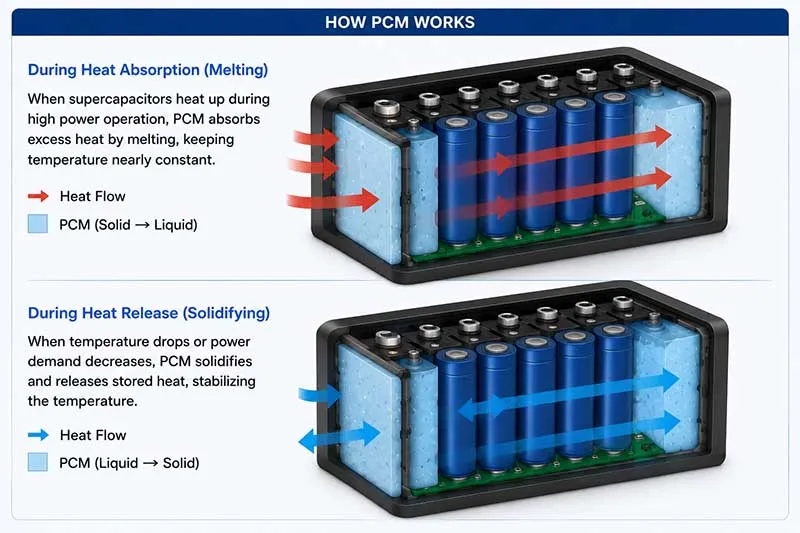
When using Phase change thermal management for energy storage systems directly on Supercapacitors, the layout usually follows this logic:
Core objective
· Stabilize rapid heat spikes in energy storage modules.
· Improve thermal management close to the heat source.
Structural arrangement
a. Inner layer: Encapsulation shell bonded to the casing.
b. Middle layer: Phase Change Material tuned to operating range.
c. Outer interface: conductive path for heat transfer.
Performance effects
✓ Better short-term buffering
✓ Compact packaging
✦ Possible bottleneck if PCM conductivity is low
Here’s the catch. Direct encapsulation boosts cooling efficiency during peak loads, yet if the thermal pathway outward is weak, stored heat lingers. For high-frequency charge and discharge cycles, that lag can stack up.
In practical thermal management for energy storage, engineers often:
· Select PCM with moderate latent heat and enhanced graphite fillers.
· Adjust encapsulation thickness to balance protection and dissipation.
· Validate through cycling tests under real operating profiles.
Sheen Technology applies this placement in compact modules where space is tight and fast buffering matters more than long-distance heat spreading.
PCM-Embedded Heat Pipes Coupled with Power Electronics
For larger power electronics, Phase change thermal management for energy storage systems benefits from a layered thermal highway:
Heat source level
· Power electronics generate concentrated hotspots.
Transfer bridge
a. Heat pipes absorb and spread heat quickly.
b. PCM reservoirs store excess energy during peaks.
Regulation loop
i. Thermal coupling plate
ii. Controlled discharge path
iii. Ambient release zone
The synergy works like this:
· Rapid vapor transport in heat pipes
· Latent heat absorption in Phase Change Material
· Smooth temperature regulation across the board
The International Energy Agency’s 2025 energy storage outlook notes that advanced cooling integration “directly influences system safety margins and long-term reliability” in grid-scale batteries.
That insight hits home. When heat dissipation is uneven, component aging speeds up. By embedding PCM along the pipe structure, cooling systems gain both spreading and storage capacity. This hybrid form of phase change cooling keeps temperature regulation steady, even under aggressive loads.
Sheen Technology integrates this method for industrial-scale battery racks where heat gradients can otherwise spiral out of control.
Need a closer match for your project? Browse these related application pages to see where phase change thermal management is used in real systems.
Multi-layer Film Approach under Battery Packs for Even Heat Dissipation
Under Battery packs, the multi-layer film strategy focuses on thermal uniformity rather than brute-force cooling.
Placement hierarchy often looks like:
Base layer
· Structural support plate
Functional layers
a. Thin Multi-layer film with Phase Change Material
b. High-conductivity sheet for heat distribution

Interface layer
· Thermal pads linking to cooling plates
Why it works:
· Distributes heat laterally before vertical escape
· Reduces hot-cell clustering
· Enhances overall heat dissipation balance
In daily operation, this approach smooths temperature differences between inner and outer cells. Instead of sharp gradients, you get a calm, even thermal profile. That’s critical for battery life and safety.
For phase change thermal management for energy storage systems, this under-pack method supports consistent thermal management without bulky hardware. It’s subtle, slim, and effective. Sheen Technology often recommends this configuration in modular battery designs where space, weight, and reliability all matter at once.
【Request a Custom Quote】 Not sure which phase change thermal management solution fits your system? Send us your rack layout, target temperature range, load profile, and application details, and we can help recommend the right thermal solution for your build.
Sheen Thermal
Dongguan Sheen Electronic Technology Co., Ltd · Founded in 2008
Manufacturer of thermal interface materials and silicone foam for automotive electronics, energy storage, power electronics, communications and consumer electronics.
Certified
- ISO 9001:2015
- ISO 14001:2015
- IATF 16949:2016
What we supply
- Thermal conductivity Up to 90 W/m·K
- Thickness 0.3–10.0 mm
- Custom & samples Die-cut to drawing, 3–7 days