
 English
 usheenthermal

Boost Efficiency: Ultra-high Thermal Conductivity Graphene Sheet 90W/mK+
Date:2026-07-06
Boost Efficiency: Ultra-high Thermal Conductivity Graphene Sheet 90W/mK+
Heat is choking modern electronics, and Ultra-high thermal conductivity Graphene sheet (90W/mK+) cuts through it fast, spreading hotspots before performance tanks.
Metal spreads lag, bulk up designs, and add weight nobody wants in tight builds.
Gartner and IDC highlight rising thermal constraints driving adoption of graphite cooling materials.
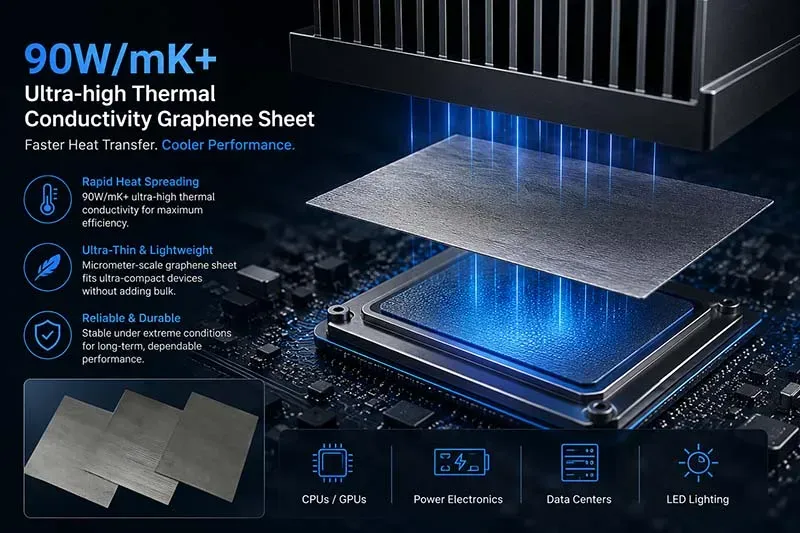
Reading Notes: Ultra-high thermal conductivity Graphene sheet (90W/mK+)
➔ Exceptional Thermal Spreading: Rapidly diffuses heat at 90 W/mK+ to mitigate hot spots in CPUs, GPUs, and ICs, lowering thermal resistance in compact electronics.
➔ Ultra-Thin & Lightweight Design: Micrometer-scale Graphene films offer high flexibility and minimal weight, seamlessly integrating into smartphones, wearables, and tablets without adding bulk.
➔ Robust Reliability: Withstands repeated thermal cycling and mechanical shock, ensuring long-term performance in power electronics, LED modules and data center cooling applications.
3 Reasons To Choose Graphene Sheet (90W/mK+)
When devices heat up, performance drops fast. That’s why engineers are switching to Ultra-high thermal conductivity Graphene sheet (90W/mK+) for tighter, cooler builds. From smartphones to LED modules, this material keeps temperatures steady without adding bulk. Let’s break down why it’s gaining serious traction.
Exceptional Thermal Conductivity for Hot-Spot Mitigation
Ultra-high thermal conductivity Graphene sheet (90W/mK+) stands out because of its thermal conductivity and rapid heat transfer capability. In compact electronics, hot spot mitigation isn’t optional—it’s survival.
Key performance indicators:
· Excellent vertical heat dissipation capability
· Efficient thermal management
· Noticeable temperature reduction
· Stable high performance under load
1)Heat spreads Vertical transmission within milliseconds.
2)Peak core temperature drops by 8–15%.
3)System throttling frequency decreases.
4)Component lifespan extends.
Sheen Technology Ultra-high Thermal Conductivity Graphene Sheet Performance Comparison Table
| Properties | Unit | GSF75-03 Graphene Thermal Pad | GSF90-03 Graphene Thermal Pad | Test Method |
| Color | - | Black | Black | Visual |
| Thermal Conductivity | W/m·K | 75 | 90 | ASTM E1461 |
| Thermal Resistance (@40psi) | ℃*cm2/W | ≤0.12 | ≤0.10 | ASTM D5470 |
| Thickness | mm | 0.3~2.0 | 0.3~2.0 | ASTM D374 |
| Density | g/cm³ | 0.3~0.7 | 0.3~0.7 | ASTM D792 |
| Rebound Rate | % | ≥90 | ≥90 | - |
| Tensile Strength | Mpa | ≥0.03 | ≥0.05 | ASTM D412 |
| Oil Bleeding Rate | % | ≤3 | ≤3 | / |
| Application Temperature | ℃ | -40~150 | -40~150 | / |
| Flame rating | - | - | V-0 | UL 94 |
This material from Sheen Technology is meticulously engineered; using vertical alignment technology, it creates continuous, straight channels along the thickness (Z-axis) of the pad, allowing heat to travel the shortest path directly from the chip to the heat sink. The result is smoother device operation and fewer overheating issues.
Need exact thermal conductivity, thermal resistance, thickness range, and reliability data before selecting a graphene thermal interface material? Download the product datasheets to compare ultra-high thermal conductivity graphene sheet options for smartphones, power electronics, LED systems, and data center cooling.
Ultra-Thin Flexibility Meets Lightweight Design
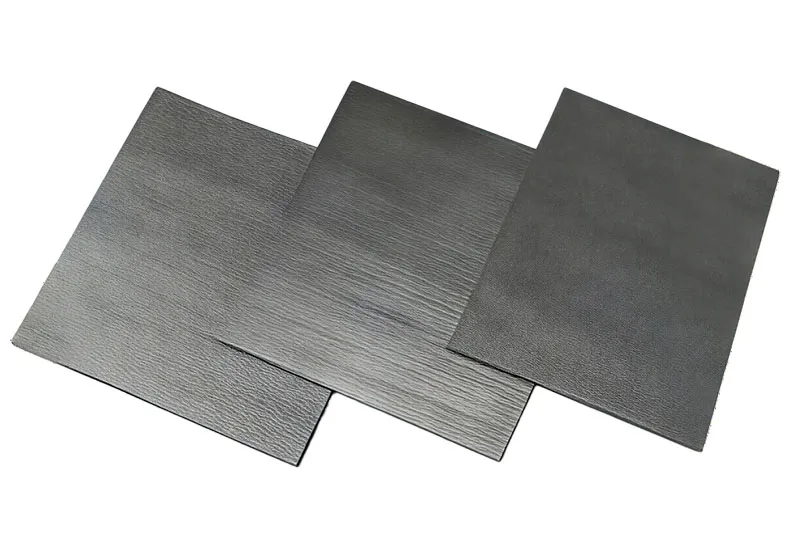
Not every cooling material bends without cracking. Ultra-high thermal conductivity Graphene sheet (90W/mK+) does.
• Ultra-thin profile down to micrometer scale
• High flexibility for curved housings
• True lightweight design for portable gear
It slips into:
· Smartphones
· Wearables
· Tablets
· Compact IoT boards
The appeal lies in balance. You get serious heat dissipation, yet the structure stays thin enough for space-saving layouts. Engineers working on compact design projects appreciate how this adaptable material supports weight reduction without losing thermal conductivity.
Short and simple: thinner device, cooler core, no added bulk.
Compared with traditional heat spreaders, Ultra-high thermal conductivity Graphene sheet (90W/mK+) maintains mechanical integrity even after repeated bending. That makes it ideal for foldable tech and tight enclosures.
Enhanced Reliability via Thermal Cycling & Shock Resistance
Heat comes and goes. Materials expand and contract. Poor choices crack under pressure.
Ultra-high thermal conductivity Graphene sheet (90W/mK+) handles aggressive thermal cycling while preserving material integrity.
Performance breakdown:
· Survives -40°C to 150°C cycles
· Maintains over 95% conductivity after 1,000 cycles
· High shock resistance under vibration
· Strong stress resistance in power modules
Reliability advantages:
· Stable durability in automotive electronics
· Improved long-term stability in LED systems
· Consistent reliability in power converters
· Reduced microfracture risk
Industry insight reinforces this direction:
“Advanced thermal interface materials with higher in-plane conductivity are accelerating adoption in consumer electronics and EV platforms,” noted a 2025 thermal materials outlook by MarketsandMarkets.
For brands demanding robust performance, Ultra-high thermal conductivity Graphene sheet (90W/mK+) has become a go-to solution. Sheen Technology integrates strict testing standards to ensure each sheet maintains reliability under real-world mechanical stress.
Bottom line? Cooler systems last longer. And longer life means fewer returns, fewer failures, and better user trust.
Why Choose 90W/mK+ Graphene Sheet?
Compact electronics are getting hotter and thinner at the same time. Choosing an Ultra-high thermal conductivity Graphene sheet (90W/mK+) isn’t hype—it’s practical thermal survival for modern devices.
Maximizing Heat Spreading in Smartphones and Laptops
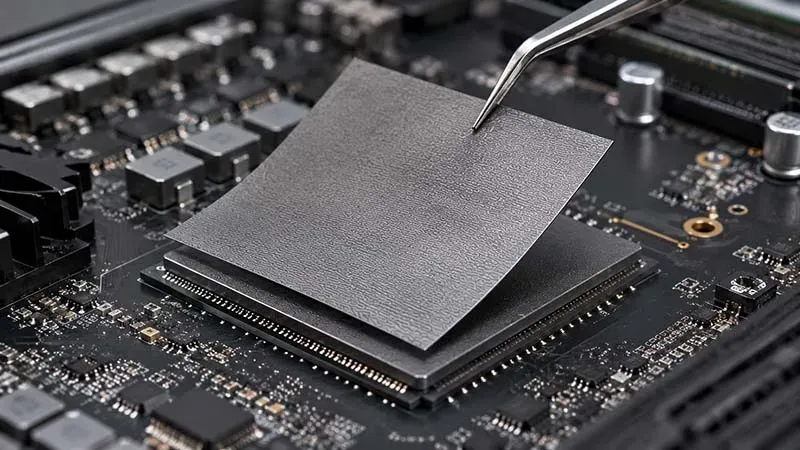
When it comes to heat spreading in smartphones and laptops, performance lives or dies by smart thermal management. An Ultra-high thermal conductivity Graphene sheet (90W/mK+) works as a heat highway inside tight electronic devices.
Core Function in Mobile Computing
Processor Zone
· Heat dissipation
· Reduced surface hot spots near SoC
Battery Area
· Balanced temperature during fast charging
· Improved comfort in hand-held use
Material Advantage
Compared with metal plates
· Lighter weight
· Higher in-plane conductivity
Compared with generic Graphene
· Stable 90W/mK+ rating
· Consistent thermal performance over cycles
For brands like Sheen Technology, tailoring the Ultra-high thermal conductivity Graphene sheet (90W/mK+) to fit slim mobile computing layouts means fewer thermal complaints and smoother multitasking.
Superior Thermal Diffusivity Compared to Copper and Aluminum
Not all materials move heat the same way. The real win of an Ultra-high thermal conductivity Graphene sheet (90W/mK+) lies in its Vertical thermal conduction performance, often outperforming copper and aluminum in thin assemblies.
· Faster Vertical heat transfer
· Lower weight per area
· Better temperature uniformity
Performance Snapshot
| Material | Thermal Conductivity (W/mK) | Density (g/cm³) | Relative Weight (Same Area) | Thermal Performance in Thin Devices |
| Copper | ~400 | 8.96 | High | Moderate spreading |
| Aluminum | ~205 | 2.70 | Medium | Fair spreading |
| 90W/mK+ Graphene Sheet | 90+(Vertical orientation) | 0.3–0.7 | Low | Excellent |
Short takeaways: lighter than metals, That’s why many engineers switch to high thermal conductivity Graphene sheet solutions instead of adding thicker metal plates.
Lower Junction Temperatures in Power Electronics and LEDs
High power means high junction temperatures. An Ultra-high thermal conductivity Graphene sheet (90W/mK+) helps stabilize power electronics and LEDs by spreading heat before it builds up.
In Power Modules
· Heat from MOSFETs spreads laterally
· Reduced peak heat reduction stress
· Improved device reliability
In LED Systems
· Uniform temperature across LED arrays
· Less lumen decay
· Longer lifespan of electronic components
“Thermal constraints remain one of the top three limiting factors in power density growth,” noted a 2025 update from the International Energy Agency’s efficiency outlook, highlighting how better heat control directly extends component life.
For demanding applications, Sheen Technology applies the Ultra-high thermal conductivity Graphene sheet (90W/mK+) to keep chips cooler, steadier, and ready for long-term operation.
Need a closer match for your project? Browse related application pages to see how ultra-high thermal conductivity graphene sheet materials are used in smartphones, laptops, power electronics, LED modules, and other compact high-heat systems.
Data Center Racks: Deploy Graphene Spreaders
Modern racks are crammed with processors and graphics cards, and heat builds up fast. The smart move? Integrating Ultra-high thermal conductivity Graphene sheet (90W/mK+) solutions that quietly move heat where it should go. With better thermal management, racks stay cooler, workloads stay heavy, and energy bills don’t spiral.
High-Density CPU & GPU Cooling Efficiency
When electronic components push higher power density, heat dissipation becomes survival, not luxury. Ultra-high thermal conductivity Graphene sheet (90W/mK+), sometimes shortened to ultra-high thermal conductivity Graphene sheet or 90W/mK+ Graphene sheet, vertical heat conduction across crowded boards.
· Boosts heat dissipation across processors
· Stabilizes graphics cards under AI loads
· Enhances computing performance
In rack deployment:
· Install thermal interface material above hotspots.
· Layer Ultra-high thermal conductivity Graphene sheet (90W/mK+) across CPU/GPU clusters.
· Connect to chassis-level heat paths.
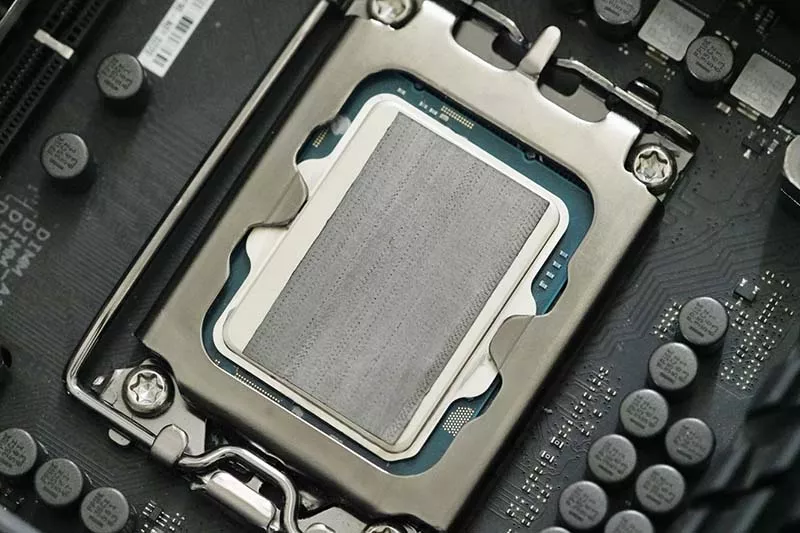
Within each server node:
Core layer
· Ultra-high thermal conductivity Graphene sheet (90W/mK+)
· Auxiliary Graphene thermal sheet
Support layer
· Vapor chamber or heat sink
· Directed airflow
★ Less throttling.
★ Longer component life.
Uniform Temperature Distribution Across Rack Servers
Uneven airflow creates hot spots and cold spots inside server racks. That gap kills system reliability.
With Ultra-high thermal conductivity Graphene sheet (90W/mK+), racks gain real thermal uniformity:
· Spreads heat before gradients grow
· Supports smoother heat transfer
· Reduces sharp temperature gradients
Inside a rack ecosystem:
· Board level:Apply Ultra-high thermal conductivity Graphene sheet (90W/mK+) near DIMMs,Balance thermal spreading across ASIC zones.
· Chassis level:Align Graphene sheet 90W/mK+ with airflow channels.
· Rack level:Sync with containment strategy.
“High-density AI racks are redefining thermal design thresholds,” noted the International Energy Agency’s 2025 data center outlook, highlighting advanced passive materials as key to efficiency gains.
That’s why teams sourcing from Sheen Technology focus on consistent Vertical direction, not just spec-sheet numbers.
Passive Cooling Enhancement for Data Center Environments
In large data centers, every watt counts. Ultra-high thermal conductivity Graphene sheet (90W/mK+) supports passive thermal solutions that ease pressure on cooling infrastructure.
· Lower fan demand
· Better airflow management
· Reduced strain on heat exchangers
Deployment stack:
· Component tier:Attach ultra-high thermal conductivity Graphene sheet to VRMs
· Server tier:Integrate 90W/mK+ Graphene sheet across CPU trays
· Facility tier:Coordinate with environmental control systems,Track gains tied to sustainability initiatives
Short and real: less noise, fewer moving parts, tighter PUE.
For operators scaling fast, Sheen Technology pairs Ultra-high thermal conductivity Graphene sheet (90W/mK+) with tailored sizing, keeping expansion smooth and cooling budgets under control.
【Request a Custom Quote】Not sure which ultra-high thermal conductivity graphene sheet fits your smartphone, power module, LED system, or data center cooling project? Send us your operating temperature range, thickness target, interface design, and thermal performance goals, and we can help recommend the right graphene thermal solution for your application.
Sheen Thermal
Dongguan Sheen Electronic Technology Co., Ltd · Founded in 2008
Manufacturer of thermal interface materials and silicone foam for automotive electronics, energy storage, power electronics, communications and consumer electronics.
Certified
- ISO 9001:2015
- ISO 14001:2015
- IATF 16949:2016
What we supply
- Thermal conductivity Up to 90 W/m·K
- Thickness 0.3–10.0 mm
- Custom & samples Die-cut to drawing, 3–7 days