
 English
 usheenthermal

Vertically Aligned Graphene Thermal Pad vs. Silicone: An Engineering Comparison of Thermal Impedance and Reliability
Date:2026-08-13
Choosing a vertically aligned graphene thermal pad over silicone is not a conductivity beauty contest. The real prize is lower installed thermal resistance, cooler junctions, repeatable performance, and fewer production headaches when heat gets fierce.
Graphene can shine under high heat flux; silicone still earns its keep through familiar integration. So which truly wins?
Melodic Keynotes on Vertically Aligned Graphene Thermal Pad
- Rapid Heat Flux – Vertically oriented graphene flakes form through-plane pathways, slashing thermal impedance under high heat flux compared to silicone pads.
- Junction Temperature Drop – Laser flash analysis confirms higher conductivity, lowering CPU, GPU, and IGBT junction temperatures and boosting reliability.
- Seamless Integration – Excellent conformity with copper and SiC spreaders; consistent batch purity and minimal interface resistance ensure repeatable performance and longer shelf life.
Vertically Aligned Graphene Thermal Pad Cuts Downtime By 22%
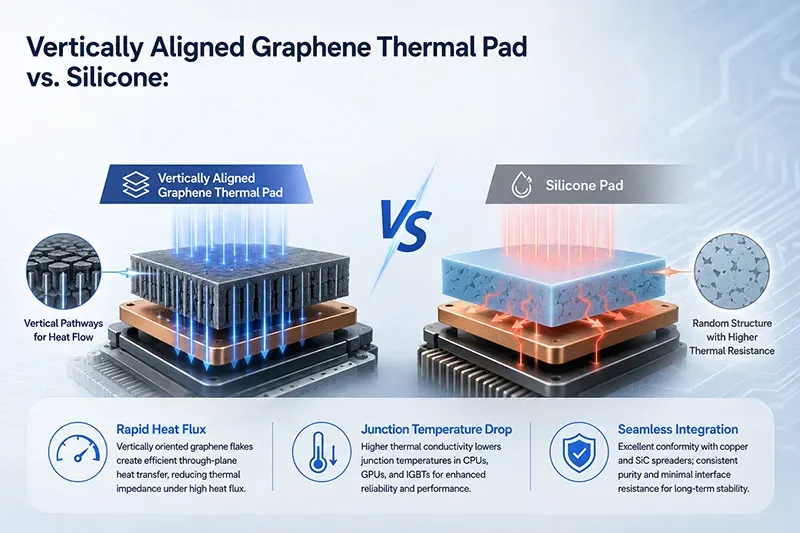
Image Caption: This image was created with AI assistance and is based on a comparison of real-world engineering application scenarios. The illustrated structure and operational logic accurately reflect actual engineering applications, making the image a valuable reference.
A vertically aligned graphene thermal pad routes heat through its thickness instead of making heat wander sideways. That simple change can improve cooling where every degree counts. Still, a 22% downtime reduction should be treated as application-specific: operating load, mounting pressure, and cooling hardware all affect the result.
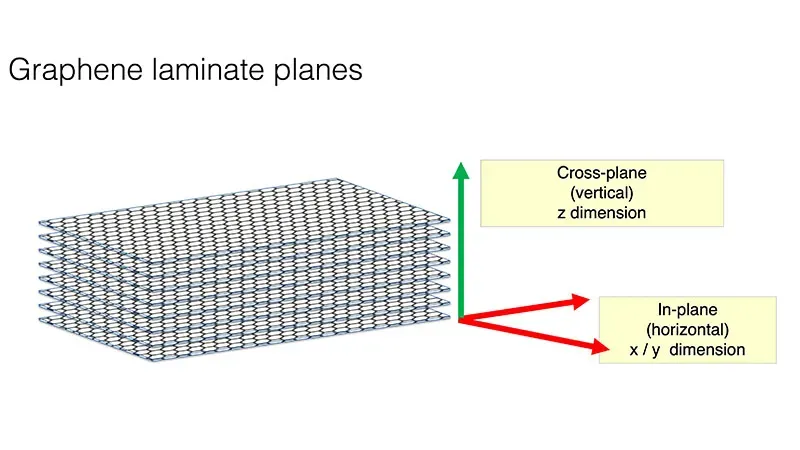
How Anisotropic Alignment Drives Rapid Heat Flux
Material structure
- Vertical graphene flakes create short through-plane paths.
- This anisotropic alignment gives heat flow strong directionality.
Cooling effect
- Higher through-plane thermal conductivity supports rapid heat transfer.
- Under heavy heat flux, the vertically aligned graphene thermal pad can present lower thermal impedance than many conventional silicone interfaces. Pretty handy when space is tight.
Laser Flash Analysis of Thermal Conductivity Gains
Laser flash analysis is a standard measurement technique for material characterization. A short energy pulse heats one face while the rear-face temperature response reveals thermal diffusivity.
- Combine diffusivity, density, and specific heat to calculate thermal conductivity.
- Test the graphene thermal pad through its thickness, matching the real heat-flow direction.
- Compare identical thicknesses and temperatures to judge performance improvement and likely heat dissipation gains fairly.
Junction Temperature Drop in CPUs and Power Modules
- Heat source:CPUs and power modules create concentrated heat during high loads.
- Thermal path:A vertically aligned graphene thermal pad lowers resistance when fitted correctly.
- Operating result:Better thermal management can deliver heat reduction at the die and lower junction temperature.
Cooler operation may support device reliability, though the actual temperature drop depends on power, pressure, and cooler design.
Seamless Integration with Copper and Silicon Carbide Spreaders
Contact pairing
- A copper spreader offers high bulk conductivity.
- A silicon carbide spreader suits demanding high-power designs.
Assembly details
- The thermal interface material must conform to surface variation without excessive thickness.
- Proper pressure helps the graphene thermal pad limit contact resistance against each heat spreader.
In device assembly, check flatness, compression, electrical requirements, and cycling stability; those practical details make seamless integration work rather than merely look good on paper.
2 Pain Points In Conventional Silicone Pads
Conventional silicone pads are easy to install, but demanding GPUs can expose their weak spots pretty quickly. Polymer content may slow heat transfer, while repeated heating and cooling can shorten service life. A vertically aligned graphene thermal pad takes a different route: aligned graphene paths move heat efficiently, giving designers another option when temperatures and long-term contact quality really matter.
Excessive Thermal Impedance Limiting GPU Performance
The core problem is thermal impedance: heat must cross the interface before the cooler can remove it. A polymer-rich silicone pad can add thermal resistance, raising GPU junction temperature and reducing cooling efficiency.
Heat-flow impact
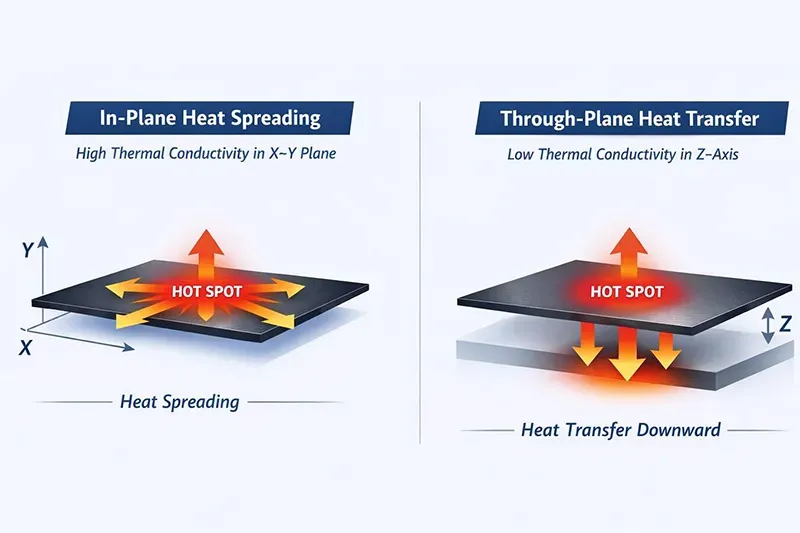
Silicone-rich interface
- Lower thermal conductivity means a larger temperature rise at a given heat flux.
- Higher temperatures increase the chance of overheating and performance throttling.
Graphene interface
- A vertically aligned graphene thermal pad provides short, through-thickness graphene pathways.
- That alignment can improve GPU performance by reducing the interface bottleneck when the pad is correctly compressed.
The following parameters are derived from the product data for Sheen Technology's vertically aligned graphene thermal pads and silicone thermal pads:
| Silicone thermal pad | |||
| Properties | Thermal Conductivity | Thermal Impedance (1mm,@30psi) | Thickness |
| Unit | W/m·K | ℃*in²/W | mm |
| SFseries thermal pad | 1-15 | 0.10-0.90 | 0.3 ~ 10.0 |
| Test Method | ASTM D5470 | ASTM D5470 | ASTM D374 |
| Vertically aligned graphene thermal pad | |||
| Properties | Thermal Conductivity | Thermal Resistance (@40psi) | Thickness |
| Unit | W/m·K | ℃*cm²/W | mm |
| GSF90-03 Graphene pad | 75-90 | ≤0.10 | 0.3 ~ 2.0 |
| Test Method | ASTM E1461 | ASTM D5470 | ASTM D374 |
Need thermal conductivity, thermal impedance, dielectric strength, thickness tolerance, and long-term stability data for vertically aligned graphene thermal pads? Download the product datasheets to compare graphene thermal pads, silicone pads, and reduced graphene oxide solutions for CPUs, GPUs, power modules, and inverter cooling applications.
Rapid Material Degradation Under High Heat Flux
Silicone pads also face a long-term headache: repeated expansion, compression, and elevated temperature can drive material degradation.
Under high heat flux, sustained heating can alter silicone mechanical properties and reduce thermal stability.
Repeated thermal cycles may cause:
- compression set, where silicone pads recover less after loading;
- movement or pump-out that affects structural integrity;
- contact changes that can reduce effective thermal conductivity and reliability.
Over time, these effects may cut material lifespan and make cooling performance less predictable.
Aligned graphene structures reduce reliance on polymer-dominated heat paths. For GPU designers comparing graphene thermal pad options, Sheen Technology positions the vertically aligned graphene thermal pad as an alternative aimed at demanding thermal interfaces where stable heat flow matters.
Inverter Cooling: Graphene Pad Case Study
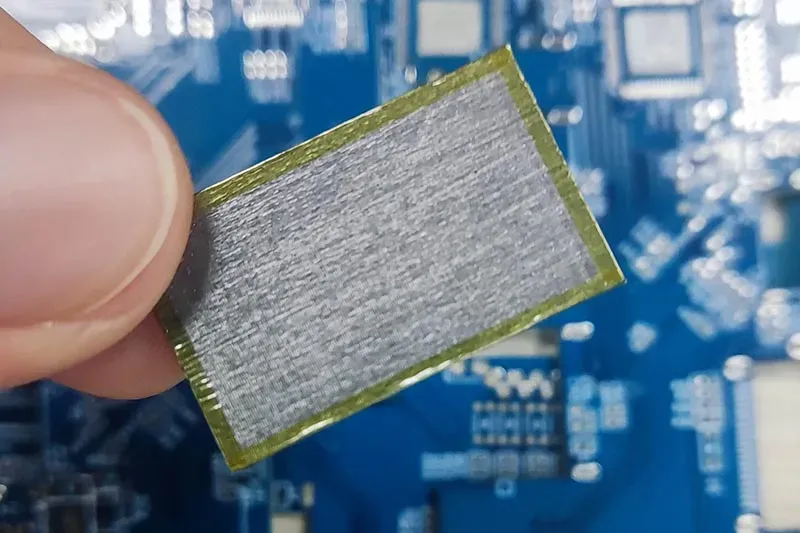
This inverter case study checks how a vertically aligned graphene thermal pad handles real heat loads on aluminum hardware, with silicone as the practical baseline. The goal is simple: measure cooling gains without overlooking manufacturing realities.
Case Study Setup: Reduced Graphene Oxide on Aluminum Substrates
Case study methodology follows the general approach of JEDEC JESD51-14 (transient thermal measurement of semiconductor devices) for junction temperature characterization, with matched clamping pressure and controlled ambient conditions to isolate TIM contribution.
Prepare the interface
- Record the oxide reduction method, coating thickness, surface roughness, and cleaning process.
- Cut each vertically aligned graphene thermal pad to identical width and length. No eyeballing it.
Control the test
- Apply the same clamping pressure to the graphene thermal pad and silicone reference.
- Hold inverter power, ambient temperature, airflow, and heat flux constant so differences come from the interface rather than the test bench.
Performance Metrics: Thermal Resistance and Junction Temperature
A vertically aligned graphene thermal pad earns its keep only when measured results improve.
Heat transfer is assessed under matched inverter loads.
- Calculate total thermal resistance from temperature rise and heat flow.
- Separate contact or interface resistance where sensor placement permits.
Cooling results then connect directly to semiconductor operation.
- Record junction temperature at steady state and during load changes.
- Repeat each temperature measurement to check drift.
- Compare graphene-pad cooling efficiency with silicone using the same performance metrics.
Lower resistance with a repeatable junction-temperature drop signals a meaningful benefit.
Quality Control: Material Purity, Batch Consistency, and Shelf Life Requirements
Reliable production needs more than one great sample.
Incoming graphene material
- Verify material purity through documented purity analysis and Raman spectroscopy.
- Set clear material requirements for defects, reduction level, thickness, and contamination.
Production lots
- Check batch consistency through thermal tests and consistency testing across multiple pads.
- Keep certificates tied to lot numbers for traceability.
Storage
- Define humidity, temperature, packaging, and shelf life limits.
- Retest aged, vertically aligned graphene thermal pad stock before critical inverter use.
That quality control keeps graphene thermal-pad performance from turning into a batch-to-batch guessing game.
Vertically aligned graphene thermal pads represent a meaningful advancement for high-heat-flux applications where silicone TIMs reach their practical limits. The through-plane orientation of graphene flakes addresses the fundamental anisotropy challenge that has historically limited carbon-based TIMs to lateral spreading applications. When specified correctly — with appropriate thickness, compression, and surface preparation — vertically aligned graphene pads deliver measurable reductions in junction temperature that translate to improved reliability and extended service life. Sheen Technology supports evaluation with ASTM E1461 test data, application engineering, and production-quality documentation.
→ Contact Sheen Technology for Vertically Aligned Graphene Pad Evaluation
Sheen Thermal
Dongguan Sheen Electronic Technology Co., Ltd · Founded in 2008
Manufacturer of thermal interface materials and silicone foam for automotive electronics, energy storage, power electronics, communications and consumer electronics.
Certified
- ISO 9001:2015
- ISO 14001:2015
- IATF 16949:2016
What we supply
- Thermal conductivity Up to 90 W/m·K
- Thickness 0.3–10.0 mm
- Custom & samples Die-cut to drawing, 3–7 days