
 English
 usheenthermal

Boron Nitride Thermal Pad vs Thermal Grease for Inverter Power Modules
Date:2026-08-14
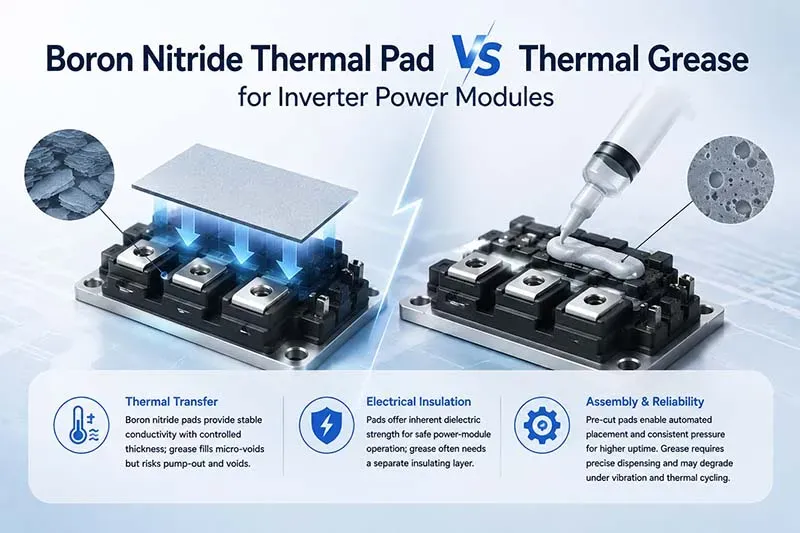
Image caption: This image was generated with AI assistance, based on a comparative analysis of boron nitride thermal pads and thermal grease. The structural applications shown in the image are for reference only.
“Inverter heat doesn’t play nice: one shaky interface can push junction temperatures up and production yields down. Boron Nitride Thermal Pad vs Thermal Grease is the practical showdown: thin, conformal grease versus controlled, insulating pads built for repeatable assembly.
For volume buyers, specs alone won’t cut it. Compare thermal resistance, dielectric protection, and manufacturability.
Quick Insights on Boron Nitride Thermal Pad vs Thermal Grease
→ Thermal Transfer: Boron nitride pads offer controlled thickness and stable conductivity, while grease fills micro-voids but risks pump-out and void formation.
→ Electrical Insulation: Pads deliver inherent dielectric strength for safe power-module operation; grease often needs a separate insulating layer.
→ Assembly & Reliability: Pre-cut pads enable automated placement and repeatable pressure, boosting uptime. Grease demands precise dispensing and can degrade under vibration and thermal cycling.
Why Boron Nitride Thermal Pad Vs Thermal Grease Matters Now
Boron Nitride Thermal Pad vs Thermal Grease is more than a material choice in modern inverters. Heat, voltage, assembly gaps, and years of cycling all come into play. Picking the right thermal interface can keep power electronics cooler and working longer.
Understanding Thermal Conductivity in Power Electronics
Boron Nitride Thermal Pad vs Thermal Grease starts with one basic job: moving heat away from semiconductor packages.
Thermal path
- Grease spreads into tiny imperfections, lowering thermal resistance and improving heat dissipation under thin bond lines.
- Boron nitride pads provide controlled thickness for power modules, where consistent assembly can matter as much as headline conductivity.
Operating impact:Better interface materials reduce junction temperature as heat flux rises. That gives inverter designers more room for dependable thermal management without making cooling hardware huge.
Electrical Insulation and Dielectric Strength Insights
Here, the pad has a practical trick up its sleeve.
Insulating path
- Boron nitride thermal pads can combine heat transfer with electrical isolation, helping provide specified voltage withstand between power devices and grounded heat sinks.
Grease path
- Standard thermal grease often needs a separate dielectric film when insulation is required. Designers must check dielectric breakdown, insulation resistance, leakage current, and dielectric constant for the complete stack, not just one material.
Conformability: Filling Gaps on PCBs and Packages
For uneven assemblies, Boron Nitride Thermal Pad vs Thermal Grease becomes a fit question as well as a thermal one.
- Microscopic fit:Grease handles fine surface roughness through close void filling, which can cut contact resistance.
- Larger variation:Soft pads offer gap filling across wider package interfaces.
With suitable interface pressure, controlled material deformation accommodates package, substrate, and heat-spreader tolerances. Sheen Technology thermal-pad options can be evaluated around these mechanical and electrical needs.
Long-Term Reliability and Chemical Stability
A cool day-one test does not tell the whole story.
Grease aging
- Thermal grease may experience pump-out during thermal cycling or dry-out during long-term aging.
- Those changes can increase interface resistance and contribute to material degradation.
Pad aging
- A boron nitride thermal pad avoids grease migration, though compression set and temperature limits still deserve attention.
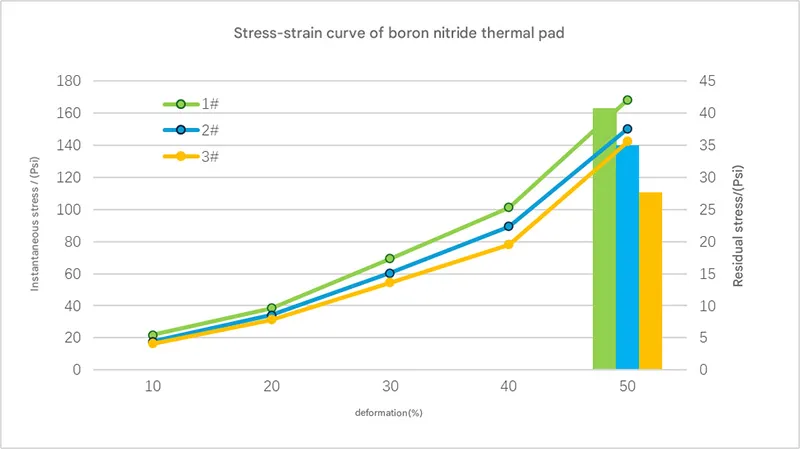
Designers should verify chemical compatibility, outgassing, and environmental stability against the actual inverter environment. Over years of service, these checks support performance longevity and explain why Boron Nitride Thermal Pad vs Thermal Grease remains an application-specific choice.
BN Pad Vs Grease: Thermal Resistance Comparison
Choosing between Boron Nitride Thermal Pad vs Thermal Grease comes down to more than a conductivity number. Interface thickness, surface contact, pressure, and aging all shape real-world heat transfer. For inverter designs, Sheen Technology helps engineers compare interface options against electrical, thermal, and assembly needs without making the choice harder than it needs to be.
Boron Nitride Thermal Pad
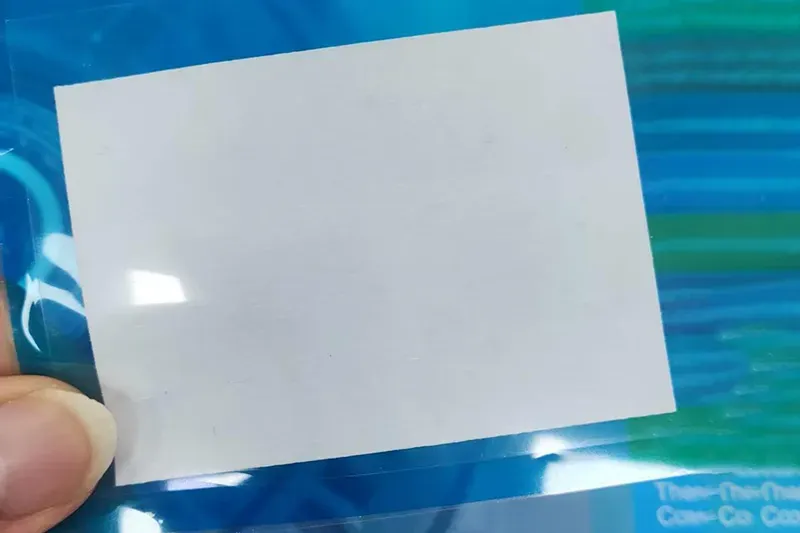
A Boron Nitride thermal pad creates a consistent solid interface between a power module and a cooler. Compared with grease, its controlled thickness makes production assembly fairly straightforward, while suitable grades can provide valuable electrical isolation.
Thickness matters
- A thinner pad generally lowers bulk thermal resistance when surface tolerances allow reliable contact.
- Higher ceramic filler loading can raise thermal conductivity, although the exact result depends on the pad formulation.
Contact matters
- Good compressibility helps fill small surface gaps.
- Adequate assembly pressure improves contact, but excessive force can strain components or mounting hardware.
Design trade-offs
- Boron Nitride Thermal Pad vs Thermal Grease comparisons should include both bulk and contact resistance, not conductivity alone.
- A BN thermal pad can make sense when electrical isolation and predictable placement carry real design value.
For production teams, that repeatability can be a pretty big deal.
Thermal Grease
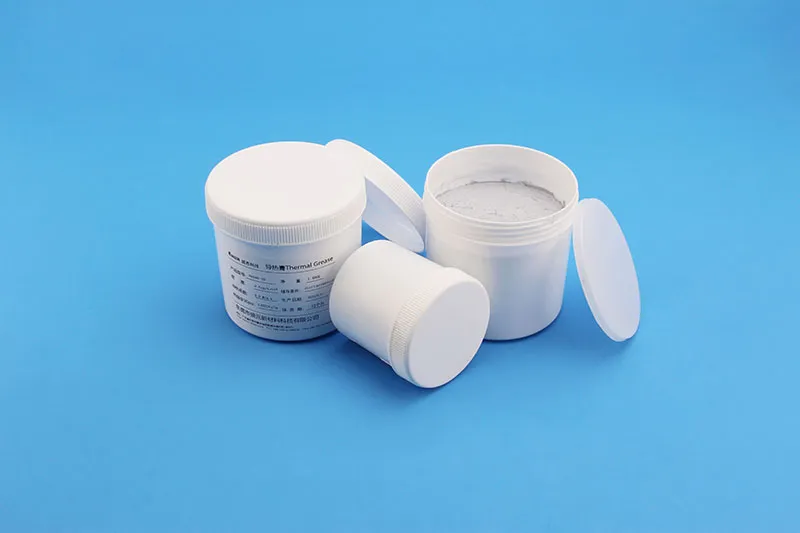
Thermal grease works as a highly conformable liquid interface, filling microscopic valleys between a power module and cooling plate. Because the paste compound can form a very thin bond line, it often offers low interface resistance and efficient heat transfer when applied correctly.
- Control viscosity and dispensing volume so coverage stays consistent without creating an unnecessarily thick layer.
- Limit trapped air. Voids interrupt the thermal path even when the grease itself has high thermal conductivity.
- Check cycling durability. Repeated heating and cooling can cause pump-out, moving material away from critical contact areas.
- Validate long-term stability under real mounting pressure and temperatures.
| Parameter | BN Thermal Pad | Thermal Grease | Engineering Guidance |
| Thermal Conductivity (W/m·K) | 16 (through-plane) | 1–5 | Pad: higher ceiling Grease: lower BLT |
| BLT (μm) | 100–500 (controlled) | 10–80 (variable) | Grease: lower resistance Pad: controlled |
| Breakdown Voltage (kV,@AC) | 4-12 | N/A (separate film needed) | Pad: integrated isolation Grease: add film |
| Pump-Out Resistance | Excellent (solid) | Poor–Moderate | Pad: cycling stability Grease: reapplication |
| Assembly | Pick-and-place, pre-cut | Dispense + inspect (volume control) | Pad: automated Grease: dispense station |
| Rework | Peel + replace | Solvent clean + re-dispense | Pad: cleaner rework Grease: messier |
The parameters above are for comparison only. Actual parameters may vary depending on the product model. The final parameters shall be based on the TDS of Sheen Technology products.
In a Boron Nitride Thermal Pad vs Thermal Grease decision, grease can win on thin-bond-line performance, while pads can win on handling and isolation. Sheen Technology recommends testing the actual stack-up because datasheet values alone don't tell the whole story. In short, Boron Nitride Thermal Pad vs Thermal Grease is an interface-system comparison, not simply a race for the highest conductivity figure.
Overheating Inverters? Try Boron Nitride Thermal Pads
Inverter cooling gets tricky when a small hot spot drives temperatures sky-high. Comparing Boron Nitride Thermal Pad vs Thermal Grease helps engineers balance insulation, contact quality, and assembly needs. Sheen Technology offers boron nitride thermal interface options aimed at practical, repeatable power-electronics cooling.
Identifying Hot Spots on Semiconductor Devices
Start with thermal imaging under realistic inverter loads, then map the temperature distribution across each semiconductor package and power stage. Don’t eyeball it.
Pin down the heat source:
- Record junction temperature estimates and case temperatures.
- Use thermal analysis to connect electrical load with each hot spot.
Match cooling choices:
- Higher heat flux can justify greater pad conductivity or a thinner bond line.
- Review the heat sink before assuming a pad alone fixes overheating.
Check risk: Repeated temperature peaks can reduce reliability and raise device failure risk.
For Boron Nitride Thermal Pad vs Thermal Grease decisions, also weigh electrical insulation and production repeatability, not conductivity alone.
Phase Change Behavior for Improved Heat Spreading
A phase change material softens around its designed transition range, helping the thermal interface conform to small surface gaps. That better contact can cut interface resistance and support heat spreading toward the heat sink. Pretty handy when package surfaces aren’t perfectly flat.
| Example design check | 45°C | 65°C | 85°C |
| Softening state | Low | Medium | High |
| Target bond line (mm) | 0.30 | 0.25 | 0.20 |
| Relative contact target (%) | 90 | 95 | 98 |
These are illustrative engineering targets, not universal product specifications. Actual material properties, thermal conductivity, latent heat, and heat transfer behavior should be validated for the application. Sheen Technology can support material selection around required thermal performance.
Automated Placement and Assembly Pressure Tips
Good automated assembly turns thermal-pad performance into something production can repeat.
Prepare
- Clean mating surfaces and remove particles or oils.
- Keep the thermal pad flat and undamaged.
Place
- Control placement accuracy around the device footprint.
- Verify alignment before compression; close enough isn’t always good enough.
Compress
- Set assembly pressure within the pad supplier’s validated range.
- Monitor bond line thickness so excess force does not harm dielectric integrity.
Verify
- Inspect for trapped air and uneven contact.
- Track contact resistance and thermal results through the manufacturing process.
This controlled approach supports process optimization and makes boron nitride pads versus thermal grease easier to compare using repeatable inverter test data.
3 Key Benefits Of Boron Nitride Pads
Choosing between Boron Nitride Thermal Pad vs Thermal Grease comes down to more than headline conductivity. In an inverter, the interface must move heat, remain electrically insulating, survive real-world stress, and fit production needs. Sheen Technology boron nitride pad solutions bring these needs together while keeping assembly and later service fairly straightforward.
Enhanced Thermal Performance with Ceramic Filler
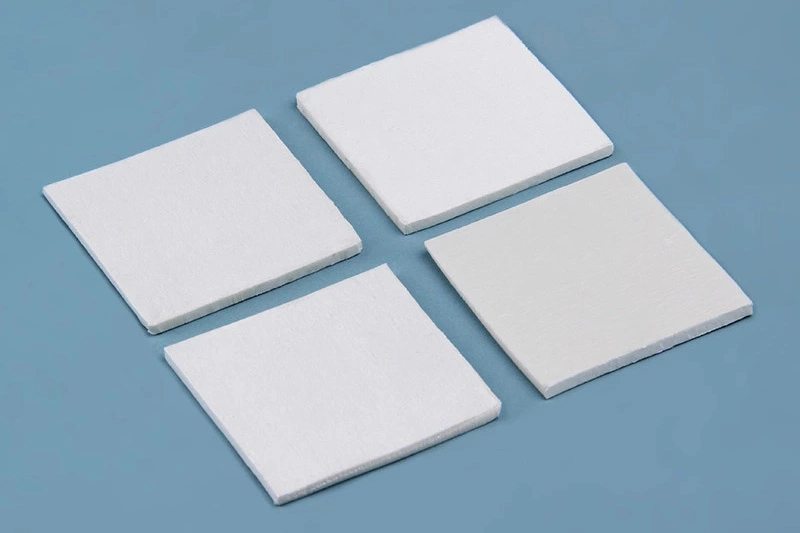
Boron nitride works as a ceramic filler inside a flexible polymer, creating paths for heat transfer efficiency while maintaining electrical insulation. That combination matters around high-voltage power modules.
At the thermal interface:
- Boron nitride supports higher thermal conductivity, helping heat travel toward a cold plate or heat sink.
- Consistent pad thickness helps control thermal resistance across mating surfaces.
At the system level:
- Better heat dissipation can reduce hot spots around inverter packages.
Here are the performance parameters for Sheen Technology's boron nitride thermal pads:
| Properties | Unit | SF1600-BN-03 | SF1600-BN-05 | SF1600-BN-07 | SF1600-BN-10 | SF1600-BN-15 | SF1600-BN-20 | SF1600-BN-30 | Test Method |
| Color | - | White | White | White | White | White | White | White | Visual |
| Thermal Conductivity | W/m·K | 16 | 16 | 16 | 16 | 16 | 16 | 16 | ASTM D5470 |
Thermal Resistance (@40psi) | ℃*cm²/W | ≤0.3 | ≤0.5 | ≤0.7 | ≤0.8 | ≤1.1 | ≤1.4 | ≤1.7 | ASTM D5470 |
Application temperature | ℃ | -40~150 | -40~150 | -40~150 | -40~150 | -40~150 | -40~150 | -40~150 | - |
Thermal weight loss rate | % | ≤1 | ≤1 | ≤1 | ≤1 | ≤1 | ≤1 | ≤1 | - |
| Thickness | mm | 0.2~5.0 | 0.2~5.0 | 0.2~5.0 | 0.2~5.0 | 0.2~5.0 | 0.2~5.0 | 0.2~5.0 | ASTM D374 |
| Breakdown voltage | KV,@AC | ≥4 | ≥5 | ≥6 | ≥10 | ≥12 | ≥12 | ≥12 | ASTM D149 |
| Dielectric constant | F/m, @ 1MHz | ≤4.2 | ≤4.2 | ≤4.2 | ≤4.2 | ≤4.2 | ≤4.2 | ≤4.2 | ASTM D150 |
| Volume resistivity | Ω*cm, @250V | ≥10¹³ | ≥10¹³ | ≥10¹³ | ≥10¹³ | ≥10¹³ | ≥10¹³ | ≥10¹³ | ASTM D257 |
| Rebound rate | % | ≥90 | ≥80 | ≥70 | ≥70 | ≥60 | ≥60 | ≥60 | - |
| Density | g/cm³ | 1.6±0.2 | 1.6±0.2 | 1.6±0.2 | 1.6±0.2 | 1.6±0.2 | 1.6±0.2 | 1.6±0.2 | ASTM D792 |
| Hardness | shore 00 | 60~80 | 60~80 | 60~80 | 60~80 | 60~80 | 60~80 | 60~80 | ASTM D2240 |
| Flammability rating | - | V-0 | V-0 | V-0 | V-0 | V-0 | V-0 | V-0 | UL 94 |
Need thermal conductivity, thermal impedance, dielectric strength, thickness tolerance, and long-term reliability data for boron nitride thermal pads? Download the product datasheets to compare boron nitride thermal pads, thermal grease, and ceramic-filled solutions for inverter power modules, IGBTs, and power electronics.
In a Boron Nitride Thermal Pad vs Thermal Grease comparison, pads also provide a defined insulating layer rather than a freely flowing compound.
Durability and Reworkability in Rugged Environments
An inverter can face years of motion, heat swings, and exposure to shop or automotive fluids. That makes durability more than a spec-sheet detail.
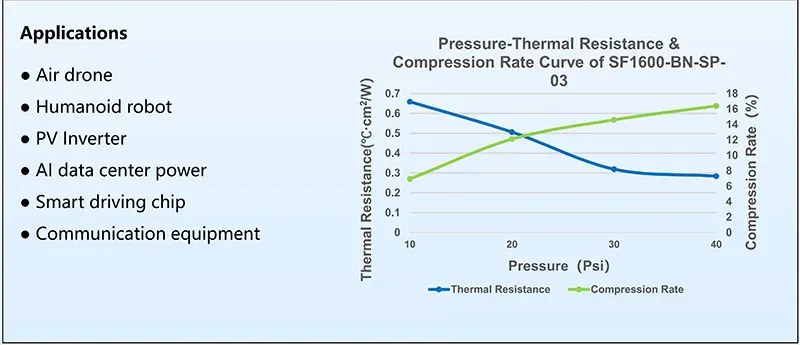
During operation:
- Mechanical stability helps resist pump-out as surfaces expand and contract.
- Vibration resistance helps the interface remain positioned in rugged environments.
- Resistance to chemical attack supports long-term performance.
During maintenance:
- A removable pad improves reworkability because technicians can lift it away for inspection or component replacement.
- Compared with thermal grease, cleanup can be quicker and less messy.
For thermal cycling, repeatable contact also supports system reliability over changing temperatures.
Streamlined Manufacturing Process Compatibility
For production teams, Boron Nitride Thermal Pad vs Thermal Grease also affects line design. Pre-cut pads can remove several variables from the manufacturing process.
Production becomes easier to control:
- Fixed dimensions support repeatable installation and coverage.
- Pick-and-place automation can improve production efficiency.
Shop-floor work gets simpler:
- Dry pad material handling means less concern about grease spreading or dispensing volume.
- No grease curing or dosing step supports process simplification and cleaner assembly.
Boron nitride thermal pads and thermal grease each occupy distinct positions in inverter power module thermal management. The selection is fundamentally an interface-system decision: grease maximizes thin-bond-line conformability, while BN pads deliver integrated electrical isolation, controlled thickness, pump-out resistance, and automated-assembly compatibility. For OEM engineers and procurement teams, the optimal choice follows from three variables — dielectric requirements, thermal cycling severity, and production process capability.
Sheen Technology can supply pad formats suited to equipment compatibility, helping manufacturers build repeatable thermal interfaces without turning application control into a headache.
→ Request BN Pad Samples + Qualification Data for Inverter Modules
Sheen Thermal
Dongguan Sheen Electronic Technology Co., Ltd · Founded in 2008
Manufacturer of thermal interface materials and silicone foam for automotive electronics, energy storage, power electronics, communications and consumer electronics.
Certified
- ISO 9001:2015
- ISO 14001:2015
- IATF 16949:2016
What we supply
- Thermal conductivity Up to 90 W/m·K
- Thickness 0.3–10.0 mm
- Custom & samples Die-cut to drawing, 3–7 days