
 English
 usheenthermal

Can a Reusable Graphene Thermal Pad Really Replace Thermal Paste?
Date:2026-08-14
A reusable graphene thermal pad can replace paste—but only when interface resistance, pressure, thickness, and electrical behavior fit the assembly. Paste fills microscopic gaps beautifully, yet dispensing drift, messy rework, pump-out, and drying can turn volume production into a headache.
For CPUs, GPUs, and power hardware, clean reuse and controlled die cuts are attractive. Still, graphene is no magic wand: buyers must qualify conductivity, insulation, durability, tolerances, batch consistency, and compliance before purchasing at scale.
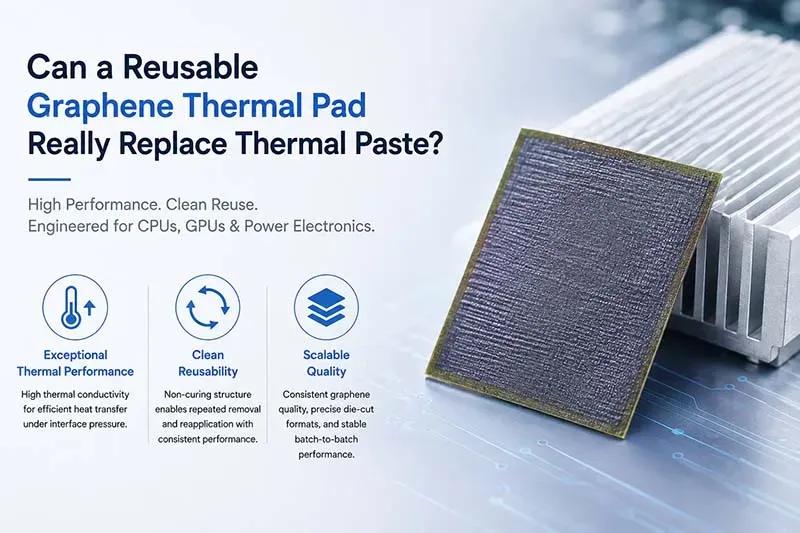
Image caption: The structure and scene shown in the image were generated with the help of artificial intelligence, but the product is a real graphene thermal pad with edge wrapping from Sheen Technology.
Key Highlights: Reusable Graphene Thermal Pad
- Exceptional Thermal Performance: Matches or exceeds paste conductivity while ensuring uniform heat spreading under typical CPU/GPU mounting pressures.
- Clean Reusability: Non-curing polymer matrix avoids pump-out and drying, allowing repeated removals and reapplications with consistent thickness.
- Electrical Safety: Composite formulations offer low thermal resistance alongside reliable electrical insulation for sensitive ICs and power electronics.
- Scalable Quality: CVD-synthesized graphene pads support ISO-certified production, die-cut form factors, and RoHS/REACH compliance for volume assembly.
Can A Graphene Pad Outperform Thermal Paste?
A reusable graphene thermal pad can make CPU and GPU cooling less messy, but raw conductivity tells only part of the story. Real results depend on pressure, flatness, thickness, and electrical safety. A reusable graphene pad also avoids paste cleanup, making repeat hardware work a lot easier for labs, builders, and data-center teams.
Assessing Thermal Conductivity on CPU and GPU Surfaces
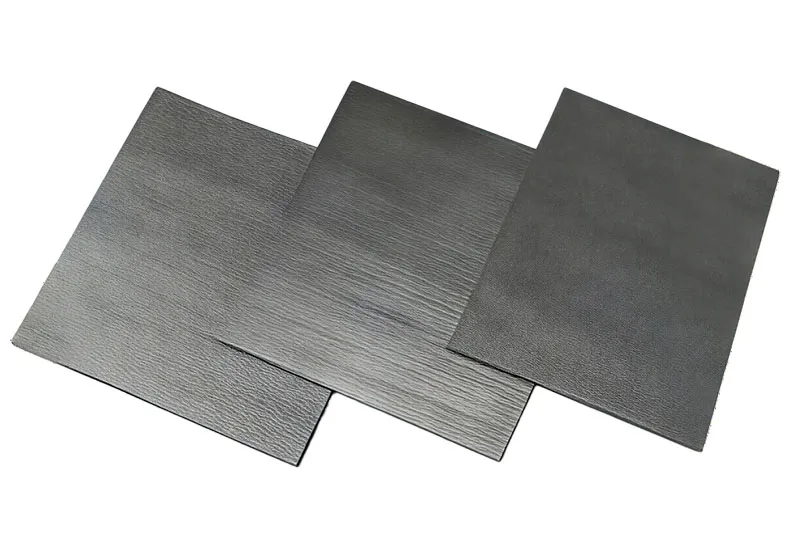
The defining advantage of a graphene thermal pad is thermal conductivity: Sheen Technology's vertically oriented graphene thermal pads have shorter heat conduction paths, enabling direct heat transfer from components to heat sinks.This is fundamentally different from conventional graphene or graphite pads, whose flake orientation favors in-plane (lateral) spreading but limits through-plane heat transfer.
Mounting changes the result:
- A GPU cooler needs enough pressure for the reusable graphene pad to conform without becoming too thin.
- Real measurement should track junction temperature and power. The best interface is the one delivering stable performance, not simply the highest advertised conductivity.
A reusable graphene thermal pad therefore can beat paste in some well-mated assemblies, but not every cooler.
Durability and Reusability in High-Performance Computing
For high-performance computing, repeat installation is where a non-curing pad gets pretty handy.
- Check durability after removal for dents, tears, or permanent thinning.
- Test reusability across mounting cycles, recording temperature after each application.
- Watch for degradation that reduces interface reliability and practical lifespan.
Unlike curing compounds, a reusable graphene thermal pad can support repeated service without scraping and reapplying paste. Sheen Technology can position this reusable graphene pad advantage around maintenance-heavy computing systems, provided cycle testing backs the claimed service life.
Electrical Conductivity
The vertically aligned graphene thermal pad is electrically conductive. This is an inherent property of the graphene filler. Engineering implications:
Advantage: Enables combined thermal + electrical grounding between metal surfaces (e.g., metal lid-to-heatsink, ground-plane coupling).
Application Restriction: Must NOT be specified for direct contact with exposed leads, PCB traces, or components requiring dielectric isolation. Electrical isolation must be provided externally (e.g., by package encapsulation or separate insulating layers).
Qualification: Surface resistivity and volume resistivity should be documented per ASTM D257 so designers can assess short-circuit risk in their specific layout.
This conductivity distinction is critical: specifying this pad in a location that requires electrical isolation would create a short-circuit hazard. Sheen Technology application engineering supports layout review to confirm compatibility.
4 Benefits Of A Graphene Thermal Pad
A reusable graphene thermal pad gives electronics a practical path for moving heat without the mess of grease. From processors to LED boards, graphene-based pads can simplify cooling and servicing while fitting tight spaces. Sheen Technology offers thermal interface options built around these everyday needs, combining stable performance, clean handling, and material choices suited to modern electronic assemblies.
Superior Heat Dissipation through a Nanomaterial Polymer Matrix
A reusable graphene thermal pad uses graphene, graphite, or carbon nanotubes as a conductive nanomaterial inside a polymer matrix.
The fillers form paths that support heat transfer away from hot components.
- Higher thermal conductivity can improve dissipation across CPU and GPU interfaces.
- Power electronics gain more consistent passive cooling without relying solely on thermal paste.
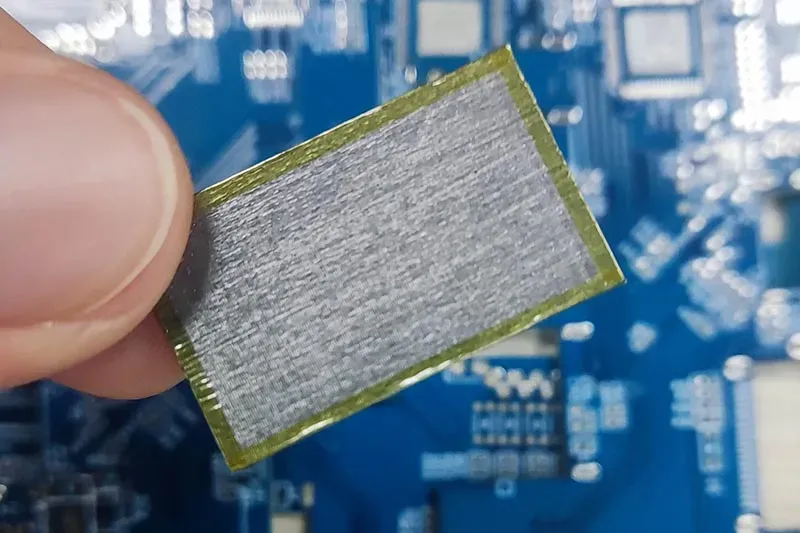
Sheen Technology vertically aligned graphene thermal pad performance properties:
| Properties | Unit | GSF75-03 | GSF90-03 | Test Method |
| Color | - | Black | Black | Visual |
| Thermal Conductivity | W/m·K | 75 | 90 | ASTM E1461 |
| Thermal Resistance (@40psi) | ℃*cm2/W | ≤0.12 | ≤0.10 | ASTM D5470 |
| Thickness | mm | 0.3~2.0 | 0.3~2.0 | ASTM D374 |
| Density | g/cm³ | 0.3~0.7 | 0.3~0.7 | ASTM D792 |
| Rebound Rate | % | ≥90 | ≥90 | - |
| Tensile Strength | Mpa | ≥0.03 | ≥0.05 | ASTM D412 |
| Oil Bleeding Rate | % | ≤3 | ≤3 | / |
| Application Temperature | ℃ | -40~150 | -40~150 | / |
| Flame rating | - | V-0 | V-0 | UL 94 |
Need thermal conductivity, thermal impedance, reusability cycle data, dielectric strength, and moisture resistance specs for graphene thermal pads? Download the product datasheets to compare reusable graphene pads, thermal paste, and nanomaterial polymer matrix solutions for CPUs, GPUs, data centers, and power electronics.
Non-curing Interface Layer Ensures Easy Reapplication
A non-curing reusable graphene thermal pad keeps its interface layer solid instead of drying like paste.
- During installation, its fixed thickness makes placement straightforward.
- During removal, there is less residue to clean up.
- For reapplication, a suitable reusable thermal pad may be installed again if it remains undamaged and uncontaminated.
That makes hardware maintenance a lot less messy.
Conformability on Complex Die-Cut Shapes and Flexible Substrates
A reusable graphene thermal pad combines conformability and flexibility with precise die-cut production.
Custom shapes suit a tight form factor.
- Compressible material follows small surface variations.
- Adaptable designs fit complex LED modules, boards, and flexible substrates without dispensing paste.
The result is easier placement around unusual component geometry.
RoHS-Compliant Composite Material with Moisture Resistance
For regulated assemblies, Sheen Technology can supply a reusable graphene thermal pad with documented RoHS and REACH compliance, subject to the specific product grade and supplier documentation.
A stable composite material can provide:
- moisture resistance for humid conditions;
- chemical stability for dependable use;
- thermal stability suited to electronics;
improved environmental and product safety compliance when verified against applicable limits.
Thermal Paste Vs. Graphene Pad: Engineering Comparison
Choosing between paste and a reusable graphene thermal pad comes down to contact quality, mounting force, and maintenance. One option molds into tiny surface flaws; the other keeps installation neat and repeatable, which is pretty handy.
Thermal Paste
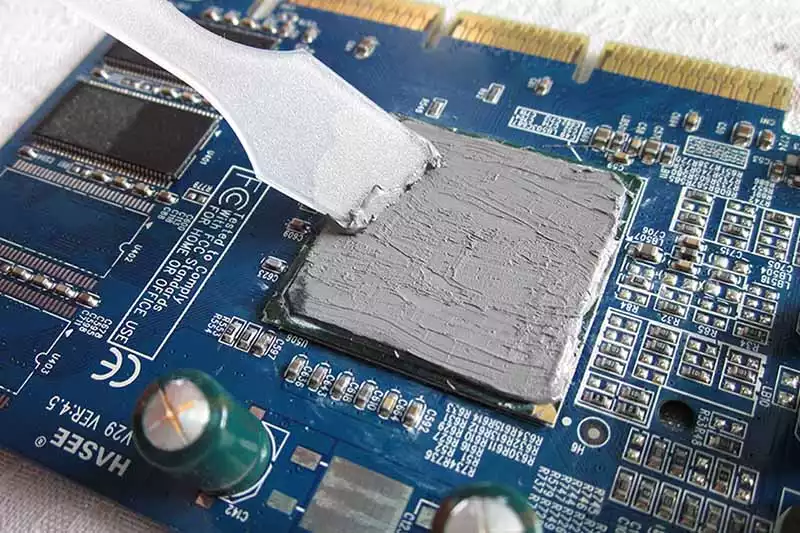
Thermal paste remains a familiar Interface material for high-performance CPU cooling and GPU cooling, mainly because it flows into microscopic gaps between two surfaces.
Contact performance
Fresh Application
- Paste conforms closely to uneven metal, supporting strong Heat transfer and low initial contact resistance.
- High Conductivity compounds can handle concentrated heat well when applied correctly.
Long-term use
- Heat cycles may cause curing, drying, or pump-out as the cooler and chip expand at different rates.
- Reapplication gets messy, and most paste cannot be reused. A reusable graphene thermal pad avoids that cleanup.
Graphene Pad
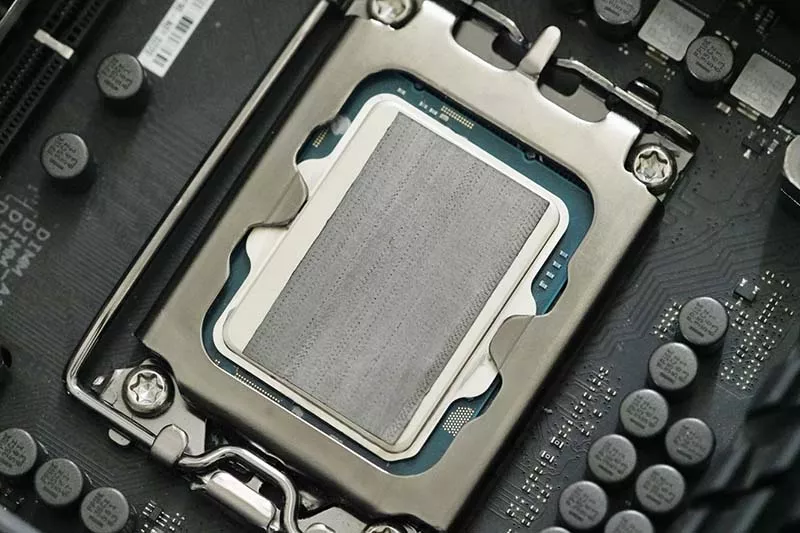
A reusable graphene thermal pad uses thin Graphene material to move heat efficiently while keeping thickness predictable. Installation is pretty straightforward.
- A reusable graphene thermal pad offers clean Installation and useful Reusability; unlike paste, the Thermal pad can often be removed and installed again.
- Through-plane conduction paths move heat directly from the die to the heatsink, lowering interface resistance where paste's thin bond line would otherwise dominate, benefiting CPU cooling and GPU cooling.
- Durability can make a reusable graphene thermal pad attractive for frequent hardware changes. Sheen Technology offers this type of reusable thermal interface option.
The catch is contact: graphene pad performance depends heavily on mounting pressure and flat surfaces. Poor conformity can raise resistance, so paste may still win on rough mating surfaces.
Mass Purchasing: Graphene Pad For Assemblers
Volume buyers need more than a good lab sample. A reusable graphene thermal pad must arrive with stable dimensions, dependable heat transfer, and assembly-friendly handling. For purchasing teams, that means connecting manufacturing choices, verified quality, and custom sizing to real production costs without making sourcing a headache.
Scaling Fabrication via Chemical Vapor Deposition
Fabrication route
- Chemical vapor deposition (CVD) can produce controlled graphene films at scale, but substrate growth and transfer add processing cost.
- Exfoliation can deliver high-quality flakes, while material synthesis makes larger-volume composite thermal pads practical.
Volume impact
- Careful lamination reduces air gaps, supporting repeatable thermal performance.
- Better scaling and automated production can lower per-part handling costs for a reusable graphene thermal pad. Pretty useful when assembly counts climb.
ISO Certification and Quality Control Best Practices
For mass orders, quality control should tie purchase specifications to measurable results.
ISO certification and documented testing
- Verify thermal conductivity, thickness, and dimensional tolerances.
- Check electrical insulation when the application requires isolation.
Compliance and assurance
- Compare batch records for consistent graphene pads.
- Confirm applicable UL component requirements plus RoHS and REACH declarations. These standards help procurement avoid nasty surprises during qualification.
Customizable Form Factors for Data Centers and Power Electronics
Customizable form factors
- CPUs and GPUs: die-cut thermal pads match package dimensions and mounting pressure.
- Power electronics: application-specific thickness supports uneven interfaces.
Repeatable design
- Kiss-cut sheets, rolls, tabs, and liners simplify placement.
- In data centers, a reusable graphene thermal pad or reusable thermal sheet can support quick servicing across high-volume applications.
The reusable graphene thermal pad occupies a distinct position: it delivers through-plane thermal performance that exceeds thermal paste, adds reusability and production consistency, and provides electrical conductivity for grounding-coupled applications — but requires careful application to avoid short circuits. For OEM thermal engineers and procurement teams, the selection decision hinges on four variables: required through-plane conductivity, acceptable BLT, electrical conductivity compatibility, and rework/maintenance frequency.
Sheen Technology supports evaluation with ASTM-referenced test data, application engineering, and die-cut samples for in-situ validation.
→ Request Graphene Pad Samples + Qualification Data
Sheen Thermal
Dongguan Sheen Electronic Technology Co., Ltd · Founded in 2008
Manufacturer of thermal interface materials and silicone foam for automotive electronics, energy storage, power electronics, communications and consumer electronics.
Certified
- ISO 9001:2015
- ISO 14001:2015
- IATF 16949:2016
What we supply
- Thermal conductivity Up to 90 W/m·K
- Thickness 0.3–10.0 mm
- Custom & samples Die-cut to drawing, 3–7 days