
 English
 usheenthermal

How to Remove Thermal Potting Compound
Date:2026-08-14
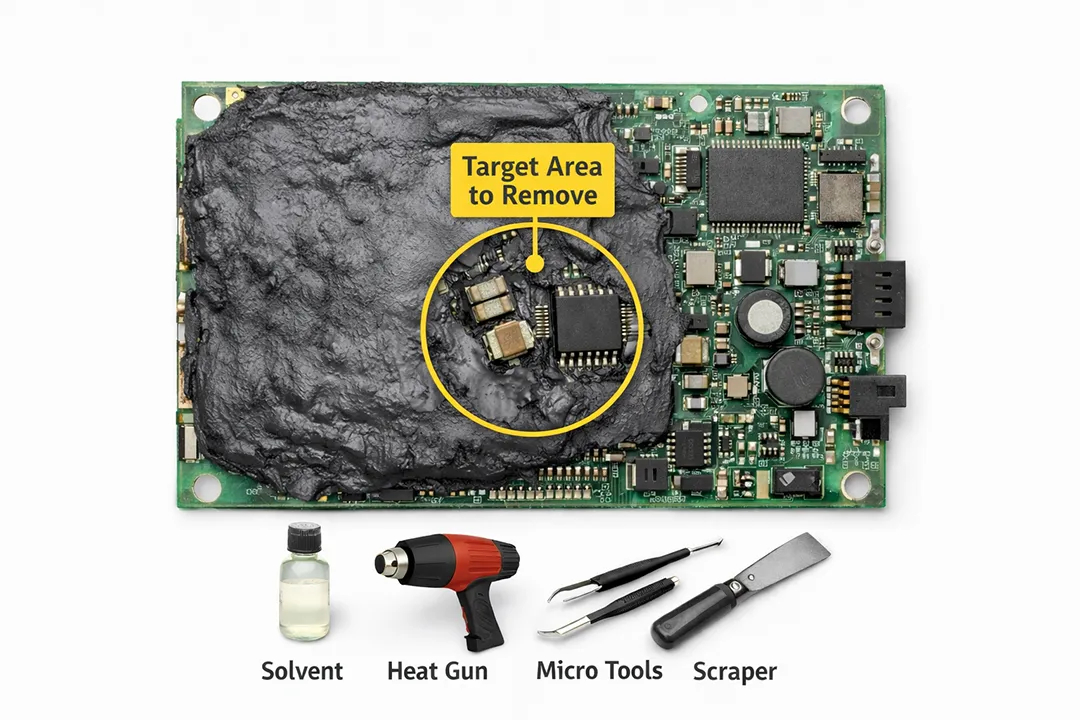
For any thermal engineer or electronics technician, a failed component buried inside a hard thermal potting compound is a significant hurdle. These materials are engineered for permanence—to protect electronics against moisture, shock, and heat. However, when failure analysis or rework is required, that same durability becomes a formidable obstacle.
In this guide, we provide a professional framework for identifying and removing these compounds without destroying the underlying electronics, and explore how switching to reworkable thermal solutions can prevent this headache in the future.
Identifying Your Thermal Potting Compound Before Removing
To make the right choice for the next step, it is essential to first understand the material type of the thermal potting compound. Different material types require different removal methods. Choosing the wrong removal method without knowing the material type not only results in poor removal effectiveness and wasted time but may also damage electronic components.
| Property | Epoxy | Urethane | Silicone | Test Method |
| Hardness | Shore D 70–90 (very hard) | Shore A 50–90 (rubbery) | Shore A 10–50 (soft/gummy) | ASTM D2240 |
| Probe Response | No indentation; brittle scratch | Bounces back; tough | Permanent dent; gummy | Manual probe |
| Solvent Response | Little/no change (chemically resistant) | Softens in ketones (MEK, acetone) | Swells in aromatic/ polar solvents | Cotton swab test |
| Thermal Behavior | Softens ~120–180°C; chars above 200°C | Softens ~80–120°C; degrades above 150°C | Stable to 200°C+; no softening | Gradual heating |
| Removal Difficulty | Highest | Moderate | Lowest (reworkable) | — |
Note: For unknown compounds, FTIR (Fourier Transform Infrared Spectroscopy) on a coupon sample provides definitive polymer identification. TGA (thermogravimetric analysis) reveals filler loading and thermal decomposition profile. These are recommended for high-value assemblies where material misidentification could cause rework damage.
Distinguishing Between Epoxy, Urethane, and Silicone:
- Epoxy: Epoxy resin is the hardest type of thermally potting compound material, offering high hardness and providing optimal protection. However, it is also the most difficult material type to remove.
- Urethane: Usually tough and rubbery; it has a characteristic "bounce" when pressed with a probe.
- Silicone: Very soft and often gummy. It is the most "reworkable" of the three.
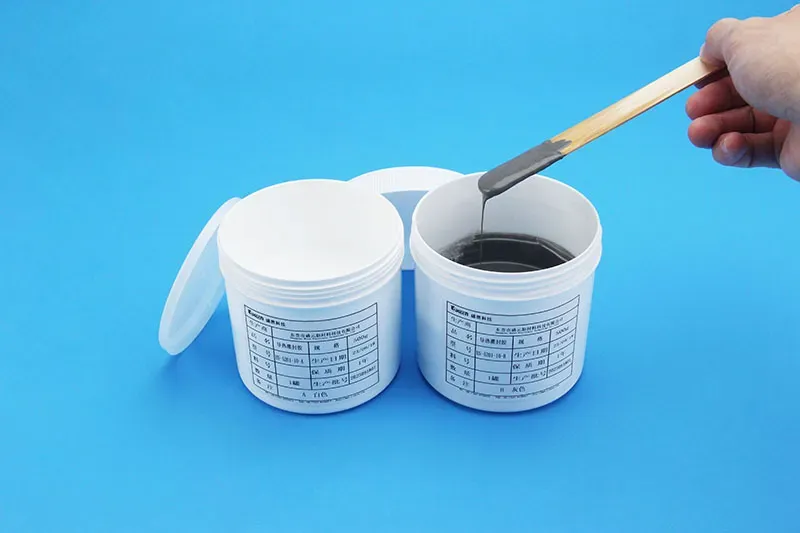
Conduct hardness and solvent tests: Attempting to scratch the compound's surface can provide a simple identification result. If an indentation remains on the surface, it indicates the material has low hardness and may be silicone or soft polyurethane. Perform a solvent test using a cotton swab to observe whether the material softens or expands. If softening or expansion occurs, the material is likely silicone or polyurethane.
Conversely, if the material shows little change, it may be chemically resistant epoxy resin. These straightforward tests enable rapid identification of thermal potting compound materials, facilitating selection of the correct and appropriate removal method.
3 Proven Methods to Remove Thermal Potting Compound
Method 1: Mechanical Removal
- Micro-abrasive blasting parameters: walnut shell or sodium bicarbonate media, 20–40 psi nozzle pressure, 45–60° incidence angle, 5–10 mm working distance.
- For precision work around IC leads: dental picks (stainless steel), Dremel tools at 5,000–15,000 RPM with carbide or diamond burrs, and low-pressure air (10–20 psi) for debris clearing.
- Best for: epoxy potting on rigid, well-supported boards.
- Risk: mechanical damage to delicate components, wire bonds, and PCB traces.
Method 2: Controlled Thermal Removal
Temperature guidelines by material:
- epoxy softens at 120–180°C (apply 10–15 min per cycle, monitor with IR thermometer ±5°C accuracy); urethane softens at 80–120°C;
- silicone does NOT soften with heat (thermal methods ineffective for silicone).
Use precision heat guns with 1–2 mm nozzle, 150–250°C output, 30–60 second application cycles followed by 60–120 second cooling.
Critical: do not exceed component Tmax (typically 260°C for reflow-rated, 125°C for some passives); use thermocouples on adjacent components.
Method 3: Chemical Removal
Solvent selection by material:
- epoxy — methylene chloride-based strippers (dichloromethane) or NMP (N-methyl-2-pyrrolidone);
- urethane — MEK (methyl ethyl ketone) or acetone;
- silicone — specialized siloxane-digesting removers (often containing toluene/xylene blends).
Soak time: 12–48 hours with mechanical agitation every 4–6 hours.
Safety: use fume hood with >100 CFM exhaust, nitrile gloves, chemical goggles, and organic vapor respirator cartridges.
| Factor | Mechanical | Thermal | Chemical | Best Use |
| Time | 1–4 h | 30 min–2 h | 12–48 h (soak) | Mechanical: fast Chemical: slow |
| Precision | High (skilled) | Moderate | Moderate–High | Mechanical: delicate areas Chemical: bulk removal |
| Component Risk | High (physical) if unskilled | Moderate (thermal) if untempered | Low–Moderate (chemical attack) | Thermal: reflow-rated Chemical: solvent-tolerant |
| Best Material | Epoxy (hard) | Epoxy, urethane (NOT silicone) | Silicone, urethane (limited epoxy) | Match method to material |
| Cost | Low (tools) | Low (heat gun) | Moderate (solvents + disposal) | — |
| Residue | Dust/particles | Char (if overheated) | Solvent residue (neutralize) | Post-clean required |
The Hybrid Combination Approach for Stubborn Applications
Hybrid Approach & Decision Framework
Challenging removal scenarios require integrated strategies that leverage multiple techniques sequentially. The systematic combination of chemical softening, gentle heating to enhance penetration, and mechanical removal of softened material proves most effective for thick epoxy applications where single methods make insufficient progress.
Decision framework:
- Identify material type (hardness + solvent + thermal tests).
- Assess component sensitivity: reflow-rated components tolerate thermal; solvent-sensitive components (some plastics, coatings) exclude chemical; delicate wire bonds exclude aggressive mechanical.
- Select method: silicone → chemical or mechanical peel; urethane → chemical + thermal; epoxy → mechanical + thermal (or hybrid for thick layers).
- Pilot on coupon: validate method on a sacrificial board or edge region before full removal.
- Execute with staged approach: bulk removal → precision removal → residual cleaning.
Critical Safety Protocols and Risk Management During Removal
Proper safety protocols protect personnel and valuable electronic assemblies throughout removal operations. Adjacent component masking shields areas from mechanical contact and chemical exposure. Chemical-resistant gloves, safety glasses, and respiratory protection with appropriate filter cartridges address hazard exposure. Adequate workspace ventilation prevents harmful vapor accumulation, while electrostatic discharge control through wrist straps and conductive work surfaces protects exposed components.
Safety data:
- Temperature: never exceed component Tmax (verify per datasheet; reflow-rated typically 260°C peak, but many passives rated 125°C).
- Chemical: methylene chloride is a suspected carcinogen — require fume hood (>100 CFM), nitrile gloves (change every 2 h), organic vapor respirator (NIOSH-approved cartridges).
- Ventilation: minimum 4–6 air changes per hour for solvent work; portable fume extractor for localized thermal fume.
- ESD: wrist strap (<1 MΩ to ground), conductive mat, ionizer for sensitive components.
- Fire safety: keep solvent-soaked materials in sealed metal containers; no open flames near solvent vapors.
Post-Removal Cleaning, Testing, and Thermal Management Alternatives
Thorough surface cleaning using appropriate solvents removes residual compound material before assembly testing. Systematic component testing progresses from visual inspection through continuity verification to functional performance assessment. Modern alternatives including thermally gels, phase change materials, and thermal gap filler pads provide excellent heat dissipation without permanent bonding, enabling future component access while maintaining thermal performance throughout product lifecycles.
Post-Removal Procedures and Future Solutions
Once the thermal potting compound is cleared, the PCB requires thorough decontamination. Residues from chemical strippers must be neutralized using an ultrasonic bath with Isopropyl Alcohol (IPA) to prevent long-term corrosion.
Choosing a Reworkable Material for Future Designs: The best way to solve removal challenges is to design for serviceability (DFS).
- Silicone Thermal Potting Compounds: Offer high thermal conductivity while remaining flexible and easy to peel off for repairs.
- Thermal Gels: For many applications, a dispensable thermal gel provides excellent heat transfer without the permanent "lock-in" of curing compounds.
→ Request Reworkable Thermal Gel / Gap Filler Samples
Frequently Asked Questions (FAQ)
Q: Can I use Acetone to remove epoxy potting compound?
A: generally, no. Acetone may slightly soften some epoxies but will not dissolve them. Specialized stripping agents (like those containing methylene chloride) or heat are usually required.
Q: What is the easiest potting compound to remove?
A: Silicone potting compounds are the easiest to rework. They are soft, can be cut with a blade, and often peel away cleanly from components.
Q: Does heating potting compound release toxic fumes?
A: Yes, especially if overheated. Urethanes and epoxies can release toxic byproducts when burned. Always use a fume extractor or work in a ventilated area.
Q: How do I identify potting compound quickly?
A: Start with SDS/BOM; if unknown, perform a coupon FTIR or visual/hardness checks.
Q: Is it cheaper to replace the board?
A: Often yes for low-value boards. Pilot a coupon removal to estimate labor, materials, and requalification cost.
Q: Will heating damage components?
A: It can—use thermocouples and respect Tmax values. When in doubt, use mechanical or chemical approaches.
Removing a thermal potting compound safely requires identify → test → least-invasive method → protect → requalify. For complex or high-value assemblies, invest in a coupon test.
Thermal potting compound removal is an engineering discipline requiring material identification, method selection, controlled execution, and rigorous requalification. The most effective long-term strategy, however, is design-for-serviceability: specifying reworkable thermal management materials from the outset eliminates destructive removal operations entirely. Sheen Technology supports this transition with reworkable silicone potting compounds, dispensable thermal gels, phase-change materials, and removable gap filler pads — all engineered to balance thermal performance with component accessibility.
→ Contact Sheen Technology for Reworkable Thermal Material Selection Support
Sheen Thermal
Dongguan Sheen Electronic Technology Co., Ltd · Founded in 2008
Manufacturer of thermal interface materials and silicone foam for automotive electronics, energy storage, power electronics, communications and consumer electronics.
Certified
- ISO 9001:2015
- ISO 14001:2015
- IATF 16949:2016
What we supply
- Thermal conductivity Up to 90 W/m·K
- Thickness 0.3–10.0 mm
- Custom & samples Die-cut to drawing, 3–7 days